- Domestication of Brassica oleracea L. It happened in the balmy Mediterranean, not along those blustery Atlantic cliffs.
- Validating local knowledge on camels: Colour phenotypes and genetic variation of dromedaries in the Nigeria-Niger corridor. The locally recognized colour-based breeds are not supported by the genetics.
- The Battle over Plant Genetic Resources: Interpreting the International Treaty for Plant Genetic Resources. The Treaty phrase “genetic parts and components, in the form received” can be interpreted in ways that do not clash with TRIPS. The author also suggests that the Benefit Sharing Fund should be used to pay lawyers, but I’m not sure if that’s tongue-in-cheek.
- The response of the distributions of Asian buffalo breeds in China to climate change over the past 50 years. Fancy maths says it’s minimal.
- Functional traits in agriculture: agrobiodiversity and ecosystem services. It’s not the taxa. Or it shouldn’t be.
- Expert opinion on extinction risk and climate change adaptation for biodiversity. In situ most preferable, ex situ most feasible.
- Conserving pollinator diversity and improving pollination services in agricultural landscapes.The view from China is much like the view from everywhere else.
- Heritage Values and Agricultural Landscapes: Towards a New Synthesis. Back to the future: heritage can mean resilience.
- Using legacy botanical literature as a source of phytogeographical data. Text parsed to yield maps. Brave new world.
- Production diversity and dietary diversity in smallholder farm households. Want better nutrition? Access to markets better than promoting production diversity.
Nibbles: Conservation genetics, African fish farming, Ecological intensification, Elderly diets, Organic breeding, Conference tweeting, Mexican maguey, African PBR
- Conservation genetics papers from Latin America, courtesy of special issue of the Journal of Heredity. No ag, but no problem.
- African aquaculture takes off. Or perhaps rises to the surface would be more appropriate.
- Expert parses what experts said “sustainable intensification” means.
- Leafy greens and wine good for oldies. Good to know.
- Student Organic Seed Symposium to discuss “Growing the Organic Seed Spectrum: A Community Approach” in a few days’ time.
- How to tweet. At scientific conferences, that is.
- Maguey genebank in the offing. Well worth tweeting about.
- Arusha Protocol on the Protection of New Plant Varieties (Plant Breeders’ Rights) adopted. Basically UPOV 1999 for Africa. But I suspect the polemics are only just starting.
Nibbles: Summer holidays, Tajik bread, Farm to pizza, Västerbottensost, Diverse bananas, Banana wine, Chinese agroforestry, Peak coffee, Responsible oil palm, Model chickens, Damn you NS
- Ah, summer and its funny medieval holidays.
- Making bread in Tajikistan.
- Making pizza in Sussex.
- Making cheese in (one village in) Sweden.
- Diversifying bananas in Queensland.
- Diversifying banana products in Kenya.
- Diversifying with trees in China.
- Better diversify coffee.
- I see your responsible soy and raise you responsible oil palm.
- Cocks of the walk.
- I’m so annoyed the New Scientist article on breeding less bitter veggies is behind a paywall that I won’t even link to it. Google it, if you must.
Brainfood: Vavilov then & now & always, Helmeted fowl diversity, MLND resistance, Sorghum diversity, Facilitation, Rice yields, Biodiversity services, Wild tomato diversity, Date diversity
- In the Footsteps of Vavilov: Plant Diversity Then and Now. The Pamiri Highlands of Tajikistan, the Ethiopian Highlands, and the Colorado Plateau of Southwestern North America compared at time of Vavilov and now: “Localities that have retained diversity have suffered the least.”
- Vavilovian Centers of Plant Diversity: Implications and Impacts. “His concept of specific centers of origin for crop plants was not an isolated aphorism but has directed breeders, on their study and reflection, to the continued improvement and economic development of plants for humanity.”
- Mitochondrial DNA variation of Nigerian domestic helmeted guinea fowl. Recent domestication, and lots of intermixing mean not much diversity, and what there is doesn’t have structure.
- Genome-wide association and genomic prediction of resistance to maize lethal necrosis disease in tropical maize germplasm. That’s when two viruses attack synergistically. Resistance is from multiple loci with smallish effects, and there are some promising markers.
- Genome-environment associations in sorghum landraces predict adaptive traits. Genotype predicts drought tolerance.
- Facilitation and sustainable agriculture: a mechanistic approach to reconciling crop production and conservation. Understanding facilitative plant–plant interactions (intercropping, varietal mixtures) in crops leads to more sustainable farming practices. Or it could.
- The relative contribution of climate and cultivar renewal to shaping rice yields in China since 1981. Mainly new varieties. Climate change has actually helped, but for how long?
- Biodiversity inhibits parasites: Broad evidence for the dilution effect. Meta-analysis shows biodiversity decreases parasitism and herbivory.
- Using genomic repeats for phylogenomics: a case study in wild tomatoes (Solanum section Lycopersicon: Solanaceae). Data that are usually thrown away turn out to be useful for something after all.
- Genetic structure of the date palm (Phoenix dactylifera) in the Old World reveals a strong differentiation between eastern and western populations. Asian and African genepools, with geneflow E to W.
ICRAF in forage shrub germplasm giveaway
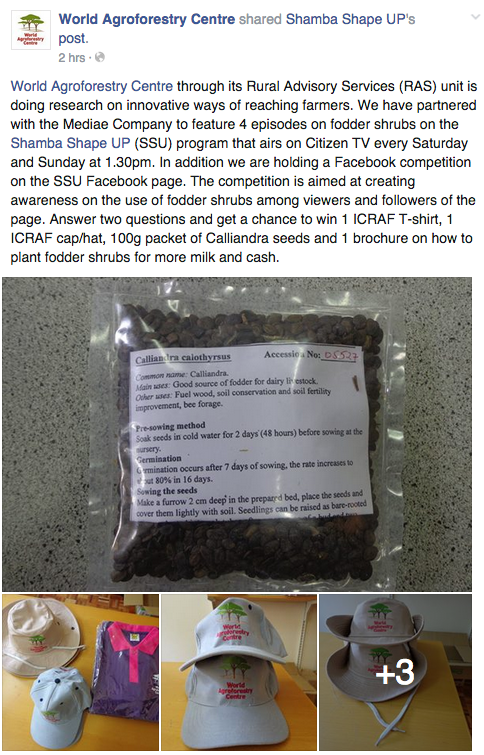 I liked this idea from the World Agroforestry Centre’s Facebook page:
World Agroforestry Centre through its Rural Advisory Services (RAS) unit is doing research on innovative ways of reaching farmers. We have partnered with the Mediae Company to feature 4 episodes on fodder shrubs on the Shamba Shape UP (SSU) program that airs on Citizen TV every Saturday and Sunday at 1.30pm. In addition we are holding a Facebook competition on the SSU Facebook page. The competition is aimed at creating awareness on the use of fodder shrubs among viewers and followers of the page. Answer two questions and get a chance to win 1 ICRAF T-shirt, 1 ICRAF cap/hat, 100g packet of Calliandra seeds and 1 brochure on how to plant fodder shrubs for more milk and cash.
That’s one way of getting germplasm out the genebank door! But I think it shouldn’t be just Calliandra. Let’s get those farmers playing around with lots of different species. And what, incidentally, is second prize?