- Why real farming needs great cooking. Upland mutton? I’d eat that.
- Down-your-throat vegetarianism. Justine bouche? I’d eat that.
- Orchid cuisine in Bhutan. Olachotho? I’d eat that.
Nibbles: Bison, GMOs, Maize map, Snails, Fruit bat market, News
- Buffalo on California’s Santa Catalina island being sterilized. In other news, there are buffaloes on Santa Catalina island.
- GMO hotspots deconstructed. Zzzzz.
- Maize genome mapped. Zzzzz.
- Nigerian nutritionist pushes slimy micro-livestock. France surrenders.
- How to shop for fruit bats.
- New newsletter from Nepalese NGO. Li-Bird, where is it on your site?
Nibbles: Old goat, Ethiopian sorghum
- Reptile-like Balearic goat.
- Sorghum diversity hotspots identified in Ethiopia.
Cavies in Congo
What next? Cane rats in Colombia?
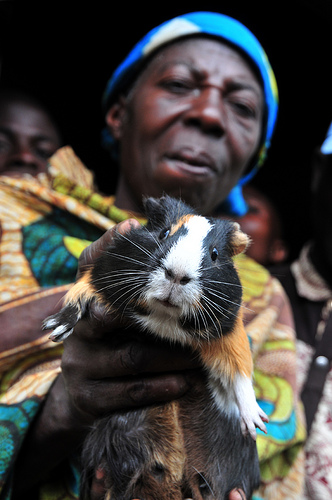
This picture really made me sit up and take notice when I saw it at CIAT’s Flickr photostream. I had absolutely no idea that people in Kivu, DR Congo, kept guinea pigs as mini-livestock, and a simple Google search turned up almost nothing of relevance. I went a bit deeper, and unearthed an article — Think big with minilivestock — in Spore from February 2008. That told me that in Kivu women often breed guinea pigs to provide their children with animal protein, which is otherwise not available to these most vulnerable members of the household. The article also says:
Throughout Central and West Africa and as far east as DRC and Tanzania, as well as in Haiti (Caribbean), small-scale guinea pig farming based on a few animals contributes to food security. It is a relatively easy activity, aside from problems caused by inbreeding which can eventually affect the health and weight of animals.
But it doesn’t tell me how this started, or what CIAT’s involvement might be. Can someone from CIAT or FAO please enlighten me?
And while we’re on the subject of introduced mini-livestock, has anything moved the other way? Luigi assures me that grasscutters (aka cane rats, Threonomys spp.) are delicious, but I’m pretty sure he didn’t taste them in Colombia.
Agrobiodiversity features in 2009 Development Marketplace awards
Our friend Ehsan Dulloo of Bioversity International is the frontman for a project that has just been selected as one of the winners of this year’s Development Marketplace awards.
A DM grant will enable Biodiversity International to protect the livelihoods of some 200 vulnerable women farmers, by providing access to seeds for locally-adapted varieties of crops. The project draws from gene banks, indigenous knowledge and farmer know-how, as well as traditional ways of adapting to climate variability.
There are several other agrobiodiversity projects among the winners. For example, “Peru’s Associación ANDES will support plant-breeding to increase diversity and production of nutritious potatoes and other tubers, improving health, incomes and quality of life for the community’s people.” And in the Philippines the “Trowel Development Foundation will replant mangroves and set up a value-chain system to fatten and market tie-crabs.” Well worth exploring the whole list. Congratulations to all.