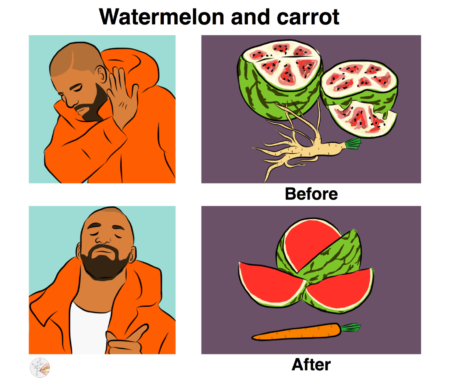
- The black roses of Halfeti.
- That original Bramley is still hanging on.
- Seedballs!
- A coral genebank? Why not.
- More on the ICARDA genebank.
- Sketching crop wild relatives.
Nibbles: Cloisters, Plum breeding, Wild tomatoes, Phytosanitary regulations, Public breeding, EU regulations, Svalbard @10, Local grains, Chips, ICRAF double
- Medieval monastery gardens deconstructed.
- Burbank’s plums decoded.
- The wild tomatoes of the Galapagos evaluated.
- Germplasm exchange expedited.
- Public sector plant breeding advocated.
- Farmer-saved seeds saved?
- Svalbard Global Seed Vault celebrated.
- Local flour milled.
- Potato chips (crisps) invented.
- Indigenous trees taken seriously. Very seriously.
Ensuring the future of coffee
Biz model is growing, having benefits, and impact, and understanding that is better if you share it. @HowardShultz @Starbucks #SaC18 pic.twitter.com/0PqUgLl3Vy
— TechFood Magazine (@techfood_mag) May 7, 2018
Want impact, Mr Starbucks? You could try supporting the coffee diversity conservation strategy for a start.
Nibbles: Garlic history, Collecting, GMO course, Rice genebank, Mango diversity, Chilli diversity, Virtual plant breeding, Navel orange, LA tree, Cotton sustainability, Saudi agritourism
- Trying to promote a “poor person’s crop”? Try the garlic trick, ennobling.
- A Reference Manual for Expedition Plant Collectors, courtesy of the The Arnold Arboretum.
- Cornell runs a MOOC on GMOs. How about one on genebanks, eh?
- Maharashtra could maybe use it.
- You can never have too many mangoes.
- Or dried chillies.
- Next generation plant breeding.
- Riverside protects its famous citrus tree.
- But not all famous California trees are so lucky.
- Making cotton sustainable. Hard row to hoe.
- Saudi farm tourism. Even harder.
Brainfood: Definitions, Atlantic goats, Sorghum photoperiod, Maize erosion, Dactylis diversity, Chickpea diversity, Social media, TR4, Diet change
- ‘Genetic resources’, an analysis of a multifaceted concept. You don’t say.
- Exploring the genetic diversity and relationships between Spanish and Moroccan goats using microsatellite markers. Different, but connected, except for the ones in the Canary Islands.
- Latitudinal Adaptation of Flowering Response to Photoperiod and Temperature in the World Collection of Sorghum Landraces. Out of 20,710: 1697 photoperiod and temperature insensitive, 18,766 photoperiod sensitive and temperature insensitive and 247 photoperiod and temperature sensitive.
- Conserving maize in gene banks: Changes in genetic diversity revealed by morphological and SSR markers. Not good ones.
- AFLP-based genetic diversity of wild orchardgrass germplasm collections from Central Asia and Western China, and the relation to environmental factors. Strongish ecogeographic structure. Good to see old school markers still in use.
- Genetic Diversity, Population Structure, and Genetic Correlation with Climatic Variation in Chickpea (Cicer arietinum) Landraces from Pakistan. Some differentiation along elevation and temperature gradients despite limited overall diversity.
- Capturing genetic variation in crop wild relatives: An evolutionary approach. Environmental data is your friend. But we knew that, right?
- New Geographical Insights of the Latest Expansion of Fusarium oxysporum f.sp. cubense Tropical Race 4 Into the Greater Mekong Subregion. Be afraid.
- The opportunity cost of animal based diets exceeds all food losses. Never happen.
- An Introduction to Social Media for Scientists. It might happen, if you tweet it.
- Tweet success? Scientific communication correlates with increased citations in Ecology and Conservation. See what I mean?