- The musapocalypse gets an infographic.
- Celebrating agricultural biodiversity in Ethiopia.
- High calcium potato wild relatives in the news. No, really.
- NY Times catches up with the Kenyan leafy green revolution.
- The world’s prettiest (only?) coffee genealogy poster.
- The great Michael Twitty’s long-awaited book on African-American foodways is out.
- Nice video on biodiversity loss actually opens with Svalbard Global Seed Vault.
Nibbles: Indian agrobiodiversity, High throughput phenotyping, Diet history, Barley and health, Fish biodiversity, Earthworm diversity, Livestock disasters, Irvingia domestication, Caffeine extraction
- BBC Food Programme on crop diversity in India, with a little help from Bioversity’s Stefano Padulosi (whose name manages to be pronounced in three different ways in 20 minutes.
- How to measure photosynthesis on a grand scale.
- The origins of our diet. It’s the interactions, stupid.
- Barley as superfood. No, not the fermented kind.
- More diverse freshwaters give higher fish yields.
- European earthworm diversity mapped. No word on relationship with yields. Surprisingly difficult to see any correlation with agricultural intensification.
- It’s been a bad time for livestock (and therefore people) in Mongolia and in Ethiopia.
- Domesticating the wild mango that is not a mango but is almost as tasty.
- The weird world of the pure caffeine trade.
Nibbles: Switchgrass mixtures, Groundnut genomes, Bean genome, New wild tomato, CC Down Under, Aussie foods, Natural history collections, Wheat genebanks, Pompeii vineyards, Colombian exhibition, Portuguese collard, Istanbul bostan, Kenyan adaptation, Norwegian adaptation, Hybrid wheat, GMO bananas, Indian organic, Coconut generator
- If you’re going to grown switchgrass as a biofuel, grow it in variety mixtures.
- The two wild parents of the cultivated peanut get sequenced.
- As also does common bean from its Mesoamerican genepool. Happy International Year of Pulses.
- New wild Aussie tomato gets a cool name. No word on when it will be sequenced. Or how long it will last.
- Speaking of climate change in Australia, wine might be in trouble.
- And more from Down Under: new book on indigenous Australian foods. Some of which may have been cultivated.
- Lots of herbarium specimens have the wrong name. Well I never.
- CIMMYT and ICARDA collaborate on wheat diversity.
- Roman wine rising again from the ashes of Pompeii.
- Exhibition on Colombia’s food plants.
- Portuguese green broth is no doubt very nice, but definitely needs a new name.
- The ancient urban gardens of Istanbul live on.
- Kenya gets on top of using biodiversity for climate change adaptation. Or on top of developing a strategy for doing so, anyway.
- Ola Westengen has a strategy, but you have to speak Norwegian to hear about it.
- Hybrid wheat is 5 years away. How long have they been saying that?
- The latest Rice Today has an article on genebank tourism by Mike Jackson (p. 39), who should know.
- Iowa State University is offering $900 to eat 3 orange bananas.
- Sahaju: saving agricultural biodiversity in India the organic way. Cheaper than $900 too.
- Want to multiply up coconuts really fast? They know how to do it in the Philippines.
Looking for a good potato picture
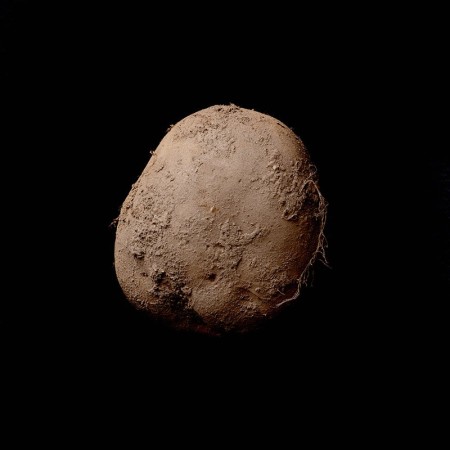
Well, Kevin Abosch takes a pretty decent picture of a potato. I’m not sure it’s worth the million dollar price tag, but it’s definitely not bad, as far as I’m concerned. Not everybody agrees, though, and this has spurred an interesting discussion at The Online Photographer, which Jeremy alerted me to.
Mike Johnston, who runs that site, threw out a challenge:
…is a good potato picture a thing that just doesn’t exist?
Commenters point to a number of plausible candidates, including the series by Andrzej Maciejewski, which I like a lot but I agree with Jeremy is spoiled by the lack of variety names.
Any more suggestions?
American vs European taste
Julia Belluz has a long article over at Vox on Why fruits and vegetables taste better in Europe. Compared to the US, that is. Here’s the bottom line. Or lines:
- American farmers put an emphasis on yield and durability, not flavour
- American shoppers favour access over seasonality
- The US government regulates for safety — but not quality
- Finding flavourful food is a matter of priorities
I’m really not sure whether like is being compared with like here, and, if it is, whether one can generalize to this extent anyway about American or European farmers, shoppers and governments. Ms Belluz seems to agree, in a tweet, that she might be winging it a bit:
I know, I know. No systematic reviews on this one. More a matter of perception and lowly anecdote
But read the whole thing for yourself, and join in on the discussion on Twitter.
Hey, @juliaoftoronto! Let's talk. Is there evidence that Euro produce actually does taste better? https://t.co/Ds0ZVcOAv3
— Tamar Haspel (@TamarHaspel) February 12, 2016