 Wait, it’s National Pollinator Week? Not in Sweden, alas.
Nibbles: Cryo, Tree diversity, Agroforestry, Seed industry, Trigonella, Ancient MesoAmerica, Niche models
- CIP’s high-tech genebank.
- “The project’s eventual aim is to plant several thousand trees at sites across Perthshire to act as a ‘living gene bank.'” What, because normally genebanks are dead?
- Millennium Seed Bank joins ICRAF’s BusyTrees thing. Which you can follow in about a million different social networking ways.
- Conservation Magazine does a number on crop improvement. Wait, what? Conservation Magazine? Yep, and with teaching resources.
- Fenugreek, barkeep, and make it a double.
- Ancient chocolate and corn routes.
- What species distribution models do you like?
Making the best of your European beach holiday
So you’re thinking of going on a beach holiday to the south of France. But you’re not sure where exactly. You juggle a thousand variable. Texture of sand. Colour of sea. Number of stars of hotel. Density of restaurants. Average price of wine in the surroundings. You know the kind of thing. A nightmare. But you’re also interested in crop wild relatives. Maybe you can get in some botanizing? Isn’t that the most important thing? Well, if so, help is at hand. Download The Guardian’s handy database of Swimming in Europe. Mash it up with GBIF data on wild Brassica, say. Voilá, pick your beach.
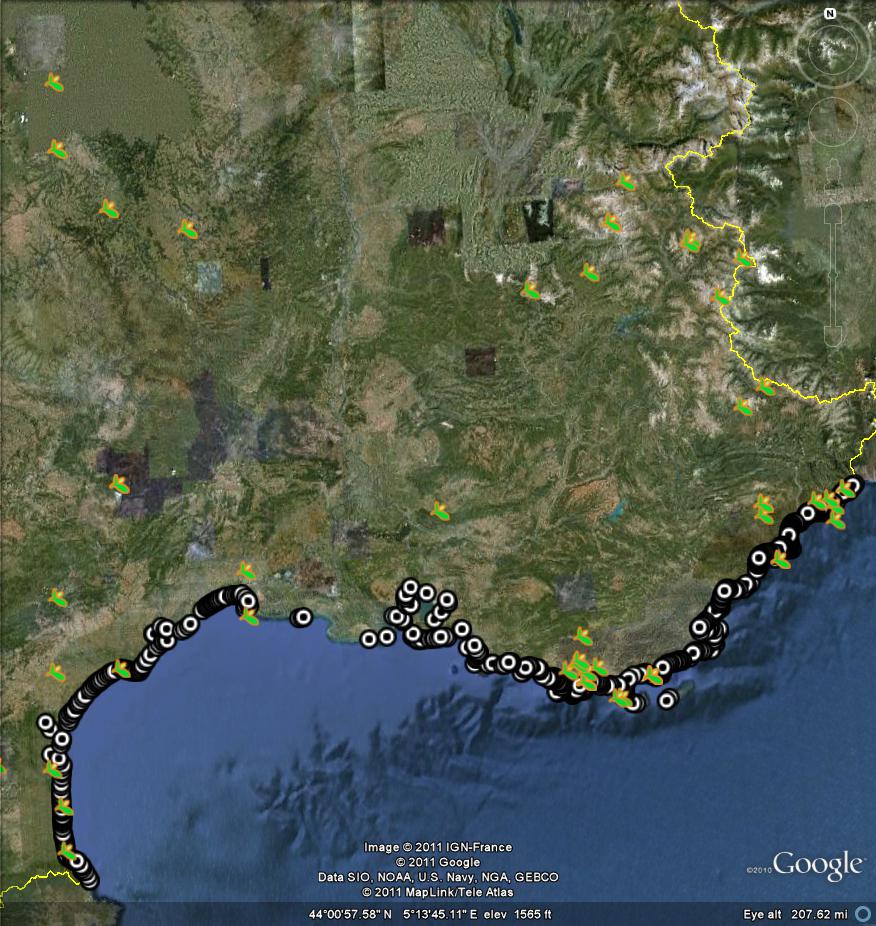
Well, it’s nice and everything, but hardly ideal. What you’d really like in choosing your beach is some idea of species richness, preferably in multiple genepools. GBIF won’t do that, so I suppose one would have to walk the occurrence data through DIVA-GIS, and then export the species richness grid as a shapefile and import that into Google Earth. Except that you need the Pro version for that, and my very precious grant from Google has just expired. But stay tuned. Don’t book anything yet. Working on it.
Brainfood: Soil, Seed aging, Organic sustainability, Yaquis, Garlic, Rice bean, Ethiopian livestock, Sweet potato intercropping, PES
- Long-term effect of tillage, nitrogen fertilization and cover crops on soil organic carbon and total nitrogen content. No till is better than conservation tillage.
- Catalase is a key enzyme in seed recovery from ageing during priming. It sure is. Good to know.
- Sustainable agriculture: A case study of a small Lopez Island farm. The authors conclude: “the need for future targeted nutrient inputs cannot be ruled out for sustainable long-term production”.
- Evolution of the knowledge system for agricultural development in the Yaqui Valley, Sonora, Mexico. They’re innovative, and diversity promotes agility.
- Changes in phenolic compounds in garlic (Allium sativum L.) owing to the cultivar and location of growth. Don’t hold your breath; only 10 varieties.
- Morpho-physiological and nutritional characterization of rice bean (Vigna umbellata). Now that’s what I call science; 30 varieties.
- Rural livestock asset portfolio in northern Ethiopia: a microeconomic analysis of choice and accumulation. Many, many factors come into play.
- Sweet potato (Ipomoea batatas L.)-based strip intercropping: I. Interspecific interactions and yield advantage. Almost every intercrop improves yield and bottom line.
- Should payments for biodiversity conservation be based on action or results? A model says: “It depends.”
Collecting to restore
We blogged recently about the huge fire in Arizona and what it may be doing to crop wild relatives. In southern California, however, they’re doing something more than just wringing their hands with worry. They’re going out and collecting seeds, that could later be used for restoration, as part of a project called Seeds of Success.
Once back at Rancho Santa Ana, the team dries the seeds in their paper bags, boxes them up and sends them to the national Bend Seed Extractory in Bend, Ore. There they are sorted and X-rayed to see whether they are viable, and then scientists go to work trying to find out how to get them to germinate.
…
Part of each seed lot is stored at the U.S. National Seed Bank as an insurance policy against future threats such as climate change, and some go to native plant researchers with the U.S. Department of Agriculture. The trove also is shared with the Kew Millennium Seed Bank operated by the Royal Botanic Garden in England, which aims to save 25 percent of the world’s plant species by 2020.
In some mountain areas, they’ll really have to hurry.