- Fancy a bamboo tour of China? Maybe these guys from Alabama will go.
- You can build with it, of course.
- Even help build a wall, perhaps.
- Rubber won’t be much good for that, I guess. But it has its uses.
- Always has.
- And then there’s cacao.
- Sustainable, of course.
- With all that that entails with regard to land rights, for example.
- And let’s stop saying that all these things poor people grow are somehow bad for them, shall we?
Gadam sorghum in the limelight
Remember the Gadam variety, saviour of Kenya’s sorghum farmers? Well, I came across it again a couple of days ago, on the occasion of International Beer Day 1, as part of an advertizing feature in the Kenya’s Nation newspaper.
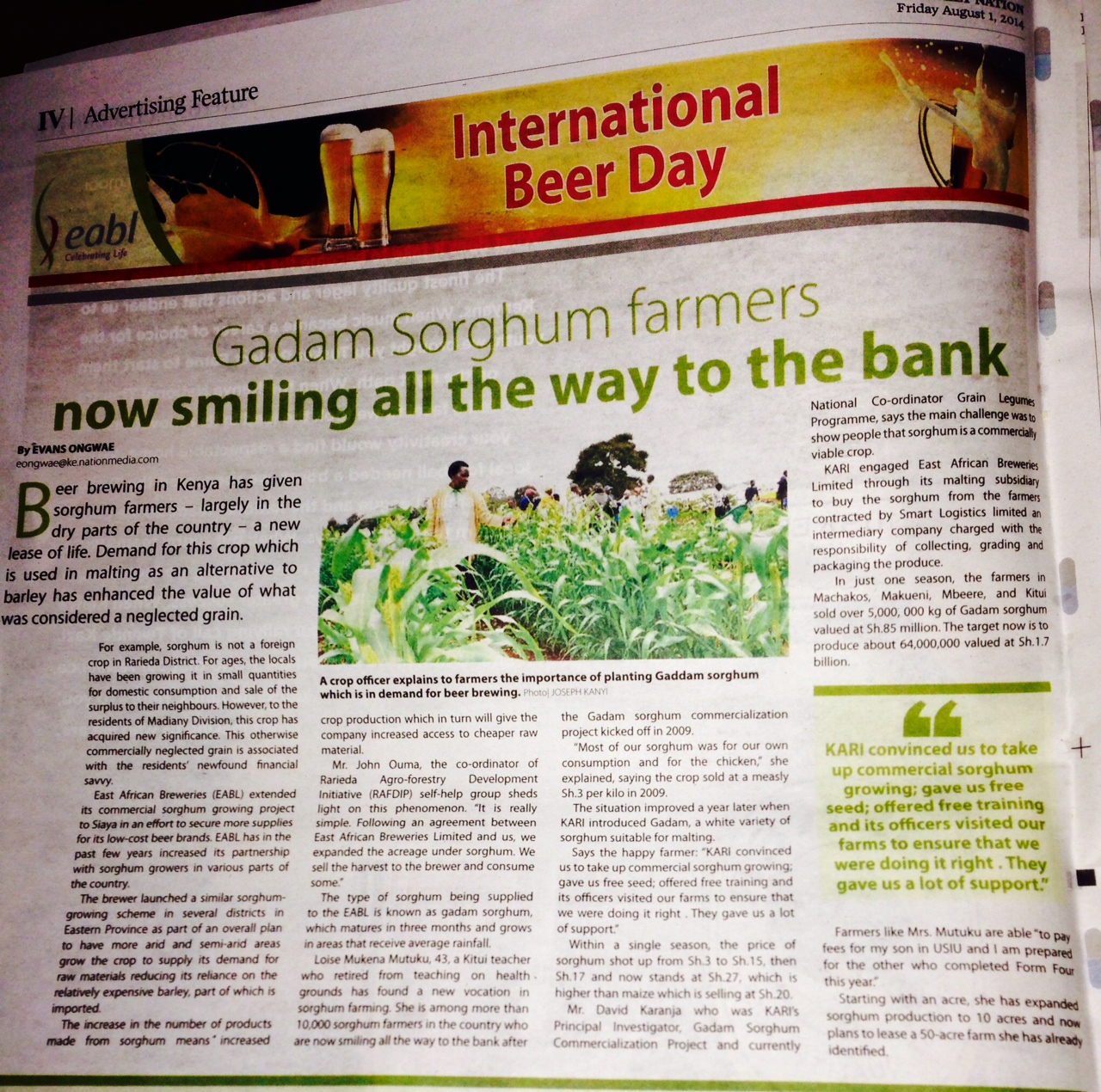
Talk about mainstream.
Wheat everywhere
Wheat has been much in the news in the past few days. There’s been the announcement of the draft genome sequence. And some fancy gene editing from China. But I want to point to a couple of more down-stream stories.
From Spain, there’s news of how an old variety — and much effort from a local family — brought back the particular taste of Los Monegros’ bread. Should anyone else be interested, the variety in question, Aragon 03, seems to be available in various genebanks.
And, from an area that is even more inhospitable to the crop, comes an announcement by Nigeria’s minister of agriculture himself that a new variety may turn the country into a major producer:
#Nigeria to be a major wheat producer with new tropical wheat that gives 6 tons per hectare. It will change the north pic.twitter.com/QRDQw9jdrP
— Akinwumi A. Adesina (@akin_adesina) July 27, 2014
Intrigued, I investigated further, and found that the variety in question, called Norman Borlaug in Nigeria, is Norman F2008, which was released by a private company a few years back in Mexico, based on CIMMYT material.
We’re going to need heat resistant wheat like this.
Nibbles: Coconut disease, Maize hybrid history, Measuring nutrition, Pollan on biodiversity & health, Ugandan staples, Shamba Shapeup, Ethiopian wine, South African diversification, Damn dumplings, Disease curation, Quinoa curation, Mango treat, Indian mangoes
- Lethal Yellowing doing for coconuts — and livelihoods — in Mozambique. And typhoons in the Philippines.
- Potted history of maize hybrids from 1998.
- Unusual rice and tomato species sequenced.
- The challenges of measuring the impact of nutrition interventions.
- Old interview with Michael Pollan on biodiversity and health resurfaces, maybe to coincide with the above.
- What will be the nutrition impact of replacing matooke with cassava, I wonder? Maybe if it was yellow cassava it would be ok?
- Maybe Shamba Shapeup will tell us.
- Well, there’s always wine. Even in Ethiopia.
- Or insects. Or roiboos. If you’re in South Africa.
- Chinese dumplings responsible for climate change.
- New Scoop.it page on downy mildews.
- And new Flipboard section on quinoa. And something to add to it.
- Eid Mubarak! Celebrate with mango kunafa.
- But which variety?
Nibbles: Soil map, Dealing with pH, Egypt pix, Samoa taro & breadfruit, Fruit genomics, GM video, Twitter
- Need soil info? There’s an app for that!
- Like pH, for instance?
- Photographing Egypt’s farms.
- Frozen Samoan taro, anyone? Only the beginning…
- Also from Samoa, a landmark breadfruit deal.
- Alas, breadfruit is not one of the tree fruits included in the website Tree Fruit Genome Database Resources (tfGDR). Maybe they should get together with DivSeek? Or the guy growing 40 different fruits on one tree.
- Soybean genetic modification 101, with video goodness.
- While both Jeremy and I are otherwise engaged, blogging in general and Nibbling in particular might be a bit slow, but you can keep up with us on Twitter. If you dare.