- Oh dear, someone else has fallen for the “weeds are better for you” line, cautious question-mark notwithstanding.
- And guess what? The poor don’t buy nutritious foods. How silly of them.
- Great post explaining the great unseen: mycorrhizal fungi as drivers of plant diversity.
- Gluten-free wheat? Really (even if the links still don’t work).
- What would you video on honeymoon in Mexico? A visit to a vanilla plantation. What else?
- Conserving apples and earth apples at opposite ends of the world.
- Oh, no, pashmina’s in trouble!
One more cup of coffee
For some reason, there’s been a sackful of coffee stories lately. Here’s a quick summary:
“Pistols for two, and coffee for one.”
“[Coffee] is of excellent Use in the time of Pestilence, and contributes greatly to prevent the spreading of Infection.”
“We just had to try at least a cup in every village we stopped at, and as they were small cups, sometimes more than one… The irony is that I am a ‘tea-only girl’.”
“Yes, Starbucks has announced it’s taking up shop in Bogota, Colombia. It says it wants to celebrate Colombian coffee.”
“Here, we do not work hard for survival, but we work hard to live a better life; that is what I’ve learned from working on this plantation.”
“In order to create these pre-breeding populations with enough genetic diversity for these economically important traits, WCR 1 will utilize genetic material from the current germplasm collections as well as new material coming from wild populations from the WCR GERMPLASM Project.”
Nibbles: Golden Rizzzzzz, Agronomy meet, Pricey poultry, Pricey Indian food, Target environments, NUS galore, G&T
- The Golden Rice thing rumbles endlessly on.
- I wonder whether it was discussed at the First International Agronomy Day. I bet that fertilizer thing in Malawi was.
- The world’s most expensive cock. Made you look!
- I wonder whether you can select sex in chickens like you can in cattle.
- Anyway, speaking of expensive agrobiodiversity, a celebrity economist rounds up links on Indian food price inflation. Must have seen our recent stuff on onions. But can you grow them on the roof?
- The secret of breeding? Location, location, location.
- List of “indigenous” fruits and vegetables of allegedly potential global importance without a damn scientific name anywhere. Annoying on many levels.
- Mind you, this piece on the threats faced by the wild herbs of Crete also doesn’t have any names.
- See, you can include a scientific name of an underutilized plant and not look unbearable geeky. Well, kinda. Although this press release on burgeoning collaboration on NUS manages to avoid mentioning even common names.
- Oh I so need a drink.
- And some cheese.
Nibbles: Golden Rice vs kitchen gardens, China vs world, Cool fungi, Measuring nutrition outcomes, Ancient pig keeping, Mapping potatoes, Plant evolution, Supporting genebanks
- Golden Rice better than kitchen gardens? We just don’t have the data. But why is that?
- Brazil and China compete for African agriculture. Are either of them at this African food security conference? Meanwhile, Australia vs China in the Pacific. Are either of them contributing to this ecosystem management survey? Oh, what could possibly go wrong?
- The “beauty” of mycorrhiza. And more cool fungi.
- World Bank says it is possible to measure nutritional outcomes in children without breaking the bank.
- It wasn’t just ancient farmers who kept pigs.
- CIP uses GIS shock.
- Darwin’s abominable mystery sorted out. Oh, and cereal vernalization to boot.
- Nabhan: The U.S. government should direct more money to the country’s “underfinanced seed collection and distribution programs.”
The further deconstruction of Indian onion prices
A quick follow-up to our post a couple of days back on the price of onions in India. Yesterday the Wall Street Journal, no less, weighed in on the subject, with a reference to a report commissioned by the Competition Commission of India (CCI) to get to the bottom of…
…volatility of onion prices and its relationship with distribution in the what the CCI described as a “loose and casual market.”
According to one of the authors, quoted by the WSJ:
There is almost an oligopoly kind of situation and until there are multiple players, the price will be dictated by a few traders.
So it’s all down to those pesky middlemen, it seems. Farmers have no chance:
Farmers generally take reference of the local markets’ rates, while traders compare rates of all markets, including major distant and export markets and then decide where to send their produce
Ah, but wait. There’s also news of a World Bank pilot project to crowdsource price data on agricultural commodities which may solve that little problem. Here’s the onion data from last year. 2 I’m not sure whether in due course we’ll also have this year’s, and thus be able to see that 200% year-on-year increase in July mentioned by the WSJ.
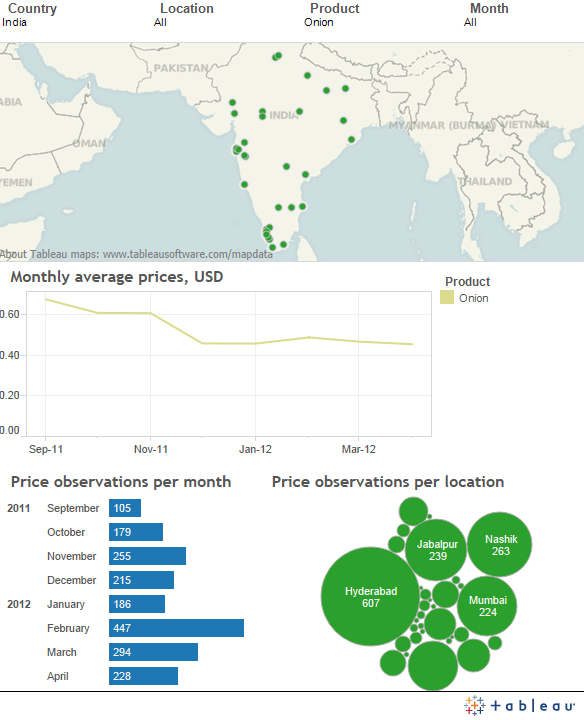
I guess the real challenge is to get these numbers out in real time, and in a way that farmers can make use of. There’s clearly a way to go:
What did we learn? The results from the pilot tell us that, yes, the crowd can collect reliable and timely prices – but you need to provide incentives and implement good verification and validation processes. The resulting data are comparable over time and space, and timeliness is pretty good — the time lag is only about a month. And, importantly, the resulting data are open to all users.
A good start, no doubt, but I’m not sure that a month after the event is going to be of much use to farmers. Other similar efforts are underway, though, so maybe one of these “thousand points of light” will emerge as a bit brighter than the others. After all, if weather, why not prices?
Why is this important for agricultural biodiversity? Well, for a start, markets have been touted as the saviours of neglected and underutilized crops, and maybe even landraces of the more successful and overused sort. Wouldn’t do if they were “loose and casual”, now would it?
Meanwhile, can we have the same for fish?