- Tritodendrum hits the market.
- DS Athwal would have approved. RIP.
- Medieval bakers too, I bet.
- Want some cherry tomatoes on your bread? No? Try these then.
- Lots of crop wild relatives among newly discovered plants. See (some of) them on the new State of the World’s Plants report from Kew. And no, Kew, none of them are “miserable.”
- Early farmers unintentionally produced vegetables with larger seeds simply by cultivating them. And cereals too.
- Head of IUCN Red Data List Unit in impassioned plea for IUCN Red Data List process.
- What is taro good for? I’m glad you asked.
- I missed International Hummus Day? How could this happen?
- Textilia Linnaeana! What do you mean I’ve just had my birthday?
- Lowering the glycemic index of rice for the Chinese market.
- Fighting for avocados. Literally.
Kew helping protect your morning joe
Remember a short blog post from seven years back saying how Ethiopia had just protected some wild coffee forests?
We Nibbled yesterday a UN press release saying that a Biosphere Reserve had been created in Ethiopia to protect wild coffee. But actually it turns out that it is no less than TWO reserves that have just been selected by UNESCO, Kafa and Yayu. Many thanks to Tadesse Woldemariam Gole for the tip.
No, I didn’t think so. But anyway, here’s the latest on that, courtesy of the coffee team at Kew.
In April 2015 we started the three year project ‘Mainstreaming biodiversity conservation and climate resilience at Yayu Biosphere Reserve (Ethiopia)’. In this project, poverty alleviation, biodiversity, and climate resilience, are inextricably linked.
…
The project has now been running for almost two years, and despite a few surprises, is achieving considerable success. Catch-up on our progress in the second part of this post, available in the coming months.
Previous experience in this sort of thing has been mixed, so I’m looking forward to hearing more. In the coming months.
The price of tea in Kenya
“When countries change their trade policies to protect themselves against price falls, small farmers – particularly those in developing countries – tend to lose profits,” said Will Martin, senior research fellow at IFPRI. “This platform gives governments access to the most recent information available, so they can make informed decisions on food policy that avoid creating global price instability.”
“This platform” is Ag-Incentives, and it’s just been launched by IFPRI.
Policies that affect incentives for agricultural production, such as those that raise prices on domestic markets, can artificially distort the global market, which then undermine market opportunities for small farmers in the world. Ag-Incentives allows users to compare indicators, such as nominal rates of protection, across countries and years.
At the moment, it seems that it is only “nominal rates of protection” (NRP) that are being compared, across countries and years, but that will no doubt change as the platform evolves. What are NRPs?
…the price difference, expressed as a percentage, between the farm gate price received by producers and an undistorted reference price at the farm gate level.
The “undistorted price” being “generally taken to be the border price adjusted for transportation and marketing costs.”
If I understand this correctly, if NRP is negative, the commodity is being taxed, positive and it is being subsidised. This is the picture for tea in Kenya, as an example.
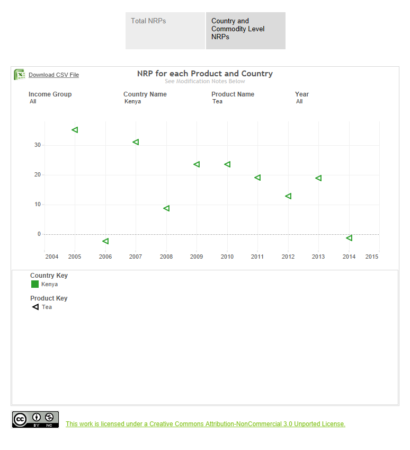
I’ll run it by the mother-in-law to see if she can make some sense of it, in particular what happened in 2006 and 2014.
Strawberry Wars forever
You know how the strawberry breeders who left the UC Davis programme a couple of years ago and set up a private company sued the university for access to the material they developed? Well, it turns out the university is now counter-suing them. I like this bit especially from the SFGate piece which brings us up to date on the Strawberry Wars:
A federal judge recently scolded both the researchers and the university for their behavior and said that each side can expect to be held financially liable at trial.
Stay tuned.
Vegetables, joy and justice
A long(ish) Edible Manhattan piece by Rachel Nuwer on the movement to breed crops for flavour, rather than only productivity or shelf-life, very nice in its own right, also gives me the excuse to link to Jeremy’s interview on Eat This Podcast with Lane Selman of the Culinary Breeding Network. Here’s Nuwer’s sign-off as an amuse-bouche. She first points out that production of the much un-loved kale has seen quite a jump lately in the US. Why not the Habanada pepper, the honeynut squash, or “a subtly flavored cucumber with a white rind”?
A similar renaissance could happen for these new ingredients, too — if only we demand it through our dining habits and grocery store purchases. As Swegarden points out, “Everything that happens upstream in the food system is dictated by the consumer.” Should a flavor-forward movement take hold, it has the possibility of changing the food system, including potentially creating more jobs for farmers and strengthening the shift toward local, seasonal and minimally-processed and -doused ingredients. Selman also anticipates that greater availability of delicious, affordable produce would translate into greater consumption of fruits, veggies and grains—and thus hopefully to a healthier general public. “I don’t do this because I want to hang out with high-end chefs,” she says. “It’s about joy and justice.”
Indeed it is.