- BBC Food Programme on crop diversity in India, with a little help from Bioversity’s Stefano Padulosi (whose name manages to be pronounced in three different ways in 20 minutes.
- How to measure photosynthesis on a grand scale.
- The origins of our diet. It’s the interactions, stupid.
- Barley as superfood. No, not the fermented kind.
- More diverse freshwaters give higher fish yields.
- European earthworm diversity mapped. No word on relationship with yields. Surprisingly difficult to see any correlation with agricultural intensification.
- It’s been a bad time for livestock (and therefore people) in Mongolia and in Ethiopia.
- Domesticating the wild mango that is not a mango but is almost as tasty.
- The weird world of the pure caffeine trade.
Brainfood: PVP in Africa, Tomato disease resistance, Open source seeds, Barley protein, Improving roots, Bambara groundnut, Indian kodo millet, Cacao diversity, Washington heirloom beans, Mato Grosso cassava, Balanites biotech, Intensive Europe
- Opportunities and Threats to Harmonisation of Plant Breeders’ Rights in Africa: ARIPO and SADC. While the intention of ARIPO and SADC is to create a single internal market for protected varieties in Africa, “the end result may look quite differently.”
- Evaluation of Resistance to Ralstonia solanacearum in Tomato Genetic Resources at Seedling Stage. Out of 285 varieties from 21 countries in the Korean genebank, 4 may be resistant to bacterial wilt.
- Following the Open-Source Trail Outside the Digital World: The Case of Open-Source Seeds. “…by not rejecting the idea of property, including intellectual property, but rather attempting to manage it differently, it creates its own enclosures.”
- Grain protein concentration and harvestable protein under future climate conditions. A study of 108 spring barley accessions. Higher CO2 and temperatures lead to higher protein concentrations but lower yields, so lower harvestable protein. The good news is that there’s variation in the response of varieties.
- How can we harness quantitative genetic variation in crop root systems for agricultural improvement? Apparently we still don’t have a mechanistic understanding of root growth, and we’ll need it if we’re going to improve function.
- Bambara Groundnut for Food Security in the Changing African Climate. It’s nutritious, it’s drought tolerant, and it can be intercropped. What’s not to like?
- Neutral and functional marker based genetic diversity in kodo millet (Paspalum scrobiculatum L.). Indian material falls into 4 groups, with Bihar being very diverse. African genepool and wild species should be useful in broadening base in India.
- Origin, Dispersal, and Current Global Distribution of Cacao Genetic Diversity. We’ve come to the limit of the usefulness of the Pound Collection.
- Exploring the role of local heirloom germplasm in expanding western Washington dry bean production. 24 bean varieties have been grown in the area for 20–130 years, representing a useful starting point for participatory plant breeding.
- Growing Cassava (Manihot esculenta) in Mato Grosso, Brazil: Genetic Diversity Conservation in Small–Scale Agriculture. Lots of diversity within communities, and differences among communities. Varieties with same name not necessarily genetically similar.
- Establishment of an in vitro propagation and transformation system of Balanites aegyptiaca. So?
- Mapping cropland-use intensity across Europe using MODIS NDVI time series. Four indicators show highest cropping intensity in Germany, Poland, and the eastern European Black Earth regions, and lowest in eastern Europe outside the Black Earth region. Interesting to mash this up with agricultural biodiversity? Like earthworms?
Building a prize-winning cassava house
We often say that crop diversity is the foundation of food security, but you have to actually build a house on a foundation, to get the full benefit. So it’s instructive occasionally to consider all the myriad other things that have to go right for crop diversity to have an impact, quite apart from breeding. And it’s great to see recognition for an organization that works on a number of those things: the Queen’s Anniversary Prize was just awarded to the UK’s University of Greenwich for the cassava work of the Natural Resources Institute, which includes everything from pest and disease control to processing and product development. Congratulations!
And if you still want to read something about how to use cassava diversity to provide the foundation for all that cool stuff NRI does, The Economist has you covered.
Nibbles: Cover crops, Viet coconut, Water maps, Mao’s mango, Tudor bread, Belgian gardening, IRRI fingerprints, Stay green barley, Miniature donkey
- Uncovering cover crops, the NY Times way.
- Uncovering coconut cultivation in Vietnam, the Roland Bourdeix way.
- Where to expect water shortages, and irrigation. Crying for a mashup.
- When a mango is not just a mango.
- Bread, and much else, according to the Tudors.
- A Belgian plantsman is revolutionizing gardening. No, really.
- How genomics will revolutionize rice breeding. No, really.
- How to get deeper barley roots for drought tolerance? Look to sorghum.
- And today’s miniature livestock is…a donkey.
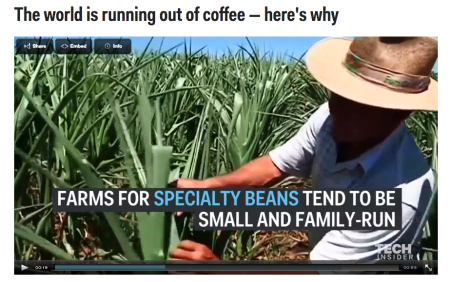
That’s some funny looking coffee
That apocalyptic video from Business Insider that we Nibbled earlier is silly in a number of ways, but someone should really have found better stock footage to illustrate small, family-run coffee farms.