- Deeper insights into how farmers get their seeds could make seed aid more effective shock, with added video goodness.
- Big data for smallholder farmers; CIAT’s boss writes the history.
- Meat for the masses and dairy for the deities. What the builders of Stonehenge ate, and where.
- If you thought grapolo spargolo was a pseudonym of the Prosecco grape variety Glera, you’re in good company. But wrong. “[M]any English-language bloggers have simply copied and pasted the erroneous information from the Wiki entry”. For shame!
Another one bites the dust
There was no blogging from me last week because I was attending the 6th Session of the Governing Body of the International Treaty on Plant Genetic Resources for Food and Agriculture in Rome. You can read all about the week’s goings-on at IISD. Or wait until the formal report comes out. For what it’s worth, the two main impressions that I came away with are that the scope of the Multilateral System is likely to expand, though it will take a while, and that at some point, probably sooner, concerns about the dematerialization of plant genetic resources will have to be addressed in earnest.
Brainfood: Wild wheat breeding, Global pea breeding, Old Swedish peas, Prolific Chinese pigs, Genomics & CC, Veggies & food security, Agrobiodiversity use, Land use double, Agrobiodiversity use
- Genealogical analysis of the use of aegilops (Aegilops L.) genetic material in wheat (Triticum aestivum L.). 1350 varieties in 50 years, involving mainly 3 wild species, the proportion of total releases using wilds steadily growing. But many pedigrees may be wrong. Not to mention the taxonomy.
- Pea. In the Grain Legumes volume of the Handbook of Plant Breeding, that is. Two cultivated species, >70,000 accessions, 28+ national and international collections, yield gains of 2% per year over past 15 years, plus good progress in lodging, disease resistance and seed visual quality and modest improvement in abiotic (heat, frost, salinity and herbicide resistance) stress resistance. Genome on the way.
- Diversity in local cultivars of Pisum sativum collected from home gardens in Sweden. Add about 70 to that number of genebank accessions.
- Genetic diversity and population structure of six Chinese indigenous pig breeds in the Taihu Lake region revealed by sequencing data. They are indeed pretty much 6 breeds. The most prolific in the world too, apparently.
- Global agricultural intensification during climate change: a role for genomics. ‘Course there is.
- The Role of Vegetables and Legumes in Assuring Food, Nutrition, and Income Security for Vulnerable Groups in Sub-Saharan Africa. ‘Course there is.
- Drivers for global agricultural land use change: The nexus of diet, population, yield and bioenergy. Livestock, in a word.
- Resolving Conflicts between Agriculture and the Natural Environment. You need “policies dedicating high-quality habitat towards nature conservation, while encouraging intensive production on existing farmland with stringent limits on environmental impacts.” But see above; although they do say in the previous paper that the trend has been slowing lately.
- Using our agrobiodiversity: plant-based solutions to feed the world. “…the preservation and development of existing agrobiodiversity has not been given sufficient attention in the current scientific and political debates concerning the best strategy to keep pace with global population growth and increasing demand for food.”
All roads lead to Rome
The Plant Treaty is having its sixth Governing Body meeting next week in Rome. Perhaps the main thing on the agenda is discussion of the recommendations of the Ad-hoc Open-ended Working Group to Enhance the Functioning of the Multilateral System. The full draft resolution is online. But here’s the money quote:
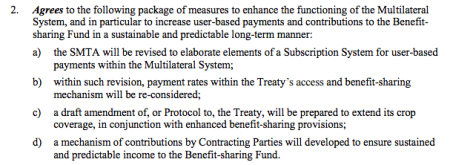
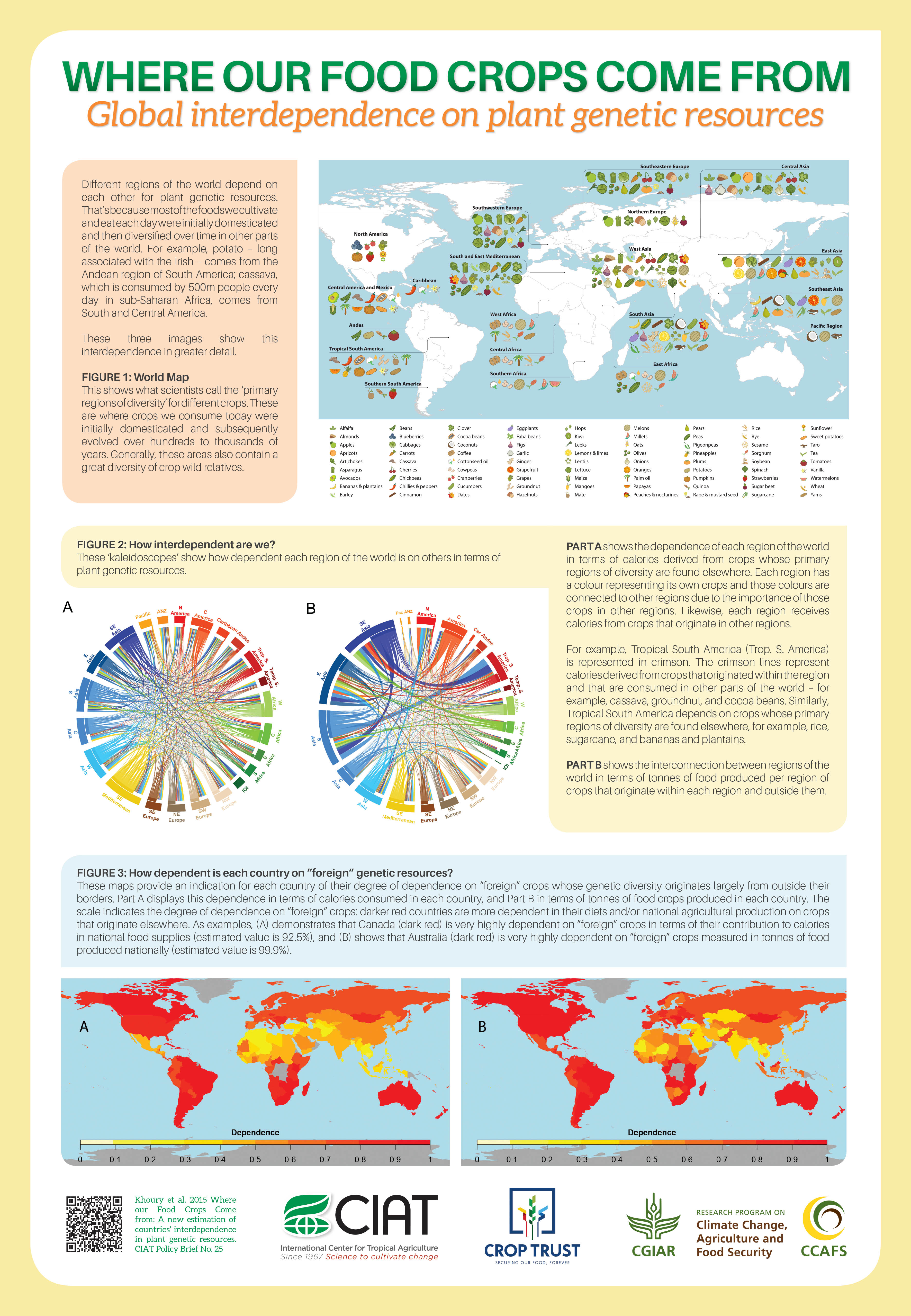
I’ll be there and will try to post on the deliberations as they happen. If I can’t do that, I’ll let you know what happened after the event. There’s also a full complement of side events. Our friend Colin Khoury will be presenting his research on “Where our Food Crops Come from: A new estimation of countries’ interdependence in plant genetic resources.” You can find out more from CIAT. Whose comms machine has also come up with a cool poster.
A global crops-go-round
A bunch of the usual suspects have just come up with an updating of an oldish study of global interdependence for crop diversity. I could describe the details here, but, frankly, Neil Palmer does it better than I ever could over at CIAT’s blog. And under a much better title than I can come up with. But to whet your appetite, here’s the money infographic, showing where different crop originated, and where they are now grown and consumed.
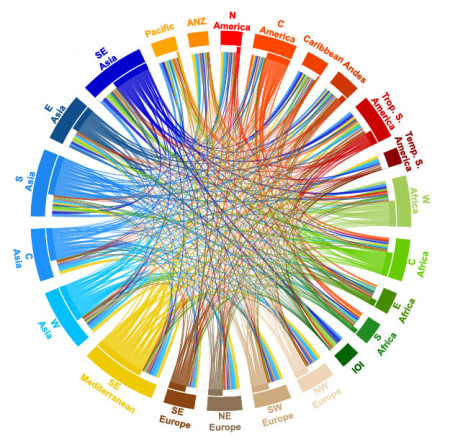
It’s all for the meeting of the Governing Body of the Plant Treaty, which is on next week.
LATER: Compare and contrast.