- Money for AnGR conservation up for grabs.
- 8th International Food Data Conference: Biodiversity and Sustainable Diets is taking place September 14-17, 2011 at NBI Conference Centre, Norwich, UK.
- So how are we doing with that MDG1?
- More on CABI’s Plantwise. I just hope most of it will be free. They have a blog, natch.
- CIMMYT drought-tolerant maize varieties featured in blog post. I’ll alert the media. No, wait. Seems like only 60% of farmers in Kenya are willing to pay for these varieties anyway.
- No extension workers? No problem.
- A tasty dish of Ugandan grasshoppers. Always a good subject for a subtly xenophobic CNN phtoto feature.
- Cows not so bad after all?
Taro leaf blight confirmed in Nigeria
We’ve blogged a few times about the emerging threat of taro leaf blight in West Africa, and what could be done about it. In case anyone was still in doubt about this threat, here comes the science.
The sequence analysis, morphological characteristics, and pathogenicity test confirmed the taro leaf blight pathogen as P. colocasiae. There are previous reports of occurrence of taro blight-like disease attributed to P. colocasiae in Ethiopia, Equatorial Guinea (1), and more recently in Cameroon, but comprehensive details on pathogen or disease are not available. To our knowledge, this is the first confirmed record in Nigeria of P. colocasiae causing taro blight. This disease poses a serious threat to the production and biodiversity of this important food crop. Urgent interventions are necessary to halt this emerging epidemic in West and Central Africa.
One possible intervention of course, is introducing resistant varieties, and I believe some of the resistant material from various South Pacific breeding programmes has now arrived at IITA from the in vitro genebank at SPC’s Centre for Pacific Crops and Trees.
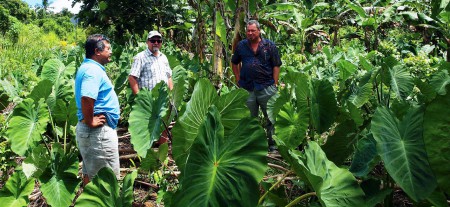
The history of the effort to breed resistant varieties is described in a recent ACIAR publication. Grahame Jackson, who was involved in the early stages of that work, had this to say about the article in a recent exchange of emails:
Interesting article; but it does not ask the hard, and perhaps more interesting questions: why did it take 5 years before there was a concerted effort to take the only route possible to solve the taro blight problem — to breed for resistance? … How many regional meetings were there over 5 years, until the start of TaroGen; how much money was wasted until a concerted effort was made to tackle the problem? … And in the meantime the Samoa farmers had solved their food insecurity: they had diversified into Alocasia, cassava, breadfruit, and rice. … More recently, another donor said of the disastrous epiphytotic of taro leaf blight in West Africa: “We get half a dozen emails a week describing some outbreak or other, mostly exaggerated. And anyway we can’t do anything until the countries ask.”
Shouldn’t be long now…
Climate change: thanks for all the dead fish
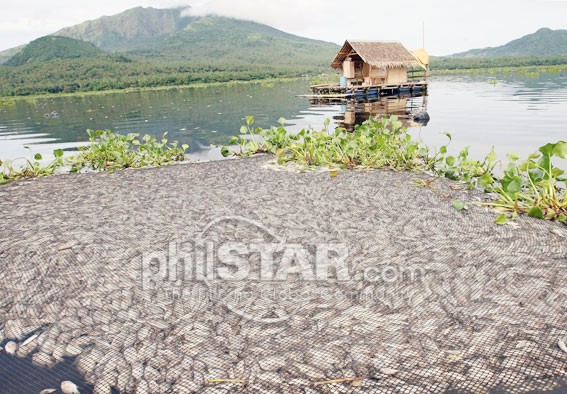
One of the little-appreciated aspects of climate change is that greater variability brings with it more frequent extremes, and if a system is already stressed it doesn’t take much to tip it over the edge. In many places, aquaculture is such a system. The photo 1 is from November 2010, but a glance at the news shows that massive fishkills are a common feature, and not just in The Philippines.
What seems to happen is a series of “unlucky” breaks. The fish are already densely stocked and overfed, and in the morning oxygen levels in the water can be dangerously low because the plants don’t produce oxygen in the dark. Most days, that’s alright, because the algae and plants in the water start to photosynthesise and put out oxygen. A cloudy morning, however, can reduce photosynthesis, and if the day is also hot oxygen levels fall even further as dissolved oxygen escapes. Worse, in hotter water the metabolism of the fish revs up, so they need more oxygen. Throw in a rainstorm, especially if soils around the fish farms are bare, and you get an influx of turbid water that further blocks photosynthesis, dropping oxygen lower still. Tonnes of fish suffocate. And lakes may take years to recover.
Authorities recommend “premature harvest” but that is clearly a Band-aid. The sustainable solution is to make the system more resilient, by decreasing stocking levels and feeding, and trying to ensure that rainwater inflows do not carry too much sediment into the water. Fish farmers cannot control the weather; can they adapt to extremes that can certainly control their business?
Nibbles: Gaur, AnGR, Wild Plants blog, Potato genebank, Research, Forests, Climate change
- Cattle do the wild thing in Vietnam.
- West African Ruminant Livestock: The Movie.
- An interesting new botanical blog on me.
- Who says working in a genebank is unrewarding? Technician is honoured with award, and that is not an oca she’s fondling?
- Back40 dissects the trouble with agriculture; it isn’t dignified. Well, it is, but …
- Forests are really, really good for economies.
- Andy Jarvis pulls it all together: looking forward to a climatically less diverse world.
Climate change and agrobiodiversity seminar report online
IISD’s report on the special information seminar that was held last Saturday at FAO headquarters in Rome, under the title “Climate Change and Genetic Resources for Food and Agriculture: State of Knowledge, Risks and Opportunities,” is out.
I must say I just don’t know what to make of stuff like this:
On conservation, several participants called for stronger focus on in situ conservation, with panelists noting that ex situ and in situ conservation are complementary strategies. Cock added that conservation must also ensure accessibility to realize appropriate deployment.
Surely we had that debate twenty years ago? Anyway, here’s the bottom line, in case you don’t want to plough through the whole pdf:
…Hodgkin said the morning session had shown that there is increasing acceptance of the ecosystem approach and the concept of ecosystem services in addressing linkages with climate change. Other messages included the: importance of accessibility of genetic resources and availability of information, especially in developing countries; different roles of in situ and ex situ conservation in addressing risks and enabling responses; need for an inter-sectoral approach to adaptation and mitigation; and recognition that climate change leads to the movement of agricultural biodiversity and creates a need for informed decisions of deliberate movements of germplasm.
The key messages from the afternoon session were: while climate change is being embedded in many agricultural strategies and plans, agriculture still needs to be embedded in climate change measures; there is a need for institutions and mechanisms to supply seeds to users; and there is a great need for capacity building activities for adaptation, such as evaluation and characterization.
Chair Mozafari added that participants had recognized the need: for the agriculture community to take action to ensure that GRFA are properly reflected in climate change efforts; to improve the knowledge base, in particular national knowledge on wild crop relatives and wild species; to reconcile efforts in all aspects of food security to ensure coherence; for global partnerships in research, evaluation and characterization; to prioritize the needs of the most vulnerable; and for financial resources. He suggested that CGRFA 13 reflect on how to communicate these needs to the UNFCCC and other instruments to put GRFA on the global climate change agenda.
LATER: And the report on day 1 of the regular session is out too now.