- Made in Brazil? Brazil Nut, yes. The genus Manihot, not so much.
- The role of botanic gardens as resource and introduction centres in the face of global change. They have one. But they need to be more like genebanks.
- Global growth and stability of agricultural yield decrease with pollinator dependence. Analysis of time-series FAO production data shows that more pollinator-dependent crops have lower yield growth and lower yield stability. So both should benefit from more active management of wild pollinators and their habitats. Results can be extended to other ecosystem services but that was a bridge too far for this reader.
- Draft Policy Framework for Investment in Agriculture. “The purpose of this document is … to initiate discussion.” Off you go.
- Deterrent and insecticidal properties of bean seed (Phaseolus vulgaris L.) whole meal or protein extract incorporated into the diet of Callosobruchus maculatus (F.) (Coleoptera: Bruchidae). To protect chickpeas from bruchid beetles, add bean proteins.
- Community genetics: at the crossroads of ecology and evolutionary genetics, a special issue of the Philosophical Transactions of the Royal Society B, which includes …
- … Insect-resistant biotech crops and their impacts on beneficial arthropods. The abstract gives nothing away: “The findings … are discussed.”
- High connectivity among argali sheep from Afghanistan and adjacent countries means you need international collaboration for conservation. Good luck with that.
- Better phenomics and genomics means you can do really cool Genetic analysis of abiotic stress tolerance in crops, and their wild relatives of course. But we knew that.
- Five ways of Improving assessment and modelling of climate change impacts on global terrestrial biodiversity: more data, process-based modelling, better understanding of role of community interactions and of the effect of genetic variation, and better functional groupings of species for improved simulations of vegetation distribution.
VIR’s Pavlovsk Research Station in the snow


VIR’s Pavlovsk Research Station, a set on Flickr.
Still all to play for at Pavlovsk.
Plantwise Knowledge Bank: The Video
The Plantwise knowledge bank will be a comprehensive global resource bringing together the best worldwide knowledge on crops, pests, diseases and weeds.
Well, it’s not exactly the citizen science advocated by some of our readers, 1 but this is an interesting exercise in a sort of crowdsourcing. One hopes that variety-level information on the crop will be recorded at the same time as all that pest and disease stuff. And that the whole lot won’t be behind some paywall.
http://www.youtube.com/watch?v=NfEfxLcgHk4&feature=player_embeddedNibbles: Lupine, Methane, Food crisis, Nutritionists, Carrots, Poi, Barhal, Mung bean, Invasives, European bison, Mango
- Saving the scrub lupine. Well, it’s a crop wild relative of sorts.
- Dietary approaches to reduction of belching. No, not less beer and peanuts in front of the TV.
- “Governments and institutions should strongly promote new agricultural technologies suitable for smallholders through increased investment in crop breeding and livestock research.” That would be IFPRI on the actions needed to prevent recurring food crises. Hope that includes supporting the genebanks.
- “Can’t nutritionists make up their minds? They keep changing things!” Nuff said.
- Carrots are exotic? In Canada? Yes indeedy.
- Rachel dissects the cost of proper poi in Hawaii.
- Behold Barhal, relative of breadfruit.
- High yielding mung-bean repatriated to Somalia. Genebanks protect and serve?
- Do your bit for conservation, eat an invasive. Or, perhaps, a bison?
- Bad news for Indian mangoes. What I want to know is whether there are any varieties that are doing really well.
- Mediterranean forests going up in smoke. Bad for the crop wild relatives in them too, no doubt
Mapping drought risk
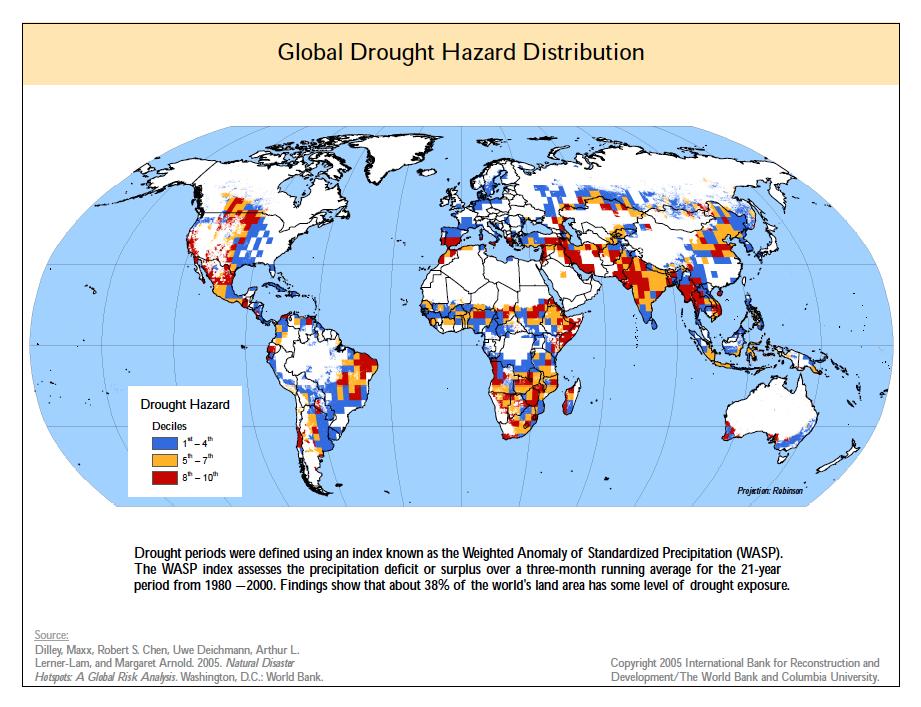
Just a quick follow-up to the rhyming couplet on water-related stresses in the just-published Brainfood. The Center for Hazards and Risks Research (CHRR) at Columbia University, which we have mentioned here before in connection with tsunami risk, also has data on Global Drought Hazard Distribution.
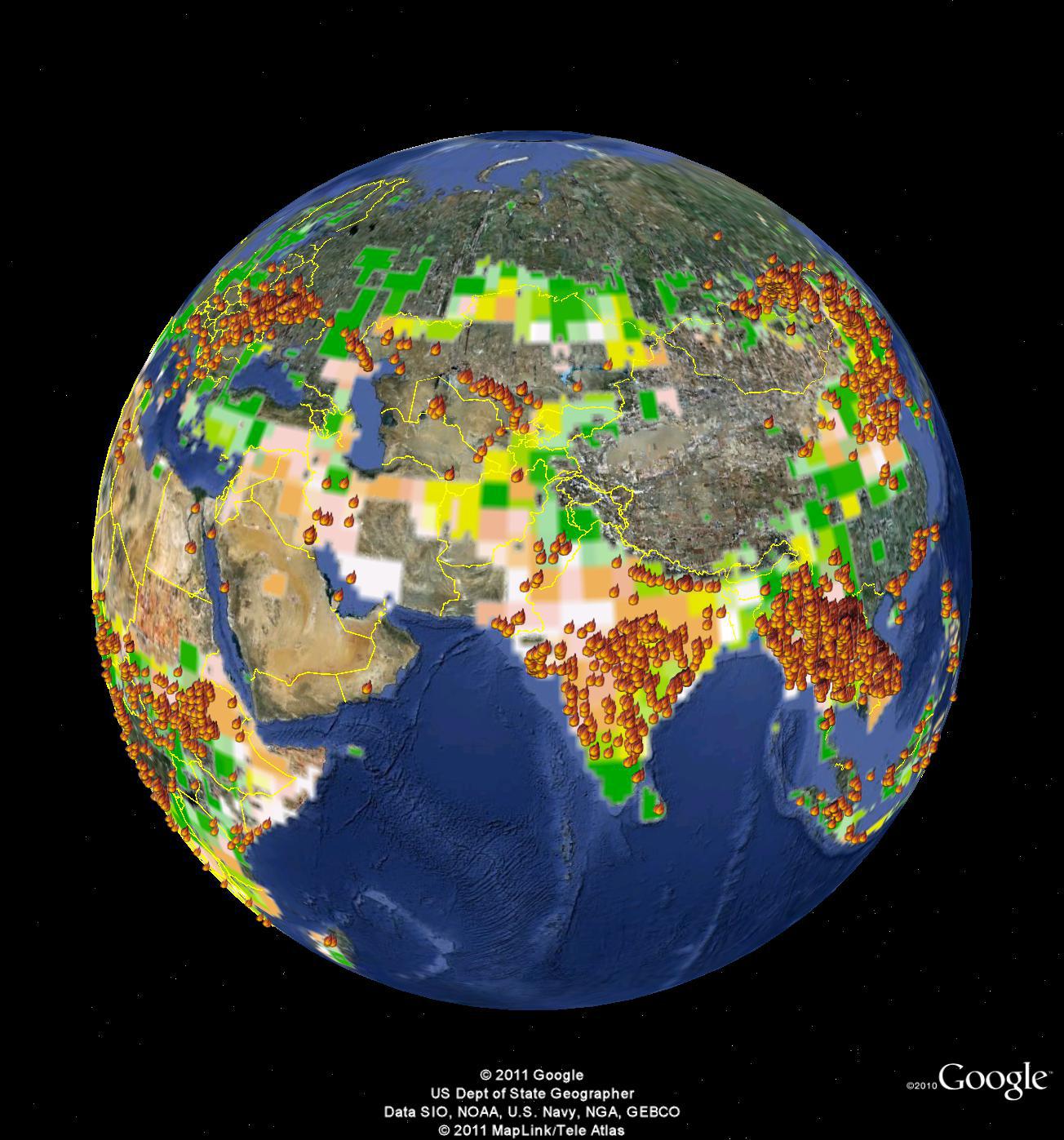
With a little R-related effort by Robert 2 you can get a Google Earth file, which looks like this for Asia. 3 I’ve also added MODIS fire hotspots for the past 24 hours, merely because I can. That would be the little fire icons.
And that means you can mash up drought risk with germplasm origin (from Genesys, say), in this case from Chad as an example.
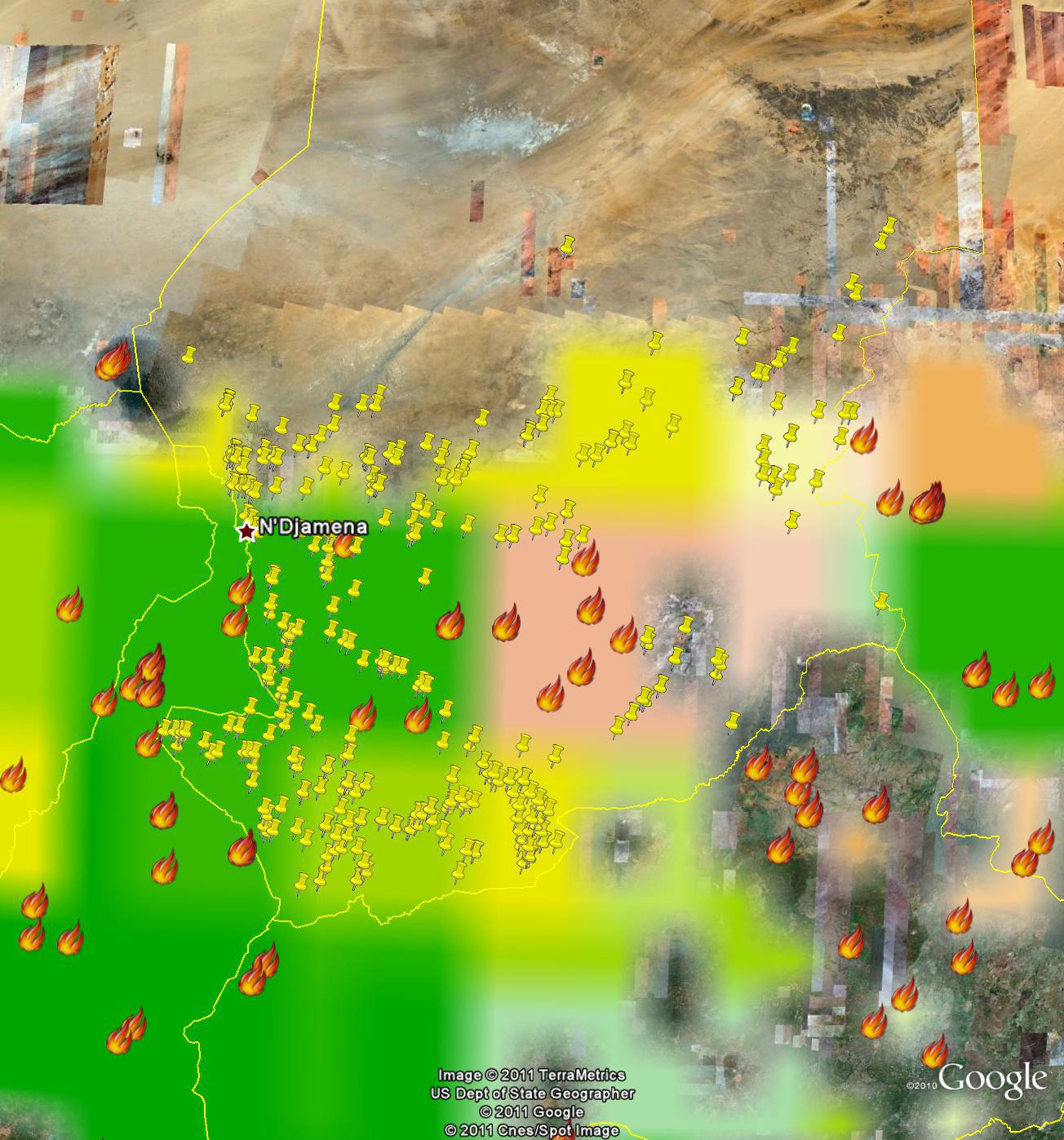
Which is a great thing to be able to do because as we have just had reconfirmed by our friend Dag Endresen, the origin of germplasm allows you to make some predictions about its performance.