- A look inside the big USDA genebank at Fort Collins. Whatever next?
- Sweet wheat. Whatever next?
- Farmers must participate in agricultural research in Europe. Whatever next?
- “Come and farm our virgin lands, Ethiopia tells India.” Whatever.
- “You may already know that yampah (Perideridia gairdneri) is a North American umbellifer.” Er, no. Tell me more.
- After cloves, vegetables? Zanzibar’s farmers increase productivity.
- More news for Luigi’s MIL: Future Climate Scenarios for Kenya’s Tea Growing Areas.
- Is this the end of trail mix?
- Body Shop uses wins award for using Cameroonian rainforest honey and wax from CIFOR-supported beekeeping project.
- Fancy a glass of ass’s milk? Totally SFW.
- Everybody is climate-proofing crops.
- The BBC looks at medicinal plants.
Nibbles: CWR, ICRISAT, Fruits, Maize, Symbionts, Tissue culture, Vegetables, Med diet
- ICARDA saves the world.
- No, ICRISAT saves the world.
- You’re both wrong, it’s CIAT.
- No, wait, maybe it’s CIMMYT. Oh I give up.
- Actually it’s fungi.
- Or maybe tissue culture?
- Surely it can’t be five unknown vegetables?
- Could it be that it’s the Mediterranean diet? And that UNESCO will screw it up for all of us?
Brainfood: Introgression, Sorghum and drought, Rice and drought, Carrot evaluation, Wheat breeding, Legume conservation, Wild Tibet soybean, Gezira, Biochar, CA, Grass ecotypes and climate, Organic ag and nutrients
- Alien introgressions represent a rich source of genes for crop improvement. Polyploids such as wheat do it best.
- Characterization of sorghum genotypes for traits related to drought tolerance. There is diversity within the “association panel” of diverse germplasm used. What I want to know is how that is different from a core or mini-core collection.
- Rice near-isogenic-lines (NILs) contrasting for grain yield under lowland drought stress. Small genetic differences can lead to big differences in yield under drought stress. What I want to know is whether doing this on NILs is better value for money than doing it on association panels of germplasm (see above), whatever they may be.
- Towards better tasting and more nutritious carrots: Carotenoid and sugar content variation in carrot genetic resources. European accessions sweeter and more orange than Asian.
- Changes in duration of developmental phases of durum wheat caused by breeding in Spain and Italy during the 20th century and its impact on yield. Fascinating unpicking of just where the genetic changes have their impact.
- Legume genetic resources: management, diversity assessment, and utilization in crop improvement. A lot of characterization, not enough evaluation. Core collections useful, but not useful enough. Crop wild relatives being used, but not enough. Good plug for the importance of geo-referencing.
- Genetic diversity and geographical peculiarity of Tibetan wild soybean (Glycine soja). Low and high, respectively.
- Analysis of agricultural production instability in the Gezira Scheme. Went up for wheat, cotton and sorghum, down for groundnuts, on liberalization.
- Biochar effects on soil biota – A review. It’s complicated but, on the whole, not unpositive.
- A research agenda to explore the role of conservation agriculture in African smallholder farming systems. Basically, it is likely to work least well in marginal conditions. Which is kinda surprising, and not, at the same time.
- Ecotypes of European grass species respond differently to warming and extreme drought. Yeah, but, alas, not in the way one might have wished.
- Comparison of nutritional quality of the crops grown in an organic and conventional fertilized soil. Maybe lower nitrate and N, higher P in organic crops. But really too much variation to be sure.
Nibbles: Chemical life, Cacao disease, Clove disease, Ag value addition
- The old go-intensive-so-we-don’t-have-to-plough-up-Nature-for-more-farmland argument rears its beautiful head again.
- Frosty pod rot comes to Latin America’s cacao, but CATIE has the varieties.
- But clove is not so lucky.
- Value addition, the Kenyan way.
Vegetable starter kits for Thailand
A short piece in AVRDC’s latest monthly newsletter tells the story of how that institute is producing thousands of “vegetable seed kits” with support from the government of Taiwan and handing them over to a university and the army in Thailand for distribution to people affected by flooding and landslides in a couple of different regions of that country.
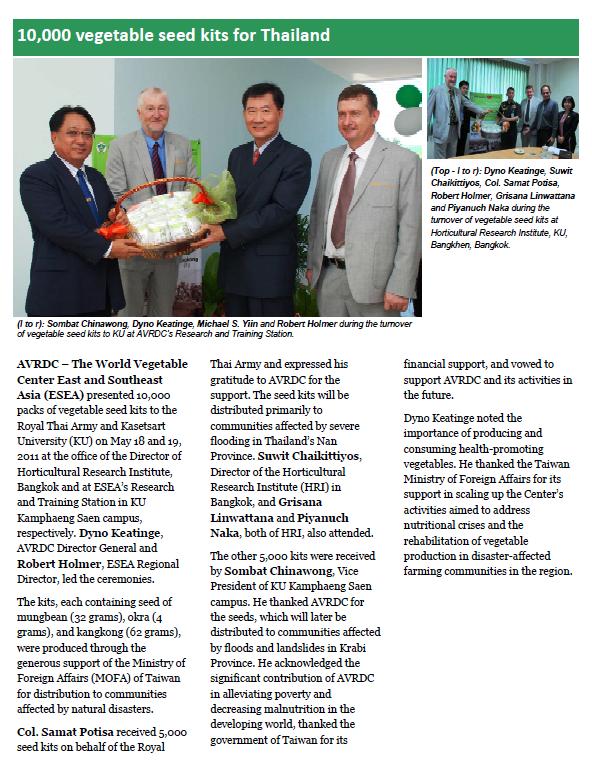
It’s an interesting idea, but as usual the article left me wanting to know more. Like how were the varieties of mungbean, okra and kangkong chosen? In fact, how were the crops chosen? And did all the thousands of kits have the same varieties? And, more fundamentally, how did AVRDC know that vegetable seeds were needed in the first place? Seed provision in the wake of disasters is a complicated business.