Pavlovsk is not alone

Over at Vaviblog, Jeremy has a post explaining why Pavlovsk is not unique. Alas, it’s because it’s by no means the only genebank that’s in trouble.

Wellesbourne and Brogdale, the UK’s national collections of vegetable and fruit diversity, have both been through the wringer lately. On October 1 Wellesbourne and the Genetic Resources Unit were officially absorbed into the new Crop Centre at Warwick University. The UK’s national vegetable collection is probably safe, for the time being, but the future of the breeding work that used to be carried out at Wellesbourne, and the many lines resulting from various crosses, is by no means clear. Brogdale too has been placed under new management, and parts of the collection duplicated at other sites where they may be safe, but it’s long-term future too is by no means assured. One could cite many other examples where national collections, built up and maintained thanks to government, are also subject to government’s budgetary whims.

We’ve blogged about the Wellesbourne situation before, and we’ll continue to keep an eye on developments. One hopes that the decision-making process will be a little more transparent than at Pavlovsk, and of course for a positive result in both cases.

Pavlovsk commission presents its results

Thanks to Tatyana Livshultz, we have a translation of the interview with the members of the expert scientific commission that was appointed by the Russian Government Department of Economic Development to examine and report on the living collections at the Pavlovsk Experimental Station.

Here’s Tatyana’s summary of the main findings:

1) The station holds extremely valuable (from scientific, agronomic, and historical perspective) living collections particularly the stone fruits (which was assembled beginning 80-85 years ago by the Vavilov Institute) and currants (which is a younger collection).

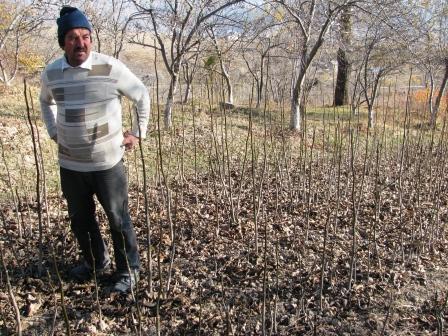
2) Some of these collections (particularly the stone fruit) are in very bad condition (old trees at risk of death) and need urgently to be renewed (re-grafted, re-propagated); others (e.g. the currants) are relatively well-maintained. The brambles are overgrown by grasses.

3) The collection has not been well-documented or well-maintained. They recommend a change of management/administration at the Pavlovsk Experiment Station, and additional resources made available for maintenance and repropagation of the collection.

4) They recommend that the station be maintained. The 13 hectares where the fruit collections are currently planted must be maintained, an additional 20 hectares are needed to renew and re-propagate the collection while maintaining the original plantings. Additional areas that do not hold collections (e.g. a wetland) or are currently planted with field crops (grains or potatoes) are identified as unnecessary to protect and may be developed.

5) The commission recommends against moving the fruit collection, considered too risky (too great a risk of loss of accessions).

Well, that sounds pretty hopeful to me. 1

Plants in peril

Kew and IUCN made a splash today with the Sampled Red List Index for Plants. A representative sample of 7,000 species of plants was selected from the comprehensive IUCN Red List Index for detailed monitoring. 2 You can contribute to the Sampled Red List in a wiki-like environment, and follow its progress on the inevitable blog. An interactive map allows some basic exploration of the data. The headline number is that 25% of plant species are threatened. There are various crop wild relatives among the 7,000 species, 3 so it might be possible to calculate some statistics for that particular category, to complement other efforts.

Photo courtesy of Kew (http://www.flickr.com/photos/kewonflickr/5036067604/)

Nibbles:Collecting missions, Grapes, Beans, Genome, Local markets, Water

Spatial datasets continue to proliferate, and evolve

A few more huge spatial datasets for you this morning, as I deal with jet-lag in a Maryland hotel room at 4 am.

Today there’s a high resolution dataset of the population of Africa. And an analysis of wetland protected areas. 4 And finally a global dataset of particulate matter pollution. This is presented from a human health perspective, but it could have applications in agriculture too.

Bean production environments in East Africa.

I still want to know who’s keeping track of this stuff. Maybe you don’t need to, you can just google as the need arises, but somehow I doubt it. Would love to hear from the CGIAR’s spatial data consortium folks, if they’re listening.

Meanwhile, one of the participants in that consortium has announced that they’re updating one of their iconic products, the now oldish “Atlas of the Common Bean (Phaseolus vulgaris) in Africa.”

Bean accessions recorded in Genesys.

How long before they mash it up with that population dataset? And with the data on the location of genebank accessions, for example from Genesys.

Not that it hasn’t been done before, in a very crude way, as you can see in the map in Figure 2 below.