- The impact of whole genome sequence data to prioritise animals for genetic diversity conservation. Relationships from whole genome sequence data were better than SNPs at preserving rare variants when selecting individuals for inclusion in a genebank.
- Genetic variation in wild populations of the tuber crop Amorphophallus konjac (Araceae) in central China as revealed by AFLP markers. Diverse, endangered, somewhat isolated populations, with some geographic structuring.
- Manihot allemii sp. nov. (Euphorbiaceae s.s.) with entire and unlobed leaves from northern Brazil, with notes about foliar anatomy. It never ends.
- Novel Genetic Resources in the Genus Vigna Unveiled from Gene Bank Accessions. Japan sorts out its genebank. It really does never end.
- Uncoupling of sodium and chloride to assist breeding for salinity tolerance in crops. We’ve been breeding for exclusion of Na+, but we should be breeding for tolerance to it.
- How can higher-yield farming help to spare nature? By making sure that lower prices and/or higher profits don’t encourage agricultural expansion.
- Seed exchange networks, ethnicity, and sorghum diversity. Culture drives diversity.
Brainfood: Lima bean cyanide, Hybrid powdery mildew, Amaranth core, Cotton core, Tibetan sheep, Water buffalo history
- Herbivore damage induces a transgenerational increase of cyanogenesis in wild lima bean (Phaseolus lunatus). Lamarck lives.
- Hybridization of powdery mildew strains gives rise to pathogens on novel agricultural crop species. Hybrid crop gives rise to hybrid pathogen.
- Trait-specific Amaranth Germplasm—Potentialities to Combat Climate Change. From 5,804 accessions to 623 really useful ones.
- Genetic diversity of the two commercial tetraploid cotton species in the Gossypium Diversity Reference Set. 100 SSRs on 2000 accessions yield really confusing results.
- Genetic diversity estimates point to immediate efforts for conserving the endangered Tibetan sheep of India. Only 250 individuals, but still some genetic diversity. But for how long?
- Water Buffalo Genomic Diversity and Post-Domestication Migration Routes. Two domestications, and some unexpected migration routes.
Nibbles: Gastronomy edition
- Gastronomy comes to the Amazon.
- Maybe it should come to Tikal too.
- You know it’s already in Mexico.
- Not to mention Peru.
- Preparing decent coffee counts as gastronomy, I guess. But SL28 is not genetically engineered. Not in the usual sense, anyway.
- Not sure that eels have much of a future in gastronomy.
- Into Africa: Indian seeds. And Indian gastronomy along with them?
- Feralization is not domestication in reverse. Lots of gastronomic potential, though.
- Meanwhile…
Brainfood: Barley landrace evaluation, Aceh cattle, Zizania diversity, French apple cores, Vanuatu food security, Tomato genomics, Cacao fermentation, Wild foods, Activist anthropologists, Ancient wheats
- Performance of 50 Lebanese barley landraces (Hordeum vulgare L. subsp. vulgare) in two locations under rainfed conditions. 47 individual plants were as good or better than the 2 checks in terms of grain yield per plant.
- Phylogenetic analysis of Aceh cattle breed of Indonesia through mitochondrial D-Loop region. A specific haplotype, mainly indicus but with some taurus.
- Genetic diversity assessment of in situ and ex situ Texas wild rice (Zizania texana) populations, an endangered plant. Diversity is dynamic in situ, and some of it is missing ex situ.
- Genetic Diversity, Population Structure, Parentage Analysis, and Construction of Core Collections in the French Apple Germplasm Based on SSR Markers. 2163 accessions divide into Old Dessert, Old Cider, and Modern Cultivar subgroups.
- Community Food Security: Resilience and Vulnerability in Vanuatu. High population pressure associated with shorter fallows but higher yields, not associated with purchasing of imported foodstuffs. Not clear what high crop diversity associated with.
- Using genomic repeats for phylogenomics: a case study in wild tomatoes (Solanum section Lycopersicon: Solanaceae). Repetition can be useful.
- The cocoa bean fermentation process: from ecosystem analysis to starter culture development. It takes a microbial community.
- Wild harvest: distribution and diversity of wild food plants in rice ecosystems of Northeast Thailand. There’s much more to rice than rice.
- Free seeds and food sovereignty: anthropology and grassroots agrobiodiversity conservation strategies in the US South. Activist anthropology for better food systems.
- Comparative Study of Hulled (Einkorn, Emmer, and Spelt) and Naked Wheats (Durum and Bread Wheat): Agronomic Performance and Quality Traits. Will need to fiddle with classic baking techniques.
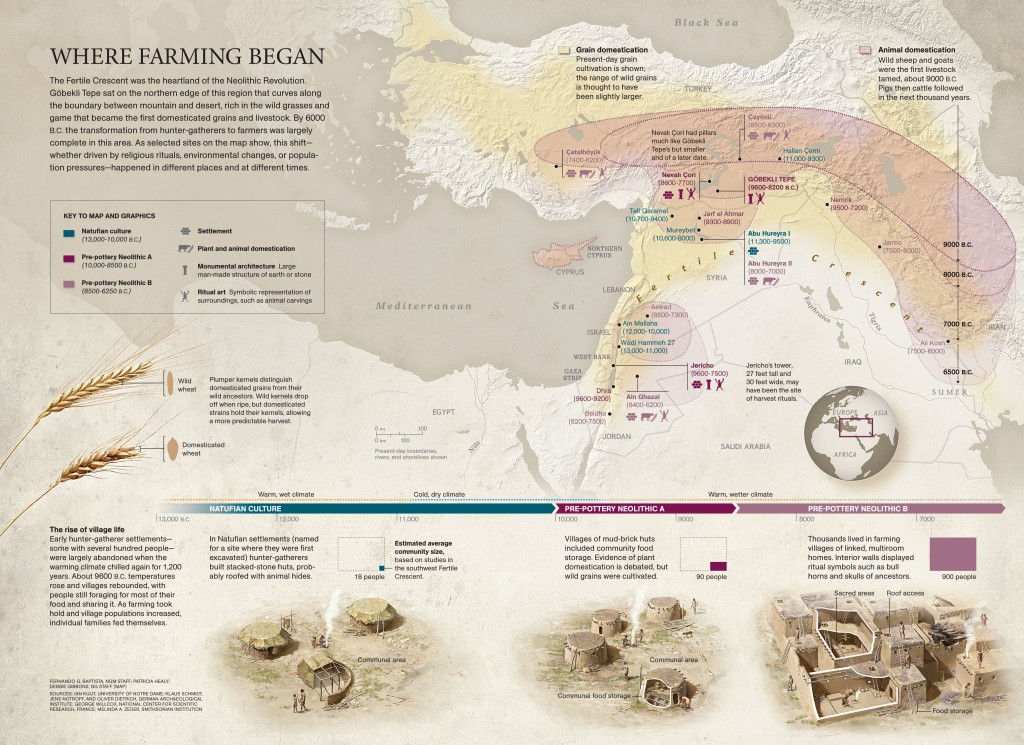
Mapping the Neolithic Revolution
Somehow we missed this great map of the Fertile Crescent from National Geographic. It came out just before Christmas, but we should have caught it, really. I hope they do similar ones for other cradles of agriculture around the world.