A short Smithsonian.com piece by Barry Estabrook does a really outstanding job of describing — no, explaining — the conservation and use of crop wild relatives to a lay audience. It’s all there. The value to crop breeders of genes from wild relatives. The history of germplasm exploration, and how it has resulted in the establishment of large collections. The need for, and urgency of, further collecting. The use of information from genebanks to guide future exploration. The challenges that such work faces, including on the policy side. And the euphoria that it can generate when you do overcome those challenges. All in a couple of pages, using a single wild species as an example. And if, once you finish reading the story, you want to know more about what Estabrook was chasing in Peru, it’s (probably) this.
Early agriculture in the Old and New Worlds
Last week saw the publication of a couple of papers about early agriculture in two very different regions which will probably have people talking for quite a while. From Snir et al. 1 came a study of pre-Neolithic cultivation in the Near East. And from the other side of the world, there was the latest in the controversy over the extent of Amazonian agriculture from Clement et al. 2.
Yes, I did say pre-Neolithic. The key finding of the archaeological work described by the first paper is that 23,000 years ago, or over 11 millennia before the putative start of agriculture in the Fertile Crescent, hunter-gatherers along the Sea of Galilee in what is now Israel maintained little — and, crucially, weedy — fields of cereals. The archaeobotanists found remains of both the weeds and the cereals at a site called Ohalo II, as well as of sickles, and the cereals were not entirely “wild”, as the key domestication indicator of a non-brittle rachis was much more common than it should have been. To see what this means, have a look at this diagram from a fairly recent paper on agricultural origins in the region. 3
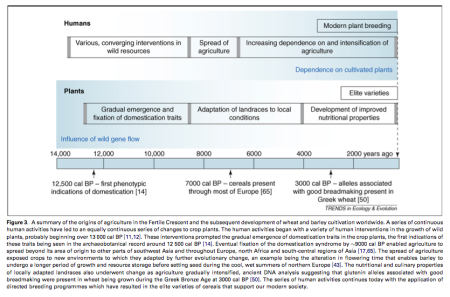
Those “first phenotypic indications of domestication”, dated at 12,500 years ago, need to be pushed quite a bit leftwards on that timeline now, off the edge in fact. A non-shattering rachis, it seems, was quite a quick trick for wild grasses to learn. But the process by which they acquired all the other traits that made them “domesticated” was very protracted and stop-start.
Zoom over to Amazonia, and the transition to farming took place much later, probably around 4,000 years ago, according to the other paper published last week. But it was just as significant as in the much better-known “cradle of agriculture” in the Fertile Crescent, with perhaps 80 species showing evidence of some domestication. The difference, of course, is that Amazonian agriculture was based on trees, rather than annual grasses and legumes.
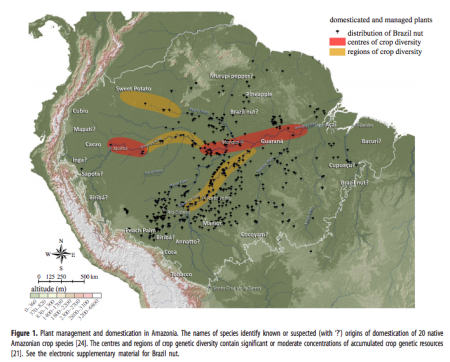
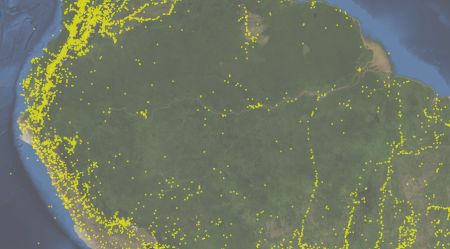
According to the authors, parts of the Amazon basin, in particular those now showing evidence of earthworks and dark, anthropogenic soils, were just as much managed landscapes by the time of European contact as the places those Europeans came from. But compare our collections of crop diversity from the Amazon basin (courtesy of Genesys, which admittedly does not yet include Brazilian genebanks)…
with what we have from the Near East…
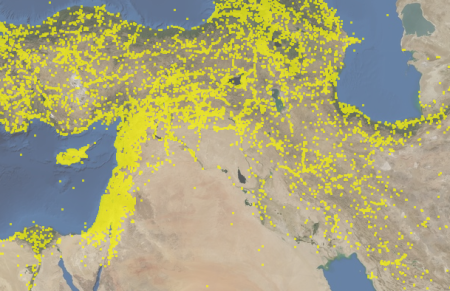
If we want to know more about how the domestication process and transition to agriculture differed in the Amazon and the Fertile Crescent, there’s a whole lot of exploration still to do.
Nibbles: High science, Methane-friendly rice, Gender, Indian priestesses, Banana extinction, Inka legacy, Diversity in ag, Yerba genome, Cucumber chains, Tomato relative, Agrobiodiversity in art
- High-level agricultural scientists thinks high agricultural science will feed the world. Oh, and smart policies.
- This new rice would qualify, I suspect.
- Participatory varietal selection manual revised to take women into account. Someone mention high science?
- No such manual needed in India, it seems.
- The banana-is-doomed story sure has legs. Or hands.
- What did the Inkas ever do for us?
- Is agriculture diverse enough? That is the question.
- Yerba mate gets sequenced. Because it can be.
- Following an Indian cucumber down the value chain.
- Thank your lucky stars for this weedy-looking tomato wild relative.
- “We’re interested in the color, shape and sizes of the vegetables from 400 years ago, compared to modern cultivars of the same vegetables: the deep sutures on cantaloupe in Italian art of the Renaissance or the lack of pigmentation in pictures of watermelon compared to today.”
- Quite a bit of agrobiodiversity featured in Day of Archaeology. Nice idea.
Brainfood: Grassland diversity, Potato diversity, English CWR, Genetic rescue, Saffron diversity, Lac, Cereal domestication, Turkish pea, Pathogen genomes, Rose fragrance, African cheese
- Worldwide evidence of a unimodal relationship between productivity and plant species richness. Grassland richness maximal at intermediate productivity levels.
- Cytoplasmic genome types of European potatoes and their effects on complex agronomic traits. Interesting relationships between cytoplasmic type on one hand and tuber starch content and resistance to late blight on other.
- Enhancing the Conservation of Crop Wild Relatives in England. 148 priority species, half of them not in ex situ at all. But there’s no excuse for that now.
- Genetic rescue to the rescue. Meaning an increase in population fitness, especially of rare species, owing to new alleles. Genomics will help by choosing the new alleles better, and monitoring the results.
- Diversity and relationships of Crocus sativus and its relatives analysed by IRAPs. No variation in the allotriploid cultigen, lots in the closely related species. Let the resynthesis begin.
- Economic analysis of Kusmi lac production on Zizyphus mauritiana (Lamb.) under different fertilizer treatments. That would be the scarlet resin secreted by some insects. NPK needed. No word on genetic differences.
- Parallel Domestication of the Heading Date 1 Gene in Cereals. Same QTL in sorghum, foxtail millet and rice, but different alterations of it. Multiple domestication for sorghum, single for foxtail millet.
- DNA based iPBS-retrotransposon markers for investigating the population structure of pea (Pisum sativum) germplasm from Turkey. No geographic structure for the landraces.
- The two-speed genomes of filamentous pathogens: waltz with plants. Fungi and oomycetes quite different genetically, but both have regions of genome which change rapidly to make them good pathogens. Bastards.
- The flowering of a new scent pathway in rose. Can we have our nice-smelling roses back now, please?
- AFLP assessment of the genetic diversity of Calotropis procera (Apocynaceae) in the West Africa region (Benin). Not just a weed, used in cheese-making, of all things.
Brainfood: Domestication stats, Apple vulnerability, Himalayan fermentation, Tree diversity, Grasslands double, Shiitake cultivation, Lablab core, Ethiopian sweet potato, Georgian grape
- A domestication assessment of the big five plant families. Half of cultivated plants are legumes, a third grasses.
- The vulnerability of US apple (Malus) genetic resources. Moderate.
- Microorganisms associated with amylolytic starters and traditional fermented alcoholic beverages of north western Himalayas in India. Veritable microbial communities.
- Spatial incongruence among hotspots and complementary areas of tree diversity in southern Africa. It’s not just about the hotspots.
- Integrating Agricultural and Ecological Goals into the Management of Species-Rich Grasslands: Learning from the Flowering Meadows Competition in France. Gotta document the synergies.
- Genetic–geographic correlation revealed across a broad European ecotypic sample of perennial ryegrass (Lolium perenne) using array-based SNP genotyping. Strong structure both with latitude and longitude. Wonder if the Flowering Meadows competition took that into account.
- Interactions of knowledge systems in shiitake mushroom production: a case study on the Noto Peninsula, Japan. Tradition is not always a totally good thing.
- Development of Core Sets of Dolichos Bean (Lablab purpureus L. Sweet) Germplasm. Heuristic is better. But is it PowerCore?
- Genetic Diversity of Local and Introduced Sweet Potato [Ipomoea batatas (L.) Lam.] Collections for Agro-morphology and Physicochemical Attributes in Ethiopia. The improved varieties are not all that great. But there were only two of them. And the local landraces were not necessarily the best.
- Study of genetic variability in Vitis vinifera L. germplasm by high-throughput Vitis18kSNP array: the case of Georgian genetic resources. Some differentiation between wild and cultivated, but significant overlap.