- That 2000-year old date palm seed is all grown up.
- And since we’re talking ancient stuff: ornithology in the service of egyptology.
- Citizen scientists track phenology.
- Citizen scientists find new species.
- Let’s hear it for cover crops.
- Turns out it’s ok for hipsters to eat quinoa.
- Sorghum takes over the Great Plains. (Well, not really.) And not only… Who needs quinoa.
- Especially when you have teff.
- And while we’re on gluten: need to make up for that off-colour quip in the last Nibbles.
- Malnutrition. Mapped. Including that much-discussed Missing Middle? Hang on, wait, here’s another nutrition mapping thing.
- African leafy greens in Benin get a video. Map that!
- Farmers make good extensionists.
- Chocolate workshops at Kew.
- Caribbean chocolate to get a make-over. Somebody telling Kew?
Complementary potato conservation in the Parque de la Papa
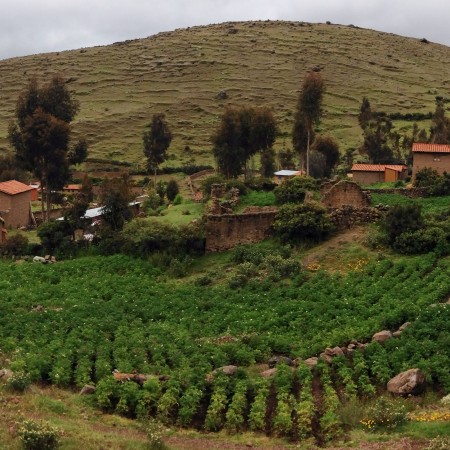 I was in South America for the past couple of weeks, which is why blogging has been, well, slow. One of the places I visited was the Parque de la Papa, or Potato Park, near Cusco in Peru, thus fulfilling a long-standing ambition. The Parque brings together six local communities around the imperative to conserve local potato diversity, both wild and cultivated, and use it sustainably. They raise money through ecotourism, including a restaurant serving local delicacies, but also through action research projects. One of the more important things that’s been happening is the “repatriation” of virus-free landraces from the genebank of the International Potato Centre (CIP), including with support from the International Treaty.
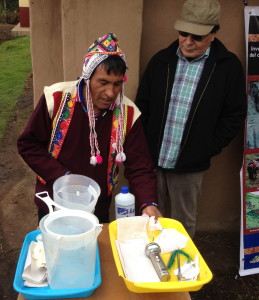 CIP staff have also been training local people in the production of botanical seed, as part of a project implemented by the Asociación ANDES with support from the Global Crop Diversity Trust. The seed is being stored in a community genebank, but will be safety duplicated at CIP, and hopefully also eventually in Svalbard. The photo shows Pedro doing a demonstration of how seeds are extracted from fruits for storage. The guy on the right is Alejandro Argumedo of ANDES. Really good to see ex situ and on farm conservation working together and complementing each other, as they should.
Nibbles: Rabbit origins, New beans and rice, New maize, Fermentation, Grape bugs, Kenya supergoats, Peruvian edible insects, Betelmania, Sustainable cacao, Making cider, Land rights, Kew funding, Avocado origins, German genebank, Oman roadshow, Chinese agriculture then and now, Underground farm, Irish potatoes, Lactase history, Nutrition report, Breeding wheat, Pulse year, Perennial cereals, Shaker agriculture, Food conference, Lupin breeding, Tanzanian ag landscapes, Coffee film, American food, Breakfast around the world, Indian wild figs, Baobab, Fragmentation, History of breeding, MARDI fruits, IARI head, Wild pig genome, Breed typology
Yeah, I know, been slacking with the blogging again of late. Lots of travel. Will try to post about it a bit now I’m back. Here’s the usual back-in-the-office game of catch-up.
- We start with something topical for Easter. The origin of the bunny: it’s not the genes, it’s the gene control control.
- CIAT’s heat-resistant beans are all over the internet. IRRI’s new rices, not so much.
- I hope they get names like Bill Tracy’s new open-pollinated maize variety.
- Bugs come in communities, and they do best when they stay that way.
- Even on grapes.
- Gotta get me one of these Kenyan supergoats.
- Are bugs next on Peru’s gastronomia menu? Probably not.
- Ban the betel!
- More on that we-need-GMO-to-save-chocolate thing. Because this?
- Some like it hard.
- Three steps to secure land rights.
- “If the seeds are never grown, they will fizzle out. Who is going to sow them and harvest them to keep them fresh?”
- The avocado shouldn’t be here. So sue me.
- The Ghana News Agency (and nobody else) says there’s a new genebank in Berlin.
- Oman’s biodiversity (including agricultural) goes on the road.
- Chinese agriculture goes sustainable. Well, in theory. Including for buckwheat, presumably.
- Maybe you can work out what this early Chinese flour was actually of: millet, barley and/or wheat?
- Meanwhile, in Japan, the opposite of sustainable farming beneath a Tokyo street.
- The Irish and the potato: in need of a reset?
- Want to develop? Learn to metabolize lactose.
- Ten research questions on nutrition.
- Well at least this gluten nonsense 1 is helping bring back some funky grains. And is spurring breeders. Who should perhaps be focusing on more important problems?
- Pulses will get their 15 minutes in 2016.
- The Land Institute is still at it, and still getting press.
- The United Society of Believers in Christ’s Second Appearing established one of the earliest seed companies in the US.
- No, getting to the bottom of food ain’t easy.
- Lupins better than soya in the UK, because breeding.
- A Tanzanian mash-up: Farmers need the landscape. I’m not kidding. And yet…
- There’s a film about coffee called “A film about coffee.”
- “In the future, the American dream of big cars and burgers will need to be adjusted to more active transport and sustainable, healthy eating. Better is the new bigger. The world needs a new diet. And it is waiting for the US to take the lead.” Good luck with that.
- Maybe start with breakfast?
- Indians need their wild figs.
- As much a African need baobabs, probably.
- A fragmented forest is no forest at all. Well, almost.
- BHL does domestication. As ever, great pix too.
- Malaysia protects its fruits.
- Who will head the Indian Agricultural Research Institute?
- The pygmy hog has been sequenced.
- A typology of livestock breeds.
Brainfood: IBPGR collecting, Persimmon diversity, ABS, On farm economics, Wild Colombian potatoes, Indian rice cores, Tibetan chickens, Ligonberry antioxidants, Tanzanian veggie IK, Melon sugar genes, Moroccan lentil diversity, Grasspea diversity, Quinoa ABS
- Plant genetic resources collections and associated information as a baseline resource for genetic diversity studies: an assessment of the IBPGR-supported collections. 35% of 200,000 accessions collected by IBPGR from 1975-95 still in a genebank somewhere.
- Genetic diversity among germplasms of Diospyros kaki based on SSR markers. Chinese non-astringent types closer to Chinese astringent types than to Japanese non-astringent types.
- Ex Post Use Restriction and Benefit-sharing Provisions for Access to Non-plant Genetic Materials for Public Research. Up-front payments can be ok.
- On Farm Conservation of Crop Genetic Resource: Declining De Facto Diversity and Optimal Funding Strategy. Fancy maths tells us to identify the landraces most likely to go extinct, and the farmers who can conserve them most cheaply.
- Current situation of wild Solanum spp. L. sect. Petota (Solanum, Solanaceae) in some Colombian regions. Not great.
- Identification of a diverse mini-core panel of Indian rice germplasm based on genotyping using micro satellite markers. Mini-core of 98 accessions based on molecular data recovers 94% of alleles in geographically-selected core of 6912 accessions from Indian collection. No word on how good the 6912 are in the first place.
- Genomic analyses reveal potential independent adaptation to high altitude in Tibetan chickens. Tibetan chickens fall into 2 groups, both with signs of selection in several genes involved in the calcium-signalling pathway implicated in adaptation to the hypoxia experienced at high altitudes.
- Antioxidant properties of lingonberry (Vaccinium vitis-idaea L.) leaves within a set of wild clones and cultivars. The wilds are better for you.
- Knowledge Sharing Strategies on Traditional vegetables for Supporting Food Security in Kilosa District, Tanzania. Farmers talk about vegetables. Well there’s a shocker.
- Variability of candidate genes, genetic structure and association with sugar accumulation and climacteric behavior in a broad germplasm collection of melon (Cucumis melo L.). 175 melons from 50 countries fall into 7 groups, fitting well with morphology and taxonomy. Ripening genes associated with diversification.
- Genetic diversity analysis of Moroccan lentil (Lens culinaris Medik.) landraces using Simple Sequence Repeat and Amplified Fragment Length Polymorphisms reveals functional adaptation towards agro-environmental origins. Evidence of combination of functional and geographic groupings.
- Genetic Diversity of Grasspea and Its Relative Species Revealed by SSR Markers. Asian landraces different to those from Africa/Europe. And all different from the wilds.
- Quinoa and the exchange of genetic resources: improving the regulation system. Quinoa for Annex 1?
Brainfood: Sustainable intensification, Shrimp IPR, Noog domestication, Nigerian leafy veggies, Basil smells, Cultural ES, Natural regeneration, Medicinal cucurbit
- What is sustainable intensification? Views from experts. Ambiguous term which may not signify a departure from current practice anyway. Ecological intensification instead?
- Intellectual Property Rights Access to Genetic Resources and Indian Shrimp Aquaculture: Evolving Policy Responses to Globalization. I kid you not.
- Patterns of Domestication in the Ethiopian Oil-seed Crop Noug (Guizotia abyssinica). Weirdness, for a domesticated crop, not due to its wild relative messing things up. What it is due to is a “mystery.” Thanks, authors.
- Bio-Banking on Neglected and Underutilized Plant Genetic Resources of Nigeria: Potential for Nutrient and Food Security. Never even heard of some of these.
- Comparison of different Ocimum basilicum L. gene bank accessions analyzed by GC–MS and sensory profile. Among 12 cultivars in the Hungarian genebank, there are 5 distinct smell profiles. That actually seems quite a lot.
- The role of cultural ecosystem services in landscape management and planning. Sometimes, they can hold you back.
- Carbon farming via assisted natural regeneration as a cost-effective mechanism for restoring biodiversity in agricultural landscapes. It can be a viable use of land in parts of Queensland, depending on the price of C.
- Ethnobotany of a threatened medicinal plant “Indravan” (Cucumis callosus) from central India. Cucumber wild relatives also medicinal.