- Seaweed cultivation: potential and challenges of crop domestication at an unprecedented pace. I for one welcome our new algal overlords.
- Recent advances in understanding the genetic resources of sheep breeds locally-adapted to the UK uplands: opportunities they offer for sustainable productivity. Lower susceptibility to Maedi-Visna virus, for example.
- Back to the wilds: Tapping evolutionary adaptations for resilient crops through systematic hybridization with crop wild relatives. The promiscuity of plants will save us.
- Breadfruit (Artocarpus altilis): a source of high-quality protein for food security and novel food products. All 49 varieties tested have full spectrum of essential amino acids.
- Predicting changes in the distribution and abundance of species under environmental change. Distributions are not enough, can adapt some methods to look at abundance too. Oh, and intraspecific diversity.
- Barnyard millet — a potential food and feed crop of future. Decline in cultivation could be reversed due to nutritional quality and adaptability, but it won’t be easy.
- Inclusion of Fermented Foods in Food Guides around the World. The benefits should be better known.
- Discovery and genetic analysis of non-bitter Tartary buckwheat (Fagopyrum tataricum Gaertn.) with trace-rutinosidase activity. Wow, a non-bitter buckwheat found in Nepal! Should now be possible to produce some better-tasting improved varieties. Yeah but you know how long that usually takes…
- Breeding of ‘Manten-Kirari’, a non-bitter and trace-rutinosidase variety of Tartary buckwheat (Fagopyrum tataricum Gaertn.). Well I feel foolish…
- Higher iron pearl millet (Pennisetum glaucum L.) provides more absorbable iron that is limited by increased polyphenolic content. High Fe is not enough.
- Characteristics of Egg-related Traits in the Onagadori (Japanese Extremely Long Tail) Breed of Chickens. It’s a “Special National Natural Treasure” of Japan and no wonder.
- Exploitation of yield stability in barley. It’s not really feasible to measure it accurately, and therefore select for it, but when you do, it seems hybrids are better at it.
Nibbles: Species modelling vids, Diverse farm, MAIZE, Maize, COP20, Scuba rice, Trad food, Siberian Svalbard
- A niche modelling course on YouTube.
- Diversify for better nutrition.
- Cool infographic for CGIAR’s maize work.
- Which doesn’t mention the 58 names of maize.
- Discussion on genetic diversity from the first day of the Global Landscapes Forum 2014, in Lima, Peru, during COP20. And more from same thing, scroll down.
- Scuba rice in Bangladesh.
- Supporting food traditions in Sudan and Oklahoma.
- More on that weird, unnecessary, Siberian seed vault.
Brainfood: Cassava descriptors, Core collections, Oat breeding, Indigenous fruits, Sandalwood in Fiji, Eggplant diversity treble, Globally important mushrooms, High amylose rice, Chickpea diversity, Finger millet diversity, Lethal yellowing, Spanish peppers, Local potato experts
- Selection of the most informative morphoagronomic descriptors for cassava germplasm. From 51 to 32. Hardly seems worth it. And dropping descriptors can be dangerous.
- Advances in core collection of plant germplasm resources. In Chinese, alas, but it sounds intriguing.
- Trends in breeding oat for nutritional grain quality – An overview. You want high β-glucan, and you can get it by breeding for high yield, luckily. A. atlantica has high β-glucan.
- Indigenous Fruit Trees of Tropical Africa: Status, Opportunity for Development and Biodiversity Management. Need for “exploiting the under-tapped treasuries of IFT.” Still? People have been saying that for years. They’ve even designated agroforestry systems as globally important and everything.
- Promoting Santalum yasi Seeman (Sandalwood or yasi) in agroforestry systems to reverse agrodeforestation in Fiji. An attempt to introduce a high value species into a threatened agroforestry system. Not just fruit, then.
- Genetic diversity and population structure of wild/weedy eggplant (Solanum insanum, Solanaceae) in southern India: Implications for conservation. Quite a lot of geneflow.
- The potential for crop to wild hybridization in eggplant (Solanum melongena; Solanaceae) in southern India. Transgenes from the crop could spread to the wild relative.
- Variation in Antioxidant Activity and Flavonoid Aglycones in Eggplant (Solanum melongena L.) Germplasm. So, the leaves are good for you. But I suspect they taste like crap.
- The Qingyuan Mushroom Culture System as Agricultural Heritage. Would pay money to see that.
- Selecting High Amylose Rice Germplasm Combined with NIR Spectroscopy at the RDA Genebank Conserved. From 9481 to 14 with high amylose and decent agronomy. But why bother?
- Field response of chickpea (Cicer arietinum L.) to high temperature. There are some heat tolerant lines in the ICRISAT genebank.
- Genetic diversity in East African finger millet (Eleusine coracana (L.) Gaertn) landraces based on SSR markers and some qualitative traits. The diversity is high, mainly within countries, and missing from the ICRISAT minicore. Naughty.
- Analyses based on the 16S rRNA and secA genes identify a new phytoplasma subgroup associated with a lethal yellowing-type disease of coconut in Côte d’Ivoire. The international genebank is threatened.
- New Insights into Capsicum spp Relatedness and the Diversification Process of Capsicum annuum in Spain. Limited genetic diversity has differentiated in Spain into pungent, elongated peppers in the South and Center, and sweet, blocky and triangular types in the North.
- Knowing native potatoes: finding local experts through innovative methods in the Peruvian Andes. Community Biodiversity Register methodology applied to potato landraces. Don’t see anything much new here, but good to have it nicely documented.
Nibbles: Biltong, Coco de mer, PGRFA course, Poplar genebank, IRRI genebank, African agriculture, Hybrid chickens, American food
- Professor wants to copyright the name biltong, should be forced to eat nothing else until he takes it back.
- Getting to the bottom of coco de mer.
- PGRFA course at Wageningen. Expensive, but worth it, and you can apply for a NFP/MENA Fellowship, check on the course overview PDF.
- The IRRI genebank manager has seen the future of genebanks: “…we need to work on building the system to estimate breeding value from genotype, and then we will be able to feed more detailed knowledge to the breeders.” He probably means DivSeek. Now IRRI really need to get a different stock image of him and his genebank.
- The UK now has a National Black Poplar Clone Bank. Not quite as big as the above.
- A different take on Bill’s Big Bet. And more along the same lines.
- Hybrid Kuroiler chickens a big hit in Uganda. Bill may be onto something after all.
- “As American as apple pie” is just the beginning. I want to see Kuroilers at KFC.
There’s more to kiwi fruit diversity than you think
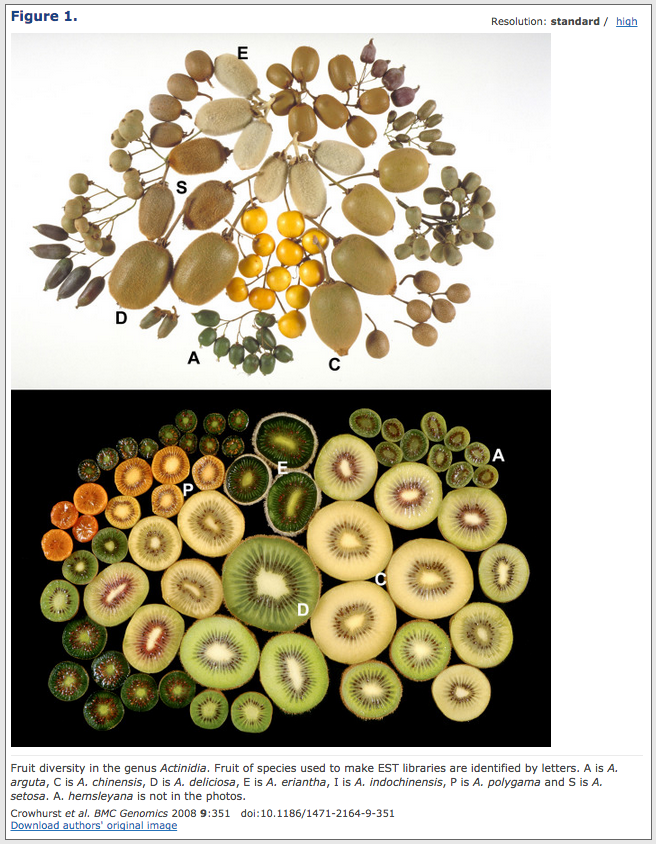 I love photos of weird plants, and the Facebook group Rare Fruit-Rare Edible Plants is a great place to find them. Once in a while, you even get a photo of diversity in a weird plant, which is even better. Case in point is this great visual summary of diversity in Actinidia. Except of course the Facebook version had no caption, which was annoying as hell. Fortunately, thanks to Google Image Search, I was able to track down the original source, a 2008 paper in BMC Genomics. Now, where can I get some of these to taste?