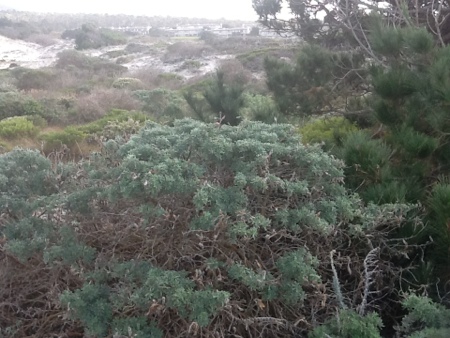
Breeders and genomics researchers are meeting at the Asilomar Conference Grounds, Pacific Grove, California to discuss how genomics can facilitate the use of crop wild in crop improvement. Follow on Twitter using #cwrgenomics. The wild lupin in the photo is found on the sand dunes just outside the conference facilities. There’s also a smaller, rarer one, but I haven’t found it yet.
Speaking of return on conservation actions, which we sort of were a couple of days back:
A new study has produced the first indicative estimate of the overall economic benefits provided by the Natura 2000 network. It suggests that the value could be currently between €200 and €300 billion per year, or 2% to 3% of the EU’s Gross Domestic Product.
That’s from one item in a special Thematic Issue of the European Commission’s news alert organ Science for Environment Policy which focuses on “Management and Monitoring of the NATURA 2000 Network,” (pdf) a network of protected areas that is described in the editorial introducing the issue as the “cornerstone of EU biodiversity policy.”
Natura 2000 site at Bärwurzwiese, Belgium. Photo made available under a CC license by Frank Vassen via Flickr.Here’s the table of contents the whet your appetite
What does ‘wilderness’ mean?
First EU-wide economic valuation of Natura 2000 network
Improved local management needed for the Natura 2000 network
Natura 2000 Case Study Hoge Kempen: from coal mining landscape to oasis of biodiversity
Improved communication about Natura 2000 may help resolve landowner conflicts
Ecotourism: protecting the nature of Natura 2000 in Latvia
Natura 2000 Case Study Slitere National Park: sustainable tourism in a Natura 2000 site
Natura 2000 Case Study Eurosite – Adaptive Management of Natura 2000 sites
Protected areas act as stepping stones for nature in the face of climate change
New Belgian approach to favourable conservation status for habitats and species of European interest
Sustaining the Natura 2000 network through LIFE
We’ve talked before about Natura 2000 in the context of conservation of crop wild relatives. I’m willing to bet that return on investment doesn’t take into account any species important in crop improvement that the network happens to be protecting. But if you know better, let us know.
With regard to … sperm collection from wild animals, FAO does not have guidelines on this, given our emphasis on domestic livestock. However, if the animal can be sacrificed, epididymal sperm collection may be an option. This procedure is briefly discussed in the FAO Guidelines for Cryoconservation of Animal (domestic) Genetic Resources (pages 99-100) (http://www.fao.org/docrep/016/i3017e/i3017e00.pdf) but some experimentation would likely be needed to adapt it to your species of choice. If the animal must remain alive, options may be to remove sperm from the testes by using a syringe (PESA — Percutaneous Epididymal Sperm Extraction), to surgically implant a catheter or by removal of only a single testicle for sperm collection, leaving the other intact. Two scientific documents on epididymal semen collection in livestock by Dr. Flavia Pizzi (one of the authors of the FAO Cryoconservation Guidelines) and her colleagues are available at:
For “conventional” sperm collection from living wild animals, an electro-ejaculator is often used, although this approach will not be successful for all species (e.g. it’s generally not used for pigs and horses among livestock species). In case your target species is wild cats, the following may be of use to you: