- Poverty doesn’t drive deforestation. Discuss using examples from Kenya and China.
- Crop Science Society of America (CSSA) position statement on “Crop Adaptation to Climate Change.” Genebanks mentioned. Crop wild relatives mentioned. Information systems mentioned. One’s cup runneth over.
Nibbles: SusAg WWF-style, Obesity, Innovation, African farmers, Cyanobacteria, Climate change experiment
- See what WWF thinks will make agriculture sustainable.
- Americans are dying younger. Obesity partly to blame.
- Study shows how scientists can get farmers to innovate. And vice versa?
- Iron-age beer in France. “Beer … might have resembled modern home brews.” Which might have created a nation of wine-drinkers.
- Voice of America ♥ Nourishing the Planet. (African farmers also important.)
- Bacteria in mosses on tree branches fertilize forest soils. How long before the whole thing is available in a packet?
- Bioengineering the prairie. Together with, presumably, its crop wild relatives.
Brainfood: Bean diversity, Rice domestication, Microbial interactions squared, Threat of extinction, Agroforestry, Species diversity
- Population structure and genetic differentiation among the USDA common bean (Phaseolus vulgaris L.) core collection. Subpopulations detected within usual Middle American and Andean genepools. The former was more diverse. Diversity was lower for domestication loci. One wonders whether game worth candle.
- Artificial selection for a green revolution gene during japonica rice domestication. There’s nothing new under the sun. Fuller fills us in.
- Positive plant microbial interactions in perennial ryegrass dairy pasture systems. Plant-microbe interactions can have significant positive impact on production of, and chemical inputs into and losses from, perennial ryegrass dairy pasture systems. Gotta love that agrobiodiversity.
- Plant growth promoting potential of Pontibacter niistensis in cowpea (Vigna unguiculata (L.) Walp.). And another one. New bacterium from Western Ghats fertilizes soil and helps cowpea to grow.
- Extinction risk and diversification are linked in a plant biodiversity hotspot. That would the Cape. Extinction threat (IUCN categories) is better explained by phylogeny than by human activity or plant traits. Go figure.
- The framework tree species approach to conserve medicinal trees in Uganda. Sort of like artificial keystone species. Lots of other cool stuff in the same issue of Agroforestry Systems.
- Use of topographic variability for assessing plant diversity in agricultural landscapes. By and large, more environmental variability means more plant diversity, in Switzerland. Maybe some crop wild relatives in there?
Wallow Fire (may) threaten (some) wild beans. Maybe.
There’s a really bad fire spreading in Arizona. 1
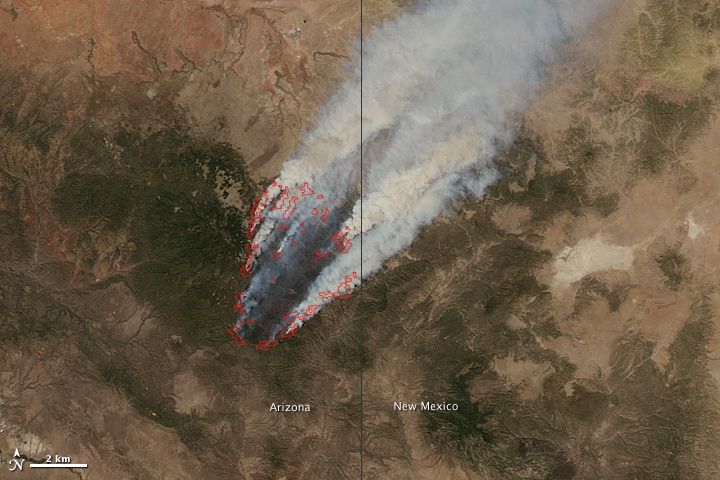
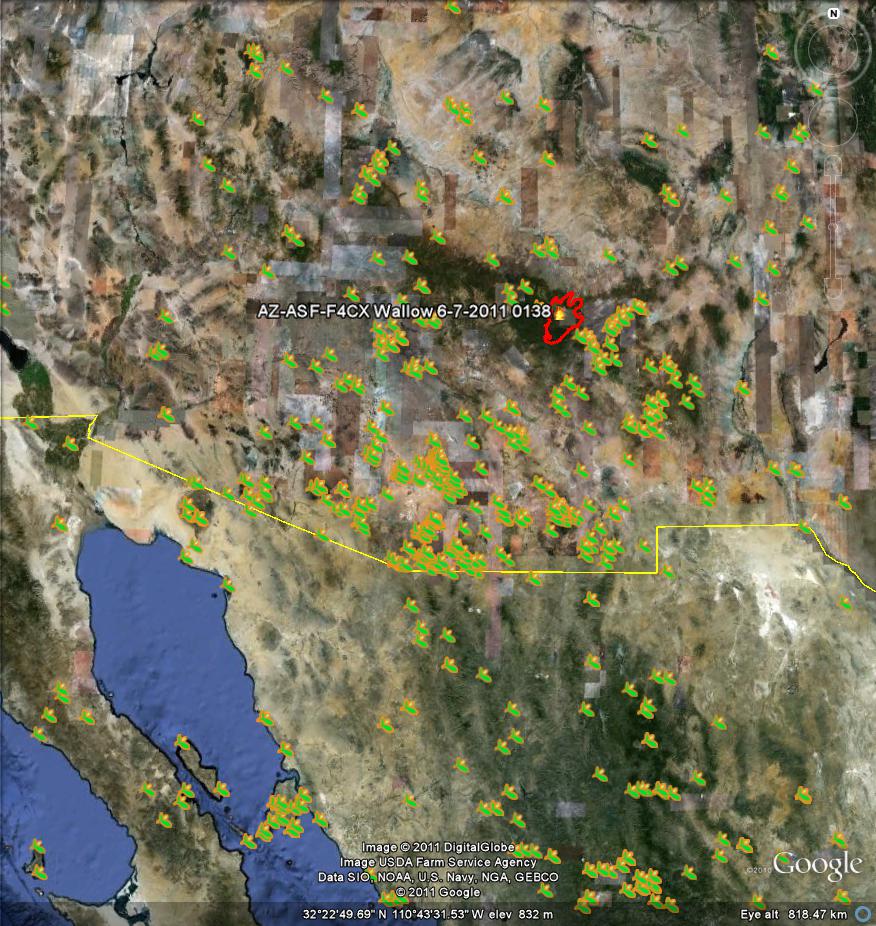
You can donwload all kinds of stuff about it, and even post your experiences of it on Facebook. But can you find out whether any crop wild relatives are threatened by it? Well, sure: all you have to do is go off to GBIF, and choose a likely genus (Phaseolus, say), and download the records, and mash them up in Google Earth with the latest fire perimeter data or whatever. 2 Like I’ve done here:
Coming in closer, and using the NASA GeoTIFF instead of the normal Google Earth imagery, you can put yourself in the position of being able to make some reasonably intelligent guesses about what might be happening to some of these populations, and the genepool as a whole in the area:
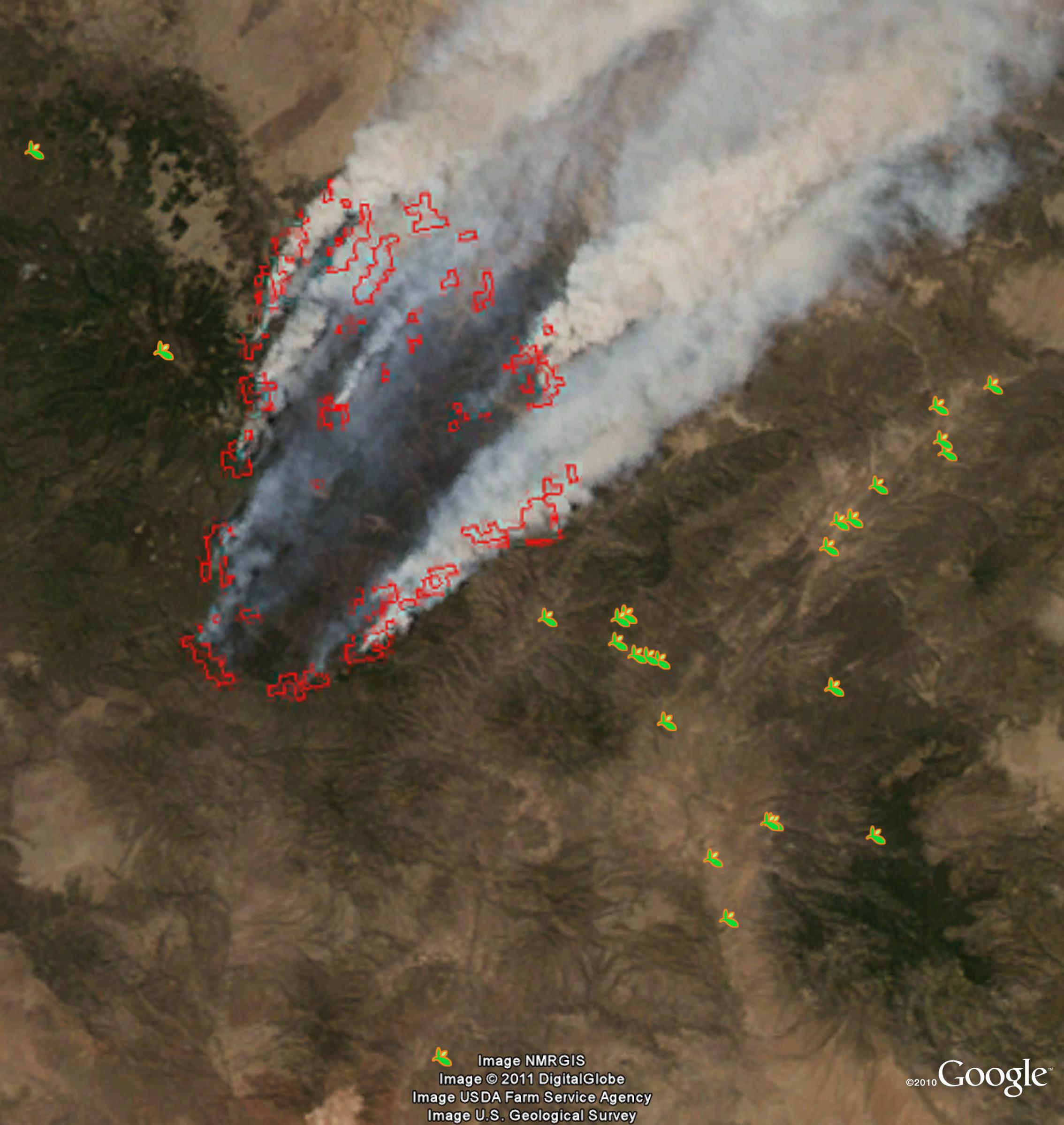
But what I really meant is that there ought to be a way to do this automagically, or something. Anyway, it is sobering to reflect that while all hell is breaking loose in Arizona, not that far away to the northeast, in the peaceful surroundings of the Denver Botanical Garden, Anasazi beans are enjoying their day in the sun, utterly oblivious of the mortal threat faced by some of their wild cousins. It’s a cruel world. And there’s a point in all this about the need for complementary conservation strategies that’s just waiting to be made. Isn’t there?
Nibbles: Food security, Food carts, Cotton, Ritual, C4 C3 CC, American Indian diets, Community genebanks in India, Fowler, Dark earth soil, Domestication
- German donor examines food and security, notes “the fast loss of biodiversity”.
- Food carts are successful oases in at least one food “desert”.
- Yesterday’s Botany Photo of the Day was American cotton.
- Good news, everyone: “Hardcore farmers prefer lowkey rituals.” Obviously the memo didn’t reach the children of the corn.
- Photosynthesis and climate change: it’s complicated.
- Native Americans try to reclaim control of their foodways. And their waists.
- “…every district should have a community-controlled seed centre with a gene bank for traditional seeds.” Of course it should. “The local available seed diversity needs to be protected and conserved at any cost.” Of course it must.
- “Right now, all over the world, projects are underway to store seeds…“
- Dark earths not just in Amazon, Africa too.
- Presentation on IFAD project on cultivating wild aromatic etc. species for money in Morocco.