- Greek organic farm resists.
- Communities getting into seed banking all over.
- Saving zapalote chico.
- Would you like chiltepines with that?
- No zapalote chico in South Africa, but lots of other maize.
- Conserving agricultural biodiversity in China.
- Including in Hainan.
- At the same time, China restricts foreign access to human genome data.
- Sexually plastic Australian wild tomato named at long last.
- Breeding flavour crops.
- And figuring out how much it will cost.
- Interesting project on human-chicken interactions.
- Veggie breeder wins World Food Prize.
- New coffee table book on cattle in Africa.
- Flagship agroforestry database gets new version. Anyone wanna test it for us?
- Minor cereals in Europe are anything but minor.
- And lots are conserved in Europe’s increasingly scrutinized genebanks.
- Meanwhile, a major cereals keeps getting the attention it also needs.
- “The candidate markers could be used by any rice genebank to potentially identify varieties with seeds that are particularly short- or long-lived in storage. Viability monitoring intervals could then be customized by variety.” And wheat?
Brainfood: Macadamia domestication, Middle Eastern wheat, ART virus, Open science, Red Queen, Food system change, Chinese Neolithic booze, Dough rings, Making maps, Biofortification, Endophytes, African maize, Switchgrass diversity, Ancestral legume
- Wild Origins of Macadamia Domestication Identified Through Intraspecific Chloroplast Genome Sequencing. One tree is the basis of the industry.
- The Israeli Palestinian wheat landraces collection: restoration and characterization of lost genetic diversity. Bringing it all back home.
- Using high‐throughput sequencing in support of a plant health outbreak reveals novel viruses in Ullucus tuberosus (Basellaceae). There’s always something…
- Plant health emergencies demand open science: Tackling a cereal killer on the run. …but openness will get us through it.
- Rapid evolution in plant–microbe interactions – a molecular genomics perspective. Until the next one.
- Understanding food systems drivers: A critical review of the literature. Spoiler alert: urbanization, raise in consumer income, population growth, attention paid to diet & health issues, technological innovations, intensification and homogenization of the agricultural sector, increase in frequency and intensity of extreme events, general degradation in soils and agro-ecological conditions, improved access to infrastructure and information, trade policies and other processes influencing trade expansion, internationalization of private investments, concerns for food safety. I guess diversity is in there somewhere.
- The origins of specialized pottery and diverse alcohol fermentation techniques in Early Neolithic China. So good, they invented fermentation twice.
- The Hoard of the Rings. “Odd” annular bread-like objects as a case study for cereal-product diversity at the Late Bronze Age hillfort site of Stillfried (Lower Austria). Unbaked, tarallini-like dried wheat/barley dough rings may have been used ritualistically. No, not like that.
- EviAtlas: a tool for visualising evidence synthesis databases. Everybody likes a map.
- Editorial: Improving the Nutritional Content and Quality of Crops: Promises, Achievements, and Future Challenges. A review of reviews of biofortification, and more.
- Fungal endophyte diversity from tropical forage grass Brachiaria. 38 fungi isolated from 9 Brachiaria species, but unclear if any are beneficial.
- Characteristics of maize cultivars in Africa: How modern are they and how many do smallholder farmers grow? Out of 500 samples in 13 countries, about half were in some way improved, covering about half of the surveyed planted area.
- QTL × environment interactions underlie adaptive divergence in switchgrass across a large latitudinal gradient. You can combine alleles which are locally advantageous in different places to get a
super-biofuel. - Reconstruction of ancestral genome reveals chromosome evolution history for selected legume species. The wild ancestor of peanut, pigeonpea, soybean, beans, mungbean, chickpea, lotus and medics was closest to wild peanuts. Maybe they can synthesize it?
Brainfood: Seed viability double, Forest reserves, Biodiversity value, Hunter-gatherers, Seed concentration, Past CC, Hot lablab, Mungbean adoption, Climate smart impacts, Tree threats, Chicken domestication, Top sorghum, Ancient wines, Plant extinctions
- Variation in seed longevity among diverse Indica rice varieties. 8 major loci associated with seed longevity.
- Seeds and the Art of Genome Maintenance. Viability is about the DNA repair response. Snap.
- Are Mayan community forest reserves effective in fulfilling people’s needs and preserving tree species? Sure they are.
- The power of argument. People don’t respond to utilitarian arguments when it comes to biodiversity. In the Netherlands.
- Do modern hunter-gatherers live in marginal habitats? Nope. What can I tell ya?
- New evidence on concentration in seed markets. Not as bad as some people think.
- Climate change has likely already affected global food production. From 2003 to 2008, there’s been a ~1% average reduction in consumable food calories in barley, cassava, maize, oil palm, rapeseed, rice, sorghum, soybean, sugarcane and wheat.
- Selection of Heat Tolerant Lablab. 6 out of 44 accessions from the WorldVeg genebank are heat tolerant. Seems a lot.
- Counting the beans: quantifying the adoption of improved mungbean varieties in South Asia and Myanmar. 1.2 million farmers reached by WorldVeg varieties. Lablab next?
- Climate smart agricultural practices and gender differentiated nutrition outcome: An empirical evidence from Ethiopia. They work, but they’re better in combination.
- Pests and diseases of trees in Africa: A growing continental emergency. Into Africa…
- Genetics of adaptation in modern chicken. Not much of a domestication bottleneck; that came later.
- Multi-Trait Diverse Germplasm Sources from Mini Core Collection for Sorghum Improvement. From 40,000 in the genebank, to 242 in the mini-core, to 6 really cool ones (from Yemen, USA, China, Mozambique, and India x2 if you must know).
- Palaeogenomic insights into the origins of French grapevine diversity. Ancient DNA from 28 pips dating back to the Iron Age provides pretty good matches to grapes grown today.
- Global dataset shows geography and life form predict modern plant extinction and rediscovery. Almost 600 plants went extinct in modern times, at least, and I count about 20 crop wild relatives among them.
Extinct CWR mapped
Following yesterday’s promise, here are extinct crop wild relatives mapped. Your job is to match dots to names.
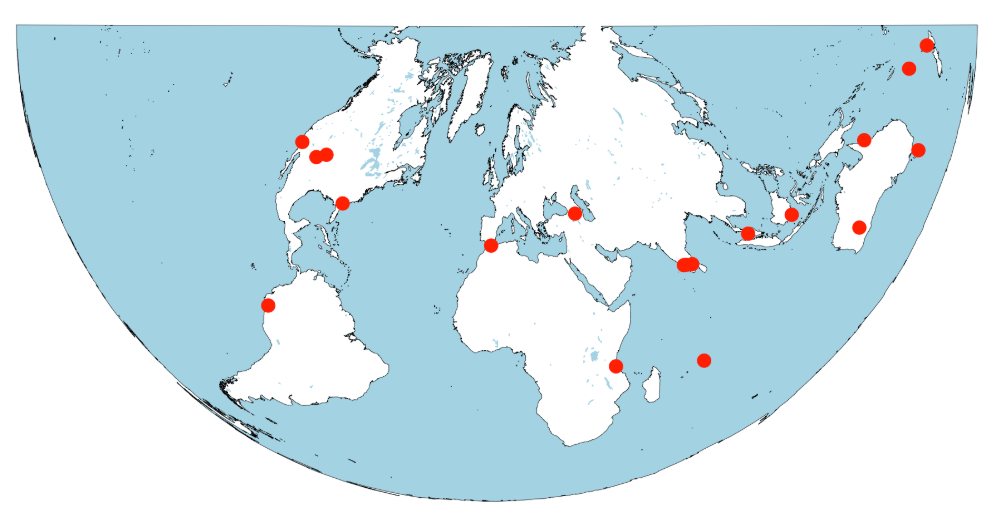
Extinct crop wild relatives
You may have seen coverage of a recent paper in Nature in which Kew researchers quantified the rate of plant extinction over the last 250 or so years. The headline number is about 3 species have been going extinct per year, which is about 500 times the background rate. But I know that what you really want to know is how many of these are crop wild relatives. Well, my friends at CIAT worked their database magic, and came up with the following list of extinct species which are classified by at least one source as a crop wild relative:
Diplotaxis siettiana
Franklinia alatamaha
Helianthus praetermissus
Hutchinsia tasmanica
Ilex gardneriana
Isatis arnoldiana
Lepidium drummondii
Lepidium obtusatum
Mangifera casturi
Musa fitzalanii
Piper collinum
Potentilla multijuga
Rorippa coloradensis
Solanum bauerianum
Solanum cajamarquense
Solanum ruvu
Syzygium balfourii
Syzygium microphyllum
Syzygium palghatense
Which means about 1 per decade or thereabouts. But that, clearly, is just a minimum.
Perhaps I’ll try to map where these plants were last seen.