Speaking of botanical gardens maintaining collections of crop diversity, this just in:
A large collection of Teosinte seed was recently transferred from Duke University to the Missouri Botanical Garden Seed Bank. Teosinte is the wild ancestor to modern corn and the preservation of its genetic material is important to corn research and supports the long term conservation of crop wild relatives. The collection includes seven different species in the genus Zea and will be stored in long-term freezer storage where it may remain viable for decades. We are in the process of accessioning, drying, counting and repackaging the seed for storage in the freezers.
The Duke collection is not mentioned either in WIEWS or the global maize conservation strategy, so it’s a little difficult to know how important it is. Interestingly, there is a maize collection mentioned in WIEWS from North Carolina State University, and that’s not that far from Duke, but still. Any way you slice it, there aren’t too many collections of wild maize relatives out there, according to the global strategy:
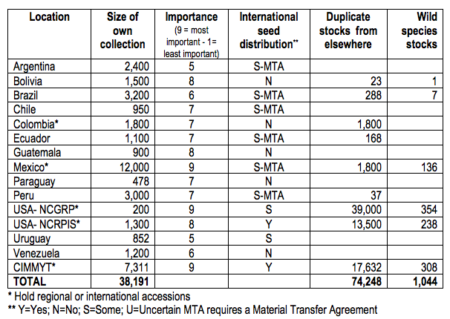
It would arguably have been better for the collection to go to USDA, Ames (NCRPIS) or CIMMYT, but Rainer Bussmann, Director and William L. Brown Curator for Economic Botany at the Missouri Botanical Garden (MO) also made a perfectly good case for this option to me on Facebook:
Because we (MO) already had a (smaller) Teosinte collection, and we are housing a large corn collection, so this fit in perfectly.
So that’s another collection that the global strategy doesn’t know about. You can look for crop wild relatives on the PlantSearch database of Botanical Gardens Conservation International, but the secretive world of botanical gardens is such that this will only tell you that a particular plant exists in a garden collection somewhere, not which garden collection.
It doesn’t really matter where this Duke collection ends up, as long as it’s well taken care of, which it obviously will be at MO. But users also need to know where the stuff is, and get their hands on it. Isn’t it time botanical gardens and crop genebanks exchanged information a bit better? Rainer, how about putting the passport data on your new collection on Genesys?