- The role of protected areas in supplying ten critical ecosystem services in drylands: a review. Let the communities take the lead, be inventive about governance.
- Breeding Oil and Table Olives for Mechanical Harvesting in Spain. 19,000 seedlings, 481 preselections in intermediate field trials, 31 advanced selections in a network of field trials, 1 new protected cultivar Sikitita (Chiquitita in USA).
- Phenotypic and molecular characterization of plants regenerated from non-cryopreserved and cryopreserved wild Solanum lycopersicum Mill. seeds. Oops, SSRs pick up some changes.
- Pollen Cryopreservation to Support Maintenance of a Wild Species Collection of the Genus Allium. Variable success. And no word on somaclonal variation.
- Epiphytic bacteria biodiversity in Brazilian Cerrado fruit and their cellulolytic activity potential. No fewer than 29 bacterial genera on 32 native fruits, 30% producing cellulase.
- Fine-scale spatial genetic structure of common and declining bumble bees across an agricultural landscape. Not much structure, due to queen dispersal. Declining species less diverse.
- Genetic Diversity in Remnant Swedish Hop (Humulus lupulus L.) Yards from the 15th to 18th Century. The old varieties are still there, having gone feral in abandoned yards because, unlike for 450 years until 1860, Swedish farmers are, alas, no longer obliged to grow the stuff.
- A comparison of wild and cultivated strawberries for nitrogen uptake and reduction. Some wild accessions might be better at assimilating N.
- Advances in European sea bass genomics and future perspectives. There’s a sequenced genome, but nobody’s using it.
- Genetic effects of forest management practices: Global synthesis and perspectives. There’s no excuse for not doing the right thing now.
- Exploring the variability of a photoperiod-insensitive sorghum genetic panel for stem composition and related traits in temperate environments. You can improve biomass quantity and quality simultaneously. Stem composition variability follows genetic origin.
Capsules of Life
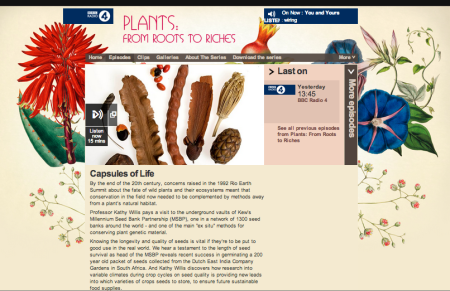 The BBC’s Roots to Riches reaches genebanking for conservation, with the above title. Mainly about the Millennium Seed Bank, which is predictable, and perfectly fine, but we know there’s a lot more to it than that, of course.
Totally terere
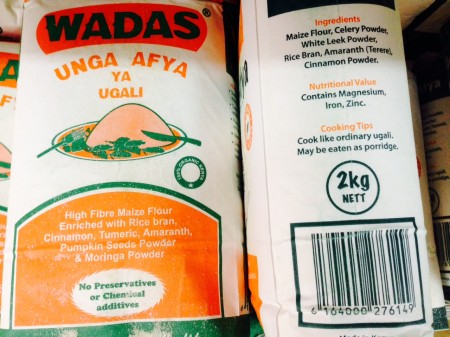
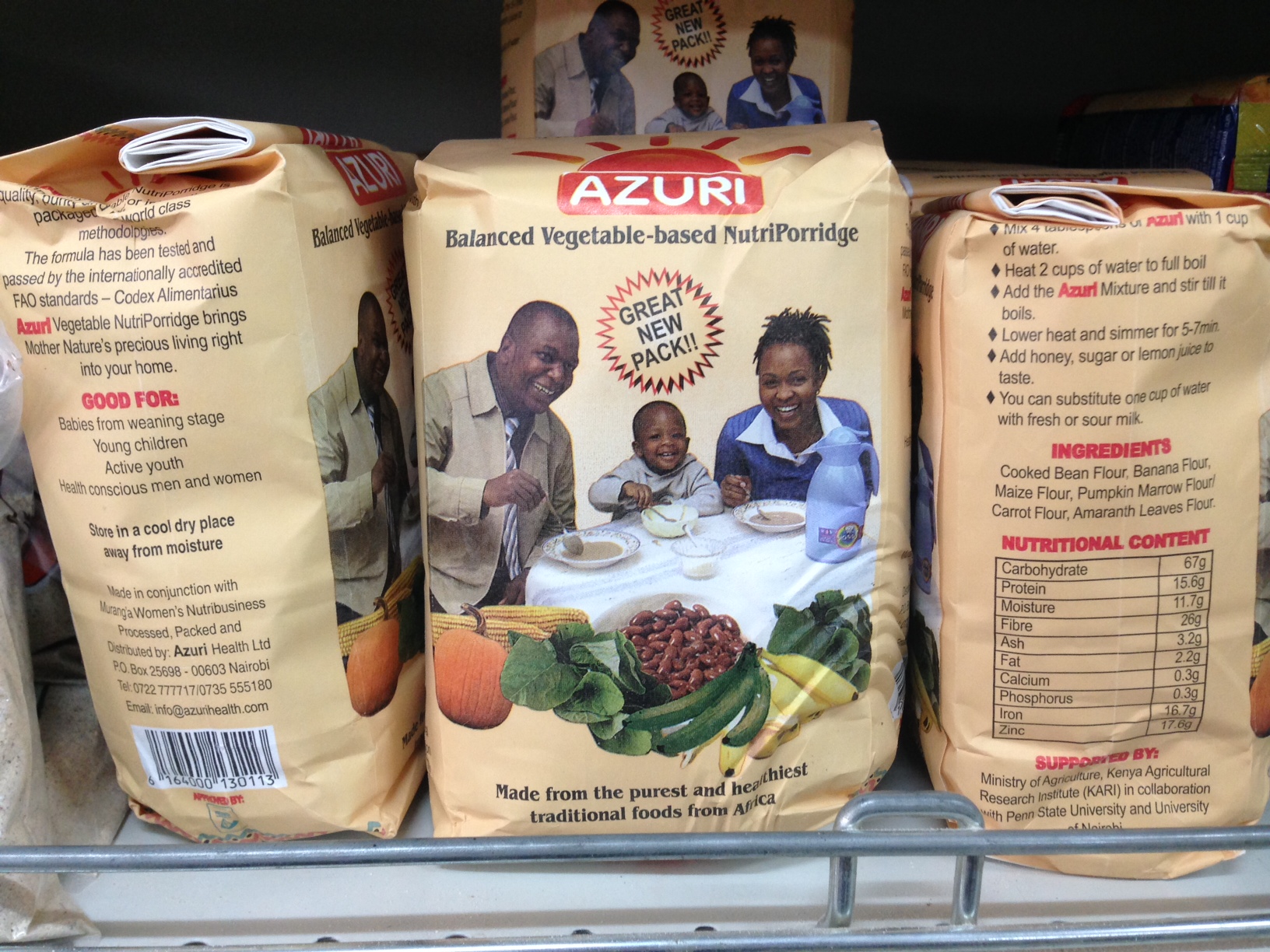
The launching of FAO’s Traditional Crop of the Month with amaranth, just announced on Twitter, reminds me that I was going to post a couple of photos showing how much the crop is being used nowadays in Kenya. These show that terere leaves are used — along with other stuff — to fortify maize meal, which is used to make ugali, the main staple food around here for many people. I took the pix in a supermarket in Lavington, an upscale residential area, and they represent two different brands of unga. Just look under ingredients.
Brainfood: Azeri grapes, Biodiversity & ecoservices, Ivorian melons, Omani chickens, Insecticides & pollinators, Czech wild wheat, African yams, Livestock breeding, Natural selection, Bean proteins
- Biodiversity and breeding of grapes: a study in Azerbaijan. Long history, 2 main wild types, 600 cultivated varieties, 100 of them threatened.
- Linkages between biodiversity attributes and ecosystem services: A systematic review. Mainly, but not exclusively, positive. Always complicated.
- Genetic relationships among accessions of African indigenous melons (Cucumis melo L. ssp. agrestis) using AFLP markers. Vegetable and soup thickener types separate genetically.
- From India to Africa across Arabia: An mtDNA assessment of the origins and dispersal of chicken around the Indian Ocean Rim. Arabian chickens come from India, Somali chickens from SE Asia.
- A restatement of the natural science evidence base concerning neonicotinoid insecticides and insect pollinators.. Here’s the data. Make up your own mind.
- Aegilops conservation and collection evaluation in the Czech Republic. 1 species in situ, 21 ex situ.
- Next-generation sequencing based genotyping, cytometry and phenotyping for understanding diversity and evolution of guinea yams. Both wild and cultivated species form distinct groups, except for Dioscorea rotundata, which is a mishmash of stuff.
- Issues and concerns in smallholder livestock genetic improvement programs in Africa. Got to select for multiple uses under less-than-ideal conditions. Not easy.
- Exploring natural selection to guide breeding for agriculture. Survival in the wild is not the same as performance in a cultivated field, but understanding the basis of adaptation can still help in breeding.
- Evaluating Two-Dimensional Electrophoresis Profiles of the Protein Phaseolin as Markers of Genetic Differentiation and Seed Protein Quality in Common Bean (Phaseolus vulgaris L.). Back to the future. Who needs DNA when you have proteins.
Remembering Dorothy Tamasia, barefoot banana curator of the Solomon Islands
Some bad news from Tony Jansen, via Facebook. He has kindly given us permission to reproduce his post here. This comes after more sad news from the Pacific just a few weeks ago.
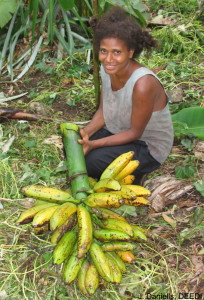 I’m very sad to hear the tragic news that my very good friend Dorothy Tamasia has died. I dont know the hows or whats, only that she was too young. She was the true embodiment of the barefoot curator and lived out her life in very basic conditions with her people in the highlands of central Makira and passionately collected, protected and shared across her island and throughout the Solomon Islands over 108 varieties of bananas that she took part in collecting with Kastom Gaden Association. She was trained in morphological descriptors and management of germplasm collections despite having little formal education. Her work in documenting and maintaining her banana collection led to Solomon Islands being recognised as holding one of the largest remaining and least documented collection of banana diversity in the world – and she was a leading figure in a revival in banana diversity and its cultural connections in Makira through diversity fairs and other events.
Banana is the staple food in Makira. Dorothy was a hero for conservation in use of plant genetic resources and she dedicated much of her too short life to that purpose. She took part in pioneering work to test and promote high vitamin A fei banana varieties. A poster from that work can be seen here and she was part of banana diversity work supported variously by ACIAR, the SPC Centre for Pacific Crops and Trees (CePaCT) and Seed Savers Network.
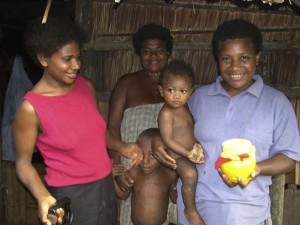 I last saw her in late 2011 after making the 4 hour walk to her village from the coast — which has no roads and is one of the most remote parts of a remote country. She was happy, and had recently started a bush early-childhood pre-school in a leaf house in a remote riverside location where she lived on her own with her children. The room was full of brightly coloured creations from nearby village children who came to her school — and surrounded by her bananas and her cacao farm. She was excited to be studying early childhood education. She was also busy duplicating, on her own, the banana collection she had maintained for almost a decade — back breaking work with no reward other than the custodianship that she treasured. She had a deep grasp of the issues including the controversy around crop genetic resources. She chose to keep above all of it and just continue her humble work that she knew was the right thing and a useful thing to do.
Dorothy was a beautiful person and a kind hearted and generous soul. I hope that in her death her life work and commitment to the Solomon Islands indigenous plant genetic resources and to food security for her people will be acknowledged and that the collections she had maintained will be supported to continue.