 AVRDC has a nice new website. You can subscribe to a couple different newsletters, and also follow the institute on Facebook and Twitter. You can buy a porcelain coffee mug and donate money. And there’s a decent RSS feed at last. The first thing that popped up when I subscribed to it was, almost inevitably, a fact sheet on the baobab. Yet another fact sheet on the baobab. Incidentally, I know I’ve already nibbled this, but also newly online is CABI’s Plantwise Knowledge Bank, an “online resource with information for all involved in plant health.” Where, almost inevitably, you can get information on the baobab.
ICRISAT’s work on crop wild relatives
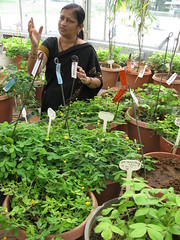
Dr Nalini Mallikarjuna with some amphidiploid peanuts: “Give me time and I’ll give you hybrids.”
The CGIAR reform explained
Frank Rijsberman, CEO of the CGIAR Consortium, gave a seminar at IFPRI yesterday on the topic of the CGIAR reform. You can watch it below, but if you want to see the slides properly, you’ll have to go somewhere else. I wonder if there’s a way to intercut the video with still shots of the slides.
You may be intrigued by the statement that the CGIAR now has “15 (+1) programs.” The details are on the CGIAR Consortium and CGIAR Fund websites, though, confusingly, you get different sorts of details in the two places. Anyway, the research portfolio is perhaps most succinctly summarized here. The 15 things Dr Rijsberman referred to are the so-called CGIAR Research Programs (CRP). The “(+1)” refers to the “Long Term Support of CGIAR Genebanks,” 1 which is somewhat different, being described as a “CRP Research Support Program.” I’m not sure that it’s entirely appropriate to relegate what are often described as the crown jewels of the CGIAR system to a bracketed addendum, but we shouldn’t quibble. It’s certainly very good to see some of the world’s most important genebanks properly taken care of.
Trees of Life: The book of the movie
 Prof. Roger Leakey’s book, Living with the Trees of Life: Towards the Transformation of Tropical Agriculture, the publication of which we trailed way back in January, is now officially out. You can get it from the CABI Bookshop. I know I will. Here’s how Prof. Leakey describes the rationale for the book in the media release:
We need a fresh approach both to food production and the use of natural resources if we are to avoid the emerging food crises expected to impact every country in the world by the middle of this century. We need to rehabilitate degraded land, diversify farming systems and protect watersheds… Few people realize the vast untapped wealth of the genetic variation that is present in trees. The development of tree crops can create local business opportunities and employment. In some cases there is the potential to support a whole range of new industries – this time however, poor people in developing countries must benefit.
Interestingly, Faidherbia albida, a photo of which graces the ICRAF post on the book, seems not to be one of Prof. Leakey’s Trees of Life. 2 Not sure if cashew is, but Kew’s Wolfgang Stuppy certainly seems to have a thing for it.
UK vegetable diversity safe
Readers with a long(ish) memory may remember some uncertainty a couple of years back over the future of the UK’s national collections of vegetable diversity at Wellesbourne. I’m glad to say the genebank is flourishing as part of Warwick University, with funding from Defra. It even has a Twitter feed, over which there is currently in course an interesting discussion of Cornish cauliflowers.