Last week we briefly Nibbled the Seeds for a Sustainable Future conference organised by European Greens and held yesterday. Despite the very short notice, an agrobiodiverse mole tunnelled her way into the proceedings and sent back a report.
Claudia Olazabal, Head of Biodiversity, which comes under the Nature Conservation & Biodiversity Unit at DG ENVI, asked “Is agricultural biodiversity part of the equation?” in her presentation on diversity of genetic resources in the context of international commitments and the EU’s Biodiversity Strategy. During which presentation, she referred to Action 10, that “The Commission and Member States will encourage the uptake of agri-environmental measures to support genetic diversity in agriculture and explore the scope for developing a strategy for the conservation of genetic diversity.”
A questioner managed to ask: Hadn’t the Commission been working on just such a strategy since 1994?
To which Mrs Olabazal extemporized thusly:
“There are lots of different actors in the Commission who work on agricultural genetic diversity – Directorate General for Environment, Directorate General for Agriculture, Directorate General for Research … we need to coordinate … “
Ah yes. A need to coordinate across Europe’s complex network of interests. It wasn’t like that in 1994, when everything was at least under one roof. But then again, maybe that’s why there still isn’t really a strategy for the conservation of genetic diversity …
Alas, I think you’ve missed your chance to tell the EU what you think of its “Options and analysis of possible scenarios for the review of the European Union legislation on the marketing of seed and plant propagating material”.
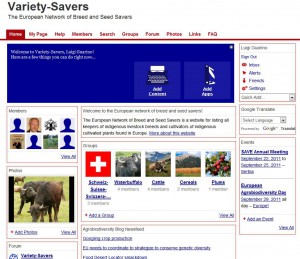 Just off the ground, and only 14 members so far, but this looks like an interesting initiative. Especially if it manages to bring formal-sector genebanks closer together with on-farm conservation practitioners and amateur heirloom enthusiasts. You do have to register, but it’s fairly painless, and the website provides some fancy social networking tools. Very best wishes!
 The report in