Friend-of-the-blog Alex Chepstow-Lusty regales us today with the story behind his latest paper, which has been 30 years in the making. While not specifically about agricultural biodiversity, it does discuss the interplay between biodiversity and agriculture, both now and in the past.
Here’s a good pub quiz question: what is the largest freshwater body in the British Isles? Few people outside of Northern Ireland know that the answer is Lough Neagh, or even seem to have heard of the place. Associated with origin legends to do with a missile-throwing Finn McCool, perhaps more importantly Lough Neagh is responsible for supplying about 40% of Belfast’s the drinking water. It is also home to several endemic fish, a thriving eel fishery (a species critically endangered elsewhere) and a globally-recognised overwintering site for migratory wildfowl. It is also a fantastic recreational resource for the people of Northern Ireland.
Alas, in 2023 Lough Neagh was described as “dying in plain sight” after satellite images posted by the European Space Agency revealed vast blue-green algal blooms from space. The eel fishery is no longer as it was. The wildfowl are greatly diminished.
What has happened?
What happened is that massive amounts of nutrient-rich agricultural runoff and sewage are reaching the many waterways that then flow into the lake. Its shallow, increasingly warmer waters, often accompanied by calm conditions, do not help this ongoing “eutrophication,” or nutrient enrichment.
Neither does the ongoing expansion of the highly invasive zebra mussel, which has caused major economic and environmental issues elsewhere too. This filter-feeding bivalve not only eats the native phytoplankton — thus depriving the larvae of the Lough Neagh fly (actually a midge) their staple, itself a vital component close to the base of the food chain. It has also made the water clearer, allowing sunlight to penetrate deeper and helping the blue-green algae to thrive.
As if all that wasn’t enough, there is also the large-scale extraction of glacial sands from the lake by suction hoses and dredgers to supply the local building industry. This disturbance causes the phosphorus deposited in the lake sediment to be released back into the water, further exacerbating the growth of blue-green algae.
Predictably, there are lots of groups, initiatives and experts out there, some even with money, promising to help us understand the desperate situation better — and maybe even to resolve it. But things do not appear to be improving.
In truth, Lough Neagh has been a dumping ground for nutrients for a long time. Some would even say for centuries, since the last major woodlands in its catchment were cleared in the early 1600s, leaving waterways unprotected and the surrounding landscape vulnerable to erosion.
In fact, this leakage of nutrients in the Lough Neagh catchment, caused by removal of the extensive Atlantic woodland cover that once existed, has been going on for millennia. That’s what we have shown in a recent paper, which actually goes back quite a ways itself.
We hear a lot about the tropical rainforests in South-Central America, West-Central Africa and Southeast Asia, and how their ongoing destruction threatens their enormous biodiversity, their function as carbon sinks and the role they play in regulating the global climate. All true and tragic. But we have a blind spot: the temperate rainforest in our own backyard — the great Atlantic woodland that grew back after the last Ice Age in Europe, particularly here in the British Isles.
Thirty years ago, I analysed the fossil pollen preserved in a sediment core obtained from the deepest part of Lough Neagh to reconstruct the history of the vegetation surrounding the lake. This was on a 6-month post-doc contract for Queens University, Belfast that came out of the blue while I was at the Plant Sciences Department of Cambridge University. I had been using fossil pollen from Peruvian lake sediments to reconstruct the history of Andean agriculture, but no more funding was available, so I jumped at the chance.
I became engrossed in the beauty of the pollen I saw down the microscope, revealing the different herbs, shrubs and dwarf trees colonising the bare soils of the early Holocene after the ice had disappeared in Northern Europe. A predictable sequence of shrubs and trees followed as the soils developed, ultimately leading to the extensive biodiverse oak and elm Atlantic woodlands covering the landscape. I was so fascinated that I worked for another three months unpaid, counting the pollen from the different layers of sediment, representing different ages. I have been thinking about those woodland history patterns ever since and what lessons they can teach us — both pre- and post- major human impact.
By chance, I also counted at the same time the green alga Pediastrum and particles of microcharcoal in each sediment layer. Pediastrum is an indicator of increasing nutrients in the water. As temperatures rose after the last Ice Age and before the trees colonised and stabilized the landscape, it was striking how prone to erosion the open catchment was, as revealed by high Pediastrum abundances.
When the Atlantic woodland arrived, the catchment was more resilient and Pediastrum almost disappeared. Mesolithic hunter-gatherers had little impact on the woodlands. However, with the first farmers settling over 5000 years ago, the landscape became increasingly “leaky” to erosion due to deforestation, and nutrients flowed into Lough Neagh, as shown by growing Pediastrum abundances yet again. This has relevance for today beyond Lough Neagh: large-scale native woodland cover can significantly reduce runoff and buffer against extremes of droughts and floods.
Also, microcharcoal was almost lacking during the time of the great, damp Atlantic woodlands. They did not burn, or not easily. But the mosaic of mostly open landscapes created by humans are much more prone to wildfires. You can tell because the microcharcoal in the lake sediments went up.
I carried these observations around with me over the years, and worked on various drafts of the paper with my friend the great Irish ecologist Julie Fossitt, but never quite finished it off.
However, the clarity — and significance — of the record never let me forget it. The eutrophication crisis in 2023 in Lough Neagh was a real wake-up call, as hardly anyone was mentioning the great Atlantic woodlands that once existed, while trees did not even seem to be getting major billing in the toolkit of nature-based solutions put forward to mitigate the increasingly desperate situation. At least not at scale.
We love preserving our ancient landscapes, but in Ireland these were created by humans following the destruction of the Atlantic woodlands, starting with pastoralists arriving about 6000 years ago, followed by cereal farmers, a thousand years later or so — these being highly efficient at deforestation. They created the emerald isle that we know today.
The question is how we can make use of this knowledge to save Lough Neagh from its eutrophication crisis.
According to the Woodland Trust, Northern Ireland has only 0.04% of its ancient woodland remaining, the lowest in the United Kingdom, and even this has been threatened by the commercial planting of monocultures of exotic Sitka spruce. Once upon a time, in 1998 to be precise, I reviewed a conference book bringing together scientific papers on the climatic crises around 2000 BCE (i.e. 4000 years ago), particularly droughts, that appeared across the world, from the Near East and the Mediterranean, to South America, to West and East Africa, causing famines and societal disruption. Oddly, the British Isles was one of the least impacted areas — but then we still had significant Atlantic woodland cover to buffer climate extremes.
Many huge Mesolithic and Neolithic log boats have been discovered by archaeologists in the area around Lough Neagh. The size of oak trees required to build them can only be found in the primeval forests of Poland these days. Can we not dream about bringing them back to Ireland?
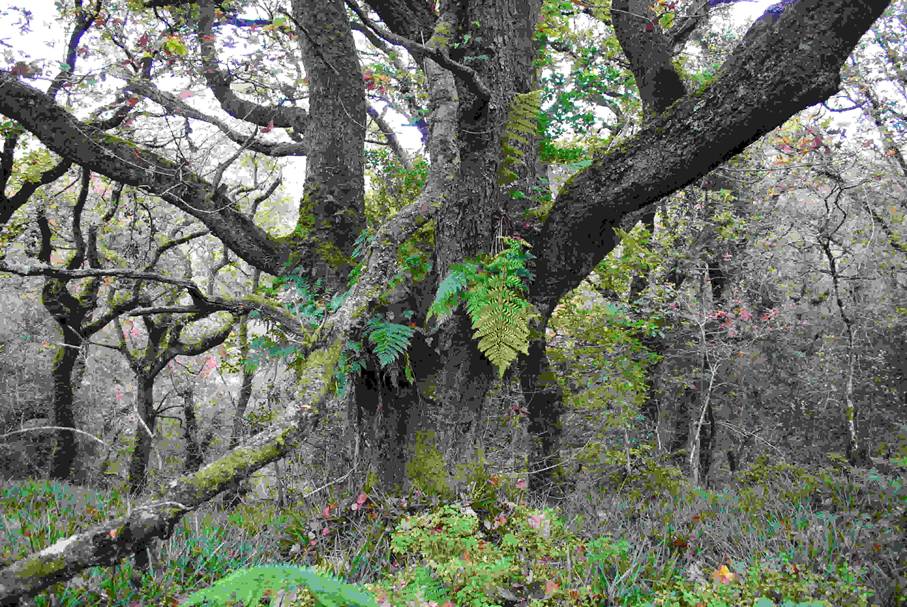
What a vision: to recreate, at least in part, those oak Atlantic woodlands, and all the biodiversity and complex relationships required to support them, and receive in turn the environmental benefits they provide.