- Finger millet is the future in Zimbabwe.
- Conventional down has a problem. I do prefer unconventional down myself.
- They had National Bison Day and nobody told us.
- Epic’s Excellent Svalbard Adventure.
- Start planning for next year’s cucurbit conference.
- Soil salinity sucks.
- On the other hand, this nutrition conference is in only a couple of weeks. And there will be radio.
- Not that these Indonesian ladies will need that.
Fighting the Ebola of maize
Speaking of Denise Costich, she recently visited CIMMYT’s Global Maize Program in Africa and shared this photo — frightening, and yet also hopeful, as she explains below:
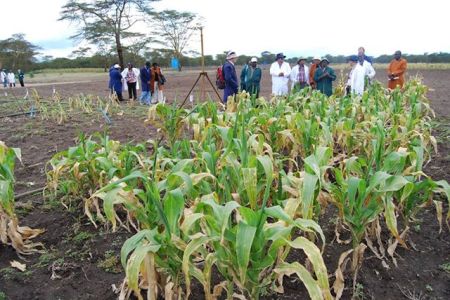
Maize Lethal Necrosis (MLN) is being called the “Ebola of maize” — it is actually a “perfect storm” of two viruses hitting the plants at the same time, carried all over the place by insect vectors… It’s hitting East Africa really hard right now, and CIMMYT scientists are screening as much germplasm as they can, in the search for resistance genes. Here you see an example of a “moderately tolerant” line. To the left of that plot, you can see another line that was completely decimated…
I’m featuring Denise a lot lately to make up for the fact that I forgot to take a photo of her to include in the mosaic of CGIAR genebank managers :)
Brainfood: Enset & cattle, Evolution Canyon, Indian spices, Bohemian fruit rhapsody, ILRI forage genebank, Wild sunflower, Agroecology, Holistic hazelnuts, Culture & conservation, Salty broomcorn, Fancy mapping, German cherries, Ethiopian barley nutrients
- Sidama Agro-Pastoralism and Ethnobiological Classification of its Primary Plant, Enset (Ensete ventricosum). The Sidama feed the high-protein parts of enset to cattle and then get their protein from milk. Seems a roundabout way of going about things but I guess they know best.
- Evolution of wild barley at “Evolution Canyon”: adaptation, speciation, pre-agricultural collection, and barley improvement. One-stop shop for researching evolution of a crop wild relative.
- Spices and Condiments: Status of Genetic Resources and Setting Priorities for Introduction in India. National Bureau of Plant Genetic Resources is on the job, collecting at home and acquiring from genebanks abroad.
- Inventory and conservation of fruit tree landraces as cultural heritage of Bohemian Forest (Czech Republic), indicators for former settlements of ethnic minorities. That would mean Germans. No word on whether the database has been cross-checked with that of BLE-IBV. Interested in the topic of European landraces in general? Try this from Bioversity.
- Forage Diversity: An Essential Resource to Support Forage Development. ILRI’s genebank deconstructed.
- Wild Sunflower Species as a Genetic Resource for Resistance to Sunflower Broomrape (Orobanche cumana Wallr.). Pretty much all the perennial species have resistance, and many of the annuals. Thank goodness for the USDA collection, eh?
- Agroecological Research: Conforming — or Transforming the Dominant Agro-Food Regime? Bit of both? Is that such a bad thing?
- A multidisciplinary approach to enhance the conservation and use of hazelnut Corylus avellana L. genetic resources. Holistic, even.
- The Cooked is the Kept: Factors Shaping the Maintenance of Agro-biodiversity in the Andes. Keep your culture, keep your crop diversity.
- Response of broomcorn millet (Panicum miliaceum L.) genotypes from semi arid regions of China to salt stress. 39 out of a core collection of 195. Result!
- Vital Signs: Integrating Data To Visualize the Human, Agriculture, and Nature Nexus. Sounds promising enough an effort to bring together livelihoods, production and environmental data, but when you go to the website (for Tanzania in this case), all you get is a bunch of admittedly very pretty pdf maps.
- Phenotypic and genotypic characterization in the collection of sour and duke cherries (Prunus cerasus and ×P. ×gondouini) of the Fruit Genebank in Dresden-Pillnitz, Germany. …give different results. If I had a dollar…
- Genome-wide association mapping of zinc and iron concentration in barley landraces from Ethiopia and Eritrea. There are QTLs. Now what?
Searching for Mangalitsa, and more
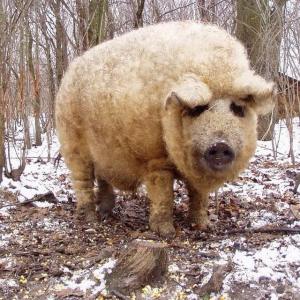 Seeing this magnificent beast on Facebook inspired me to revisit an old post on livestock genetic resources information systems.
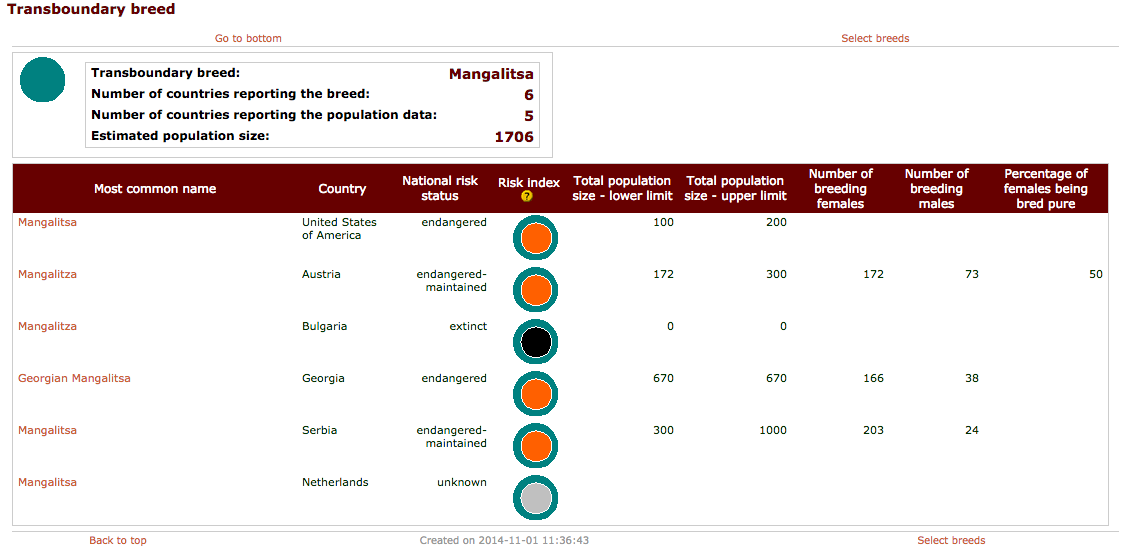
First, DAD-IS. Turns out there’s data from Mangalitsa or Mangalitza from a number of countries, and it’s not all that difficult to find. Here’s the summary from the “Transboudary breed” section.
Then, DAGRIS. Over to the search page, type in the name, 1 and click go:
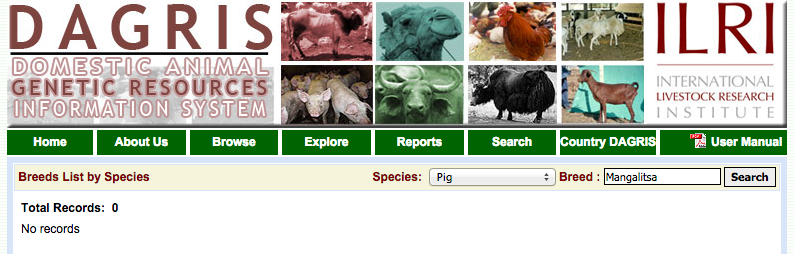
Uhm.
On the other hand…
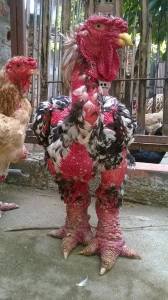 I then looked for this equally fabulous creature, Vietnam’s Ga Dong Tao chicken, also seen on Facebook, on DAD-IS. I got a nice “breed data sheet”, including photos, but I can’t link to it because there’s no permalink. You’ll have to take my word for it, or go and search yourself. And what is provided as the reference for said data sheet? Why, DAGRIS, of course, though if you go there, you don’t get any photos.
I think there’s some way to go yet in sorting out animal genetic resources information systems.
IPCC AR5 in easily digestible bites
#IPCC: global temperature rise >4°C combined with rising food demand would pose large risks to global food security. #Climate2014
— IPCC (@IPCC_CH) November 2, 2014
Yes, the latest IPCC report, the Fifth Assessment Report (AR5), is out, and the news is not great, as the tweet pithily points out. You should probably read the whole thing, but if you prefer diagrams, you can try The Guardian’s, or our own.