- Improving yams at IITA.
- Improving aroids the world over.
- Parallel evolution in the domestication of cereals. Will it help to improve them?
- Foxtail millet helps with switchgrass genome assembly. And, one supposes, improvement.
Mapping nutrition research
The Leverhulme Centre for Integrative Research on Agriculture and Health (www.lcirah.ac.uk) and the University of Aberdeen are embarking on an interesting project for the UK’s Department for International Development.
The objective of the project is to map the growing research activity on agricultural interventions to improve nutrition in low-middle income countries and identify “gaps” in current and anticipated research.
You might like to consider contributing information if you are undertaking or planning research with a
focus on an interaction between agriculture and nutrition, such as agricultural interventions to improve nutrition and their evaluation, the influence of agricultural practices and food value chains on nutrition, governance and policy processes through which agriculture and nutrition are linked, and links between agricultural productivity and/or growth and nutrition at a macro scale etc.
The people to contact are Corinna Hawkes (corinnahawkes “at” o2.co.uk) and/or Rachel Turner (rachel.turner “at” lshtm.ac.uk). It could be your research, or research you know about. Or indeed relevant networks (mailing lists, online fora, communities of practice) you participate in.
No doubt someone will eventually mash up the results with all the clever maps now available on HarvestChoice‘s recently revamped website.
The cutting-edge MAPPR, for example, enables users to pick and choose among hundreds of “layers” of map-based information about all aspects of smallholder agriculture in Africa—from poverty to rainfall—and make customized maps and summary tables.
But more on that tomorrow. Stay tuned…
LATER: It occurs to the blogger, belatedly, that “to map” has more than one meaning. Ooops.
Brainfood: Bee diversity, Fodder innovation, African agrobiodiversity, Quinoa economy, Fragmentation and diversity, Rice in Madagascar, Rice in Thailand
- Management increases genetic diversity of honey bees via admixture. No domestication bottleneck there!
- Enhancing innovation in livestock value chains through networks: Lessons from fodder innovation case studies in developing countries. Fodder innovators of the world, organize. If you don’t, you will lose your value chains.
- Introduction to special issue on agricultural biodiversity, ecosystems and environment linkages in Africa. Special issues? What special issue?
- The construction of an alternative quinoa economy: balancing solidarity, household needs, and profit in San Agustín, Bolivia. Despite the allure of fancy denominations of origin and the like, old-fashioned cooperatives, and the much-maligned intermediary, manage to hang on in there.
- Species–genetic diversity correlations in habitat fragmentation can be biased by small sample sizes. Can.
- The original features of rice (Oryza sativa L.) genetic diversity and the importance of within-variety diversity in the highlands of Madagascar build a strong case for in situ conservation. Actually the way I read it, the stronger case is for ex situ. But see what you think.
- Population structure of the primary gene pool of Oryza sativa in Thailand. In situ Strikes Back.
Nibbles: Quinoa, Chilean landraces, Planetary sculptors, Offal, Eels, Grand Challenges in Global Health, ILRI strategy, Artemisia, Monticello, Greek food, Barley, Rain
- The commodisation of quinoa: the good and the bad. Ah, that pesky Law of Unintended Consequences, why can we not just repeal it?
- No doubt there are some varieties of quinoa in Chile’s new catalog of traditional seeds. Yep, there are!
- Well, such a catalog is all well and good, but “[o]ne of the greatest databases ever created is the collection of massively diverse food genomes that have domesticated us around the world. This collection represents generation after generation of open source biohacking by hobbyists, farmers and more recently proprietary biohacking by agronomists and biologists.”
- What’s the genome of a spleen sandwich, I wonder?
- And this “marine snow” food for eels sounds like biohacking to me, in spades.
- But I think this is more what they had in mind. Grand Challenges in Global Health has awarded Explorations Grants, and some of them are in agriculture.
- Wanna help ILRI with its biohacking? Well go on then.
- Digging up ancient Chinese malarial biohacking.
- Digging up Thomas Jefferson’s garden. Remember Pawnee corn? I suppose it’s all organic?
- The Mediterranean diet used to be based on the acorn. Well I’m glad we biohacked away from that.
- How barley copes with extreme day length at high latitudes. Here comes the freaky biohacking science.
- Why working out what is the world’s rainiest place is not as easy as it sounds. But now that we know, surely there’s some biohacking to be done with the crops there?
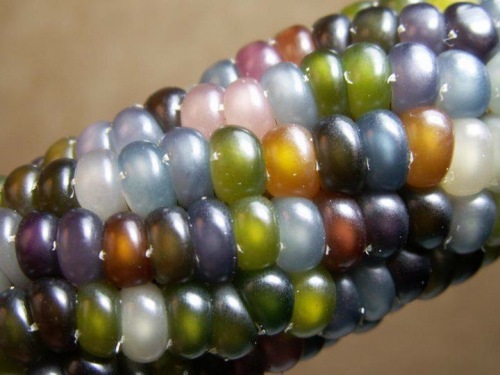
Glass gem corn goes viral
This image of ‘Glass Gem’ corn has sort of exploded on Milkwood Permaculture’s Facebook page, with over 3,000 “likes” and 10,000 “shares.” I just hope there’s enough seed out there.