
Including agricultural biodiversity!
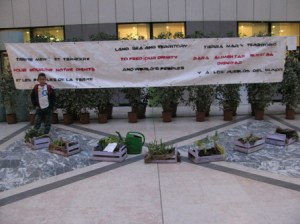
Orto Errante at FAO

ICRAF DG shakes up the landscape
“But how do we communicate an approach that has no common language?” asked Tony Simons, Director General of the World Agroforestry Centre. He literally threw this question on the audience by tossing into the air a set of 74 note-cards containing different terms used to describe integrated landscape management. “These words are neither comprehensive nor coherent.”
So many times I’ve wanted to do that with those little note-cards people make you write on during workshops… Follow the fun of the Landscapes for People, Food and Nature International Forum on Twitter.
Nibbles: Eyzaguirre speaks, Hunger, India in Africa, Aquaculture, Mutation breeding, Climate info, Micronutrients, Peanuts, Crops from space, CIMMYT in Africa, Cassava beer, Heirloom onion, Coffee research, Newton’s apple, Gastronomica
- An anthropologists speaks about landscapes.
- ILRI says: “Landscapes, I’ve got your landscapes right here.”
- India makes its play for African agricultural landscapes. I hope there will be scorecards and women. And access to Indian genebank holdings…
- Will there be fish though?
- And will India be pushing its mutation-bred varieties in Africa? Not that there’s anything wrong with them.
- Or using climate information?
- Or mining technology for that matter.
- Surely there will be dual-purpose groundnuts.
- Doesn’t India have a satellite?
Meanwhile, CIMMYT is making its own African play. Maybe some of the stuff it is doing there could be useful in India too?Two dead linksAfrica could teach India some other stuff too.Dead link.- Pretty sure this nearly-extinct-onion-rescued story is totally irrelevant to both India and Africa.
- Unlike coffee research.
- I don’t suppose I can interest anyone in a not very nice tasting, disease-prone but historical apple?
- And speaking of historical connections… Well that was quite a journey.
Featured: EU seed law
Isabel is not optimistic about EU seed law:
Since it was sued by some big seed companies, Kokopelli, and other similar organizations, are embarked in an admirable crusade to open up the EU seed market to non registered varieties, particularly traditional ones, coming from EU countries but also abroad. They are certainly making their voices heard, but I am afraid they will need more than that to actually influence EU bodies.
Worth a try, though, I guess.