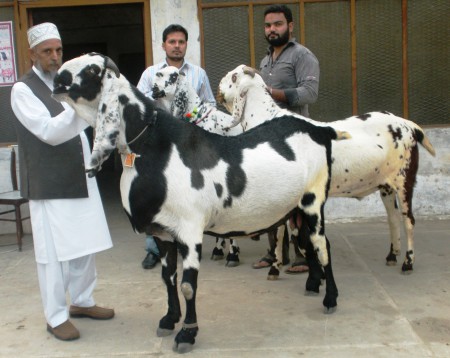
I KNOW you wanted another photo of that prize-winning Pakistani goat.
Agricultural Biodiversity Weblog
Agrobiodiversity is crops, livestock, foodways, microbes, pollinators, wild relatives …
I KNOW you wanted another photo of that prize-winning Pakistani goat.
Don’t forget the open Mendeley group for the papers we link to here.
The best thing about blogs is that they allow an immediate reaction. The worst thing about blogs is that, well, they allow an immediate reaction. So it kind of behooves the blogger to highlight the times when more considered reflection might have been appropriate. There have been two such times recently. So let me set the record straight.
First, those pesky cucumbers. It has been pointed out to me that resistance to Cucumber Green Mottle Mosaic Virus (CGMMV) has not in fact yet been found, contrary to what I suggested in my post of a couple of days back. I misinterpreted the results of the evaluation data made available on the CGN website, because I don’t know enough about the subject. So no finder’s fee for me, alas. But on the plus side, I did learn a lot about cucumbers. And also that if you’re going to look for data on cucumbers, it helps to know something about cucumbers.
Second, that SE Asia regional seed bank stuff. There I was guilty of jumping to a conclusion. There were clues in the original article, and also in the official documents I dug up, that should have warned me that we were talking here about a repository of relatively large quantities of high-quality seed of new, modern varieties, not smallish samples of traditional landraces. And indeed I was suspicious, and sent out feelers to various people who I felt sure would know more. Sure, the documents were ambiguous, but if I had just waited until the experts’ replies were in, I could have simply clarified the situation, rather than accusing the South Asian Association for Regional Cooperation of ignoring their national genebanks and the international collections at their disposal in their rush to establish an arguably unnecessary regional structure. So apologies to them. And thanks for teaching me that a seed bank is not always the same as a genebank.
Ok, but of course none of this means that I won’t shoot from the hip again in future. It’s probably way too late for me to learn that lesson.
 Rachel Laudan does a nice job in her latest post of balancing the rather silly Wall Street Journal article of a couple of days ago which suggested that breadfruit, an important staple in the Pacific for hundreds of years, is “inedible.” Read the comments to that article too. Full disclosure: I like the stuff.