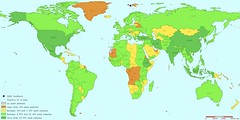
…by country of origin, on its third birthday.
Quality standards for in situ agrobiodiversity conservation published
This just in from Dr Jose Iriondo of the Depto. Biologia y Geologia, Universidad Rey Juan Carlos, Madrid, Spain. Do provide your input if you can.
One of the deliverables of the AEGRO project (AGRI GENRES 057), 1 funded by the European Commission, DG AGRI within the framework of Council Regulation 870/2004, is the formulation of quality standards for genetic reserve conservation of crop wild relatives (CWR). The quality standards are a guide containing a set of criteria for the establishment of genetic reserves within existing protected areas and a set of management standards to optimise the efficacy of genetic reserves as a tool for the conservation of CWR.
The current version of these quality standards is available. We are interested in knowing you opinion. Please send us your comments and suggestions. We would appreciate it if you would also disseminate this email to members of the Crop Wild Relatives community and Protected Areas community in your country for additional feedback.
Nibbles: Plant Cuttings, Truffles, Diseases, Vegetables, Capsicum, Calestous Juma
- Nigel Chaffey’s roundup of botanical news is out.
- Learn how to grow truffles. For Canadians.
- ILRI policy brief on how agriculture and human health are connected. Bottom line: it’s complicated.
- AVRDC introduces you to Mali’s Magnificent Cube.
- Biofortified on pepper breeding.
- Calestous Juma in the New Agriculturist on why he’s optimistic about African agriculture.
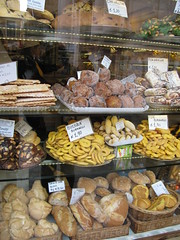
Venetian pastries on display
Papaya protected from virus by wild relative
Papaya ringspot virus is the major limiting factor to production of pawpaws in many countries. There is a GM “solution”, but there’s now news that after 50 years of trying researchers have transferred resistance by conventional breeding from a wild relative, Vasconcellea quercifolia. I ran this by a colleague who’s an expert on papaya taxonomy, genetics and breeding and he had this to say:
I am very happy that they seem to have succeeded in their long and difficult work. And this is excellent news for all developing world papaya growers. GM was not the right solution because each virus strain implied a costly transformation (including patent rights), and the virus is highly variable.