- Designing the next generation of community-based natural resource management projects. No agriculture. Weird. Well, not so much actually.
- Extension systems have a website! Yeah but do they need one?
- Informal seed system working just fine in Indian Himalayas. So maybe the extension system is not needed? But, hey, they have a website, did I mention that?
- Climate Change and Crop Production: The Book. And: The Conference. No but wait, here’s another.
- The unusual crop that is cassava.Yeah, but in The Economist?
- ” …among the largest collections of endophytes…” Not a lot of people know that.
- Old Irish goats (and others, to be fair) meet to talk about, well, Old Irish goats.
- The great Plant Cuttings.
- How to design an ethnobotanical garden. Would coca find a place?
- Musings on the evolution of weeds.
Saying goodbye to a maverick
The distinguished agricultural journalist Tom Hargrove died a few days ago. A contributor to a closed mailing list noted that he had made “a stellar scientific contribution to the CGIAR” in particular, though his renown went far beyond that. Very true. All the more so as he was one of the first to question the wisdom “of growing genetically uniform varieties over millions of hectares…from within the ‘lions den’ where the dogma was gospel.” Perhaps his greatest legacy is that the dogma is not as entrenched as it was.
Getting curators to think like breeders
The presentation on genomics and fruit genebanks Cameron Peace gave at the recent PAG symposium deserved more than the nibble we gave it. Dr Peace, who is an assistant professor in tree fruit genetics at Washington State University, is advocating nothing less than a complete change in the mindset of genebank curators. Here’s how he characterizes the current system:
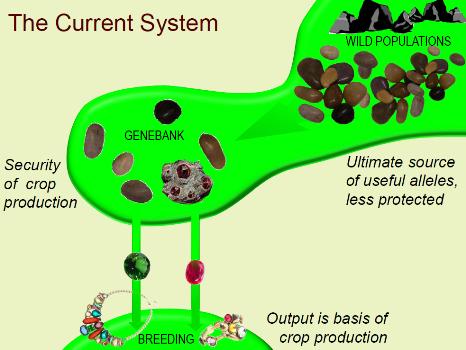
Notice the mere trickle of material from the genebank to the user. All too true. I would say that there is also much less movement of material from wild populations to genebanks than is suggested by the diagram. But that’s at least partially down to the fundamental fact that flow of material to breeders is fairly limited. No demand, no supply. This, in contrast, is what Dr Peace wants to see:
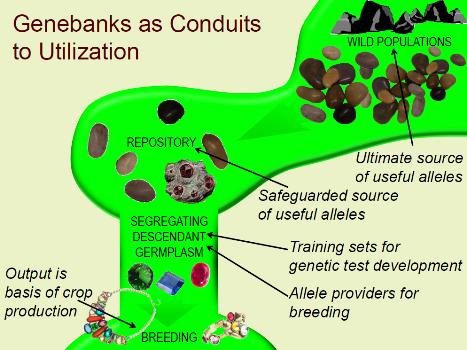
He wants genebanks to get their skates on and, to mix a metaphor, not wait for the breeders to pull. He wants them to push. He wants them to provide performance information, and not just data on morphological descriptors; performance-predictive DNA information, and not just genetic diversity data; segregating descendant populations, and not just landraces or wild populations.
In essence, Dr Peace wants genebank curators to think like breeders. More, he wants them to be breeders. Or at least pre-breeders.
There’s much to be said for this. The latest State of the World’s Plant Genetic Resources for Food and Agriculture (SOW2) bemoans the continuing obstacles to use of collections. Something Must Be Done, it suggests. But curators have their hands full. The same SOW2 says that they have no money. That they need more equipment. That they have regeneration backlogs. That people are telling them to conserve more neglected and underutilized plants, and more crop wild relatives. That’s when armed gangs of looters are not ransacking their facilities. Now they should be plant breeders as well? Sheesh!
Well, the fact is that with the International Treaty on PGRFA, most curators don’t have to worry about basic conservation. Not really. Not for Annex 1 crops anyway. They can choose to outsource that stuff, for example to the international centres of the CGIAR, secure in the knowledge that they can have access to the material whenever they want it.
With the ITPGRFA, curators have the space to think like breeders. But do they have the training? And will the breeders return the compliment, and think a bit like curators?
Egyptian genebank looted
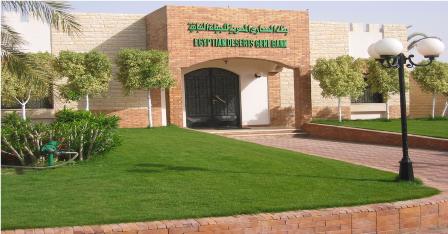
I suppose it’s only a small blip in the great scheme of things, but you know what they say: to a hammer everything is a nail. And to a genebank guy everything that happens affects genebanks. In this case, the Egyptian Deserts Gene Bank at Sheikh Zowaid Station in North Sinai, which we are told has been trashed during the current turmoil in Egypt. 1 It specializes in desert plants, and has wide international partnerships, including with the Millennium Seed Bank at Kew and the Genetic Resources Policy Initiative. The manager had to abandon the place when its security detail disappeared and an armed gang warned him that they would be coming in the night. Which they indeed did, to devastating effect, getting away with lots of equipment and wrecking the cooling system. The collection is not duplicated in the national genebank in Giza, which apparently has not suffered similar looting. 2 The genebank manager called a few people in Cairo before having to abandon the place, including our informant, so the problem is known to the national agricultural research authorities, but there’s nothing anyone can do at the moment, clearly.
LATER: Nourishing the Planet weighs in with a nice article.
Hot sauce, madam?
They do have a knack for marketing agrobiodiversity in Texas. Thanks, Kem.