- More on that thing about how the Amazon was once pullulating with people. And why.
- Why conserve livestock genetic resources. And one possible way to do it.
- The American people are bringing back the American chestnut.
- COP-watchers, something to amuse yourselves with if things get dull.
- Even Neanderthals understood the benefits of a diverse diet. Though not, perhaps, of jewellery.
Coconut conservation dilemma de-horned
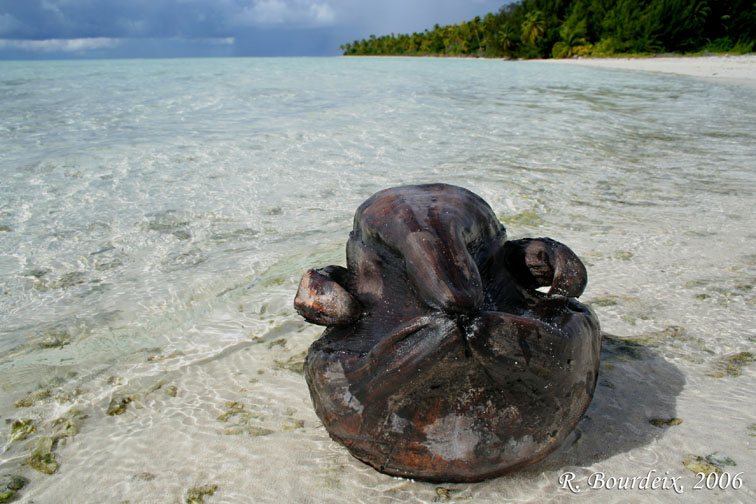 Remember the Polymotu Project, that intriguing new approach to conserving coconut genetic resources? Well, it is making progress, at least with the so-called “horned coconut.” Read all about it on Roland Bourdeix’s blog.
Share Fair set fair to share
The “AgKnowledge Africa Share Fair” is off and running at the International Livestock Research Institute (ILRI) in Addis Ababa, and will continue until 21 October. You can follow proceedings in all sorts of web 2.0 ways, detailed on the blog. There’s no specific “learning pathway” on agrobiodiversity, but that’s ok, there’s still plenty of interest to us here. Including a “food fair” which will focus on “sharing the indigenous/local content embedded in African food.” Wish I was there for that!
Nibbles: Milk-drinking, Diversity and stability, Indian sheep, Development of the African savannah, Teaching rice, Silk, Diverse diet, Huge phallic inflorescences
- Der Spiegel does its usual impressive number, this time on the Völkerwanderung. Via.
- Diversity and stability in grasslands. Yes, there’s a connection.
- Sheep breeds in India deconstructed.
- The future of the Guinea savannah. Probably not that great.
- IRRI teaches Singaporean cityslickers to grow rice.
- Silk beginning to fade where it was born.
- The diverse benefits of an agrobiodiverse diet. Should someone tell rich Indians?
- Tales of two giant inflorescences. What are the odds?
Nibbles: Abalone, Yak, Forests, Mountain plants, Yams, Ulmus, Apple, Banana
- We now know how to harvest abalone sustainably. Is there anything we cannot do?
- Wild yaks get assessed. Wait, there are wild yaks?
- “…forests played a central role in the rise of the modern state.” Not as flaky as it sounds.
- Andean plants at risk from, well, everything.
- Yams in Nigeria, from festivals to in vitro.
- London’s elms.
- “[L]ike biting into a perfume bottle, but without shards of glass piercing your tongue.” A knobbed russet.
- Banana evolution just got more complicated.