Attentive readers of this blog will recall an interesting experiment run by Richard Lankau of UC Davis and others a couple of years back which looked at how genetic diversity can help maintain species diversity in a model ecosystem. There’s now a new paper out by Dr Lankau which investigates in more detail the mechanism behind this. 1
Let’s recap. In the earlier paper, researchers…
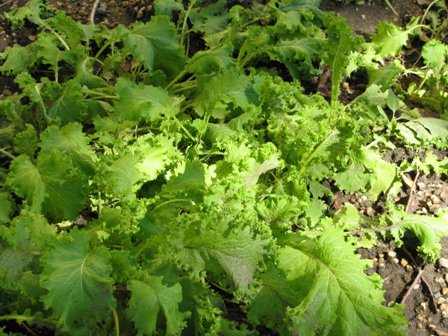
…grew monocultures of two genetic variants of an annual plant called black mustard [Brassica nigra], and also a mixture of three species. One of the black mustard varieties produced high levels of a compound called sinigrin, which is toxic to other plants and to beneficial soil micro-organisms, the other produced low levels. The researchers then introduced a “foreign” individual into each of these experimental communities: a low sinigrin plant into the high sinigrin monoculture and the mixture, a high sinigrin plant into the low sinigrin monoculture and the mixture, and a plant of a different species into the monocultures and the mixture. Which would survive? It turned out that the high sinigrin invader only survived in the mixture, while the low sinigrin variety only survived in the high sinigrin monoculture. No one variety was always best, which meant that each could survive somewhere. Remove any one element, whether variety or species, and the system became dominated by a single thing.
In the latest study, Lankau et al.
performed several experiments to determine whether different B. nigra genotypes and their heterospecific competitors cultivated different soil communities, and, in turn, if differences in these communities mediated some or all of the competitive interactions seen in previous field studies.
The answers were: yes, and some. Yes, indeed, the composition of the soil microbial community (bacteria, fungi, arbuscular mychorrizal fungi) was indeed quite different under the different plant communities. But this did not affect the ability of the different mustard genotypes to invade mustard monocultures, for example. In contrast, however, the fact that high sinigrin mustard genotypes competed strongly in heterospecific mixtures was probably due to changes in the soil biota.
The main conclusion of the earlier study was:
Preventing the erosion of genetic diversity within species may require maintaining a diversity of species in a community. At the same time, we may need to focus on protecting high levels of genetic diversity within species in order to maintain diverse communities of species.
We can now add that soil biodiversity can play an important role in maintaining both genetic and species diversity in plant communities by mediating competitive interactions. I’m looking forward to the next installment of this saga.