Fairtrade is all well and good, 1 but African agriculture needs roads too.
Nibbles: GIPB, NPGS, Dogs for conservation, Harare gardens, Goat milk value added, Equator Prize, Humanitarian relief, Peruvian maize, Pseudo-cereals, Katine, Vavilov goes web 2.0, Travel, Haggis ban, African road datasets, Dyes, Adaptation pix, Baltic, AnGR, Jatropha
- GIPB revamps its website. Knowledge Resource Centre is ver. 4.0, no less.
- US National Plant Germplasm System explained to Canadians. Why? They have their own!
- Armadillo sniffing dogs.
- More urban farming in Zimbabwe.
- Interesting stuff you can make with goat milk.
- Who do you like for Equator Prize 2010? Avatar? No, wait, that’s something else. Well, actually…
- Nutrition for humanitarian workers.
- Large-eared white maize is ‘cultural heritage’ of Peru. So that’s all good then.
- Minor cereals and a gluten-free diet.
- Wanna talk to Katine? Ask about what the project is doing with/about agrobiodiversity, of course!
- Nikolay tweets!
- Agricultural and other assorted musings along the Mekong. Can’t help thinking that if you somehow aggregated all similar observations and geo-referenced them you’d come up with a pretty interesting picture of agriculture worldwide.
- A blow for Scottish agrobiodiversity and cuisine.
- Digitizing Africa’s roads.
- Natural dyes 101.
- IUCN photos of climate change adaptation. Includes agriculture! Well, sort of.
- Nordic agricultural scientists to discuss climate change adaptation. Grow bananas?
- Breeding Strategies for Sustainable Management of Animal Genetic Resources from FAO. Via.
- ATREE questions Jatropha.
Conservation International publishes Food Security Strategy
Conservation International’s blog has a post on the problems faced by pollinators. A nice enough summary, but what struck me was the mention of CI’s new Food Security Strategy.
As a part of CI’s new Food Security Strategy, CI recognizes the critical role that native pollinators play in food production. The conservation and promotion of native pollinators is an excellent demonstration of where synergies between food security and healthy ecosystems can occur.
You can find more about it on another blog post. Will it be another agriculture-is-the-enemy diatribe? Maybe not. Something else for the to-read list.
More agrobiodiversity Web 2.0 stuff
Following that piece a few days back about how social networking can help taro breeding, I posted a note on GIPB‘s Plant Breeding Forum in a thread about the usefulness or otherwise of producing a directory of plant breeders. I suggested that rather than a conventional directory some kind of social network might be called for. After a certain amount of toing and froing it emerged that there is in fact a Plant Breeding and Genetics Network on Linkedin. It was set up by David Feldman of Monsanto last year. Interesting enough, but what I was really thinking of was something more specifically focused on exchanging information on germplasm, rather than on breeders, as a way to move beyond germplasm databases 2. Any examples of that out there?
Photographs of Old Hawaii and its taros see light of day
John Cho — he of the leaf blight-tolerant hybrids — has just posted some wonderful archive photographs of old Hawaiian taro culture to his Facebook page. He kindly agreed to us featuring one of them.
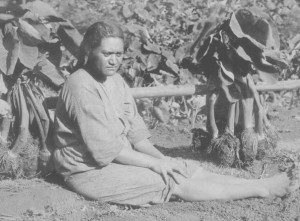
Here’s the backstory.
The images are from photographs archived in the State Archives that I selected and had them scanned by a third party. Sure would have been nice and less costly if the Archives digitized all the images that they have and allow the public to download them. But that is not the case and I had to hire a professional photographer contracted by the Archives to photograph then scan black and white negative images of taro photos that I had selected from the collection. I had planned to eventually put together a taro publication summarizing taro production and culture in Old Hawaii but have not quite gotten off the ground as yet. I decided to at least share some of the images on Facebook for the public to see and hopefully some day I would get off my duff and put the publication together. I also have several scans of taro culture from the Bishop Museum but require their permission to post their images on Facebook.