6. ACKNOWLEDGES that agrobiodiversity is an important element of biodiversity with significant potential for improving global food security and for climate change mitigation and adaptation, INVITES Member States and the Commission to promote research and capacity development for the sustainable use of agrobiodiversity and ENCOURAGES Member States and the Commission to implement and further strengthen the ITPGRFA;
News from the Pacific
Our friend at the Island Food Community of Pohnpei, Dr Lois Englberger, sends us news that her wonderfully agrobiodiversity-friendly NGO is now on Facebook. Go on and become a fan. Lois also points us to a great series of photographs on local foods by Anna Herforth, a PhD student at Cornell University: “Her thesis work examines the nutritional benefits gained through traditional African vegetables in the diets of certain Tanzanians and Kenyans.” Speaking of photographs of agricultural biodiversity…
Banana improvement at IITA explained
IITA has uploaded to youtube a longish interview with renowned banana expert Prof. Ivan Buddenhagen of UC Davis. Lots of fascinating insights, both technical and historical. What for me was the money quote comes at the beginning of the second installment (of five). Asked about what direction banana improvement should take at IITA, he says: “The first thing is to get more germplasm.” Thanks to Jacob for the tip.
How fast will this climate change be anyway?
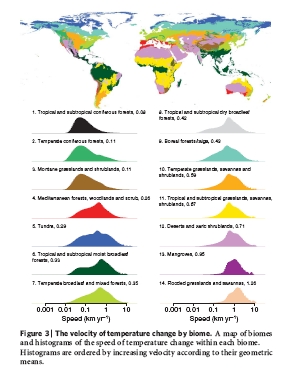
 Well, in terms of distance along the Earth’s surface, about 400 m per year on average, ranging from 80 m per year in mountainous regions to 1.26 km per year in deserts. That’s according to a new paper in Nature by Loarie et al. 1 Compare that with figures of postglacial migration rates of <100 m per year for some trees. Here’s a map of the speed of temperature change by biome from the Nature paper (click to enlarge).
And here’s the “persistence time” for protected areas in different biomes, i.e. the diameter of protected areas divided by the climate velocity.
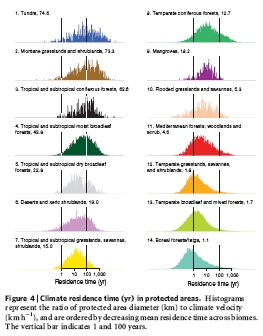
The persistence time — which is how long it takes for the current climate to cross a protected area — exceeds 100 years for only about 8% of protected areas. And that, dear reader, is why we need protected areas that are larger and more connected. Oh, and genebanks.
Indigenous vs exotic trees in Kenya
I promised to reveal a silver lining to the black cloud of my mother-in-law’s forced felling of part of the eucalypt plantation she’s been tending and coppicing forever, her main source of firewood, so here goes. The sight of the newly bare patch of land made her start looking around for a source of seedlings for replanting, and a coincidental visit by some old friends of mine got her thinking that maybe she should go indigenous. At least partly, anyway. Eucalypts are too fast-growing to give up altogether. Her visitors were Lex Thomson and Randy Thaman, who I worked with in the Pacific, and were in Kenya for the International Agroforestry Congress. They noticed a few Prunus africana trees around her place, and told her about its potential. Lex has since left a comment about this on an earlier blog post of mine.
Anyway, after some searching around, Hilda (for that is her name) came across Mr Douglas Ndirangu Kirichu’s nursery at a place called Lari Forest Station in Uplands Division, a short drive along a passable dirt road from her farm. Mr Kirichu runs the Kimotu Environmental Group. He has about a hundred people who collect seeds from the surrounding forest, which he then raises to seedlings and sells, for KSh 30 each (that’s about USD 0.50). Apparently there’s a law that a community can only graze their animals in the forest if they also have a nursery raising indigenous tree seedlings for replanting. So that’s what Mr Kirichu’s group does. To the tune of about 30,000 seedlings when we visited him. 2
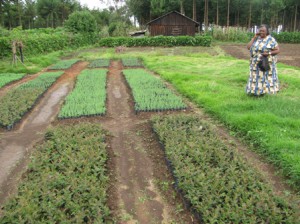
In addition to Prunus africana (mueri in Kikuyu), Mr Kirichu (that’s him on the left in the picture below) also has muna (Aningeria), mutamayo (Olea), mukoe (Dombeya), pondo and mukima (not sure what these are — maybe someone out there can help me?).
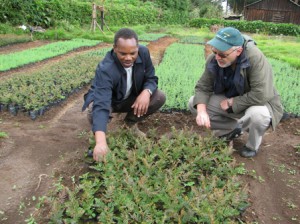
So we bought a couple of each, of course. And Hilda got a dozen mueri to start off her plantation.
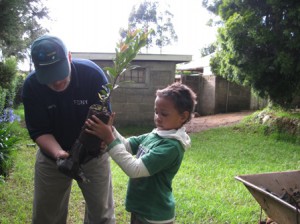
And we planted them both up at the farm (thanks, GK!) and down in Nairobi. Maybe that made the holiday carbon neutral?