- Conservation genetics papers from Latin America, courtesy of special issue of the Journal of Heredity. No ag, but no problem.
- African aquaculture takes off. Or perhaps rises to the surface would be more appropriate.
- Expert parses what experts said “sustainable intensification” means.
- Leafy greens and wine good for oldies. Good to know.
- Student Organic Seed Symposium to discuss “Growing the Organic Seed Spectrum: A Community Approach” in a few days’ time.
- How to tweet. At scientific conferences, that is.
- Maguey genebank in the offing. Well worth tweeting about.
- Arusha Protocol on the Protection of New Plant Varieties (Plant Breeders’ Rights) adopted. Basically UPOV 1999 for Africa. But I suspect the polemics are only just starting.
Frozen fruits
A recent Nibble describing work in South Dakota to extend ever northward the range of the grape, including using wild relatives to breed new cold-tolerant varieties, brought back childhood memories for one of our readers:
Hansen was a proponent of stretching agriculture for the harsh northern environments. My grandparents lived in northern South Dakota and hence Hansen was one of the horticultural heroes from my childhood.
Hansen is — or was — Dr Niels Hansen, “South Dakota’s Great Plant Pioneer.” He sounds a fascinating character:
Already in his senior year as an undergraduate in 1887, N.E. Hansen was writing to his father, “There is both money and honor to be gained by someone who succeeds in bringing out fruits, better than old ones.” The money seemed to elude Hansen, though – he never got wealthy from his work as a plant breeder. But he did win honor, and he cultivated it carefully.
As chance would have it, there was another article on a northern fruit yesterday, this time the blueberry. That also has a long history of breeding in the Great Plains, though it all really started in New Jersey, of all places, as the article describes. Perhaps not surprisingly, though, the blueberry has expanded more southwards than northwards recently.
No word on whether macadamia is next for the cold treatment.
Agrobiodiversity illustrated then and now
There really is nothing like photos of agricultural biodiversity to set the pulse racing. Well, at least in our weird little corner of cyberspace. It’s been crazy over on Twitter and Facebook, what with frenzied sharing of, and commenting on, a couple of stories about, of all things, watermelons. Well, it is summer, I guess: they don’t call it the silly season for nothing.
To recap for those who do not follow us on other media, 1 people seem to have really been impressed by the photos which accompanied a story on the sequencing of the watermelon genome. Although it dates back to three years ago, for some reason it resurfaced again last week.
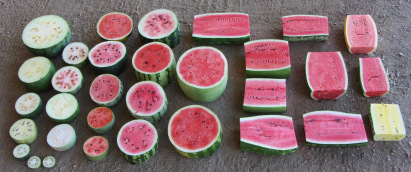
It may well have been resurrected because of a Vox.com story on how James Nienhuis, a horticulture professor at the University of Wisconsin, is using Renaissance paintings of watermelons and other produce to illustrate the changes that have been wrought by modern plant breeding. The story was later taken up by others, and bounced around a lot. And all long before National Watermelon Day. And also before the AoB post on watermelon origins.

Well, let me add to the hysteria. Courtesy of my friend Dr Yawooz Adham, here’s another fantastic agrobiodiversity photo, of tomatoes this time.
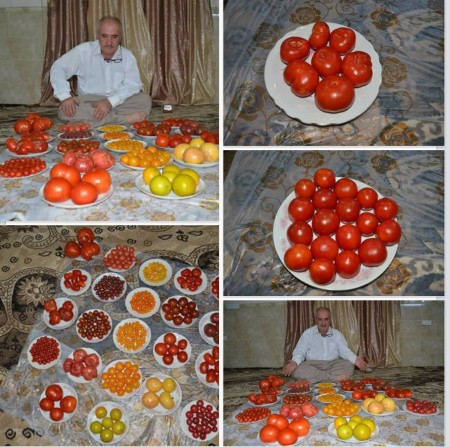
The farmer’s name is Shiek Jamally Karbanchi 2 and he lives in a village near the town of Chamchamal, between Kirkuk and Sulaymaniyah in Iraqi Kurdistan. He tends 22 different tomato varieties, and is clearly incredibly proud of them. Though I’m pretty sure he doesn’t charge Euros 20 each for them. I don’t know if they’re all commercial varieties or whether there’s a few local heirlooms in there, but either way it’s damn impressive.
Nibbles: Summer holidays, Tajik bread, Farm to pizza, Västerbottensost, Diverse bananas, Banana wine, Chinese agroforestry, Peak coffee, Responsible oil palm, Model chickens, Damn you NS
- Ah, summer and its funny medieval holidays.
- Making bread in Tajikistan.
- Making pizza in Sussex.
- Making cheese in (one village in) Sweden.
- Diversifying bananas in Queensland.
- Diversifying banana products in Kenya.
- Diversifying with trees in China.
- Better diversify coffee.
- I see your responsible soy and raise you responsible oil palm.
- Cocks of the walk.
- I’m so annoyed the New Scientist article on breeding less bitter veggies is behind a paywall that I won’t even link to it. Google it, if you must.
Brainfood: Vavilov then & now & always, Helmeted fowl diversity, MLND resistance, Sorghum diversity, Facilitation, Rice yields, Biodiversity services, Wild tomato diversity, Date diversity
- In the Footsteps of Vavilov: Plant Diversity Then and Now. The Pamiri Highlands of Tajikistan, the Ethiopian Highlands, and the Colorado Plateau of Southwestern North America compared at time of Vavilov and now: “Localities that have retained diversity have suffered the least.”
- Vavilovian Centers of Plant Diversity: Implications and Impacts. “His concept of specific centers of origin for crop plants was not an isolated aphorism but has directed breeders, on their study and reflection, to the continued improvement and economic development of plants for humanity.”
- Mitochondrial DNA variation of Nigerian domestic helmeted guinea fowl. Recent domestication, and lots of intermixing mean not much diversity, and what there is doesn’t have structure.
- Genome-wide association and genomic prediction of resistance to maize lethal necrosis disease in tropical maize germplasm. That’s when two viruses attack synergistically. Resistance is from multiple loci with smallish effects, and there are some promising markers.
- Genome-environment associations in sorghum landraces predict adaptive traits. Genotype predicts drought tolerance.
- Facilitation and sustainable agriculture: a mechanistic approach to reconciling crop production and conservation. Understanding facilitative plant–plant interactions (intercropping, varietal mixtures) in crops leads to more sustainable farming practices. Or it could.
- The relative contribution of climate and cultivar renewal to shaping rice yields in China since 1981. Mainly new varieties. Climate change has actually helped, but for how long?
- Biodiversity inhibits parasites: Broad evidence for the dilution effect. Meta-analysis shows biodiversity decreases parasitism and herbivory.
- Using genomic repeats for phylogenomics: a case study in wild tomatoes (Solanum section Lycopersicon: Solanaceae). Data that are usually thrown away turn out to be useful for something after all.
- Genetic structure of the date palm (Phoenix dactylifera) in the Old World reveals a strong differentiation between eastern and western populations. Asian and African genepools, with geneflow E to W.