Here’s a half hour podcast on genebanks, which says some slightly strange things but is reasonably accurate overall.
It wasn’t entirely clear to me, but it sounded at the end as if they will be discussing policy issues on the next episode.
Agricultural Biodiversity Weblog
Agrobiodiversity is crops, livestock, foodways, microbes, pollinators, wild relatives …
Here’s a half hour podcast on genebanks, which says some slightly strange things but is reasonably accurate overall.
It wasn’t entirely clear to me, but it sounded at the end as if they will be discussing policy issues on the next episode.
Our friend Nik Tyack explains his paper Social Valuation of Genebank Activities: Assessing Public Demand for Genetic Resource Conservation in the Czech Republic. I think we included it in Brainfood recently, with the usual pithy summary, but it’s always nice to get it at greater length, and from the horse’s mouth to boot. Thanks, Nik.
Most attempts to put a value on genebank activities and the conservation of crop diversity have focused on specific uses of conserved materials. For example, Brennan and Malabayabas (2011) calculate that varietal improvement efforts using (among others) genetic resources from the genebank of the International Rice Research Institute (IRRI) yielded a high internal rate of return of 28%. Economists have also examined farmer preferences for the conservation of genetic diversity, like Poudel et al. (2009), who find that Nepalese rice farmers were willing to pay about $2 per year for ex situ conservation and $4 per year for in situ conservation of rice varieties. However, the total economic value of a properly conserved collection of crop diversity is not restricted to direct observed use or farmer preferences for conservation, but also includes a broader set of social values provided to the public, including option value, bequest value, insurance value, and existence value.
In this recent analysis, we take the case of the Czech Republic and use stated preference methods to generate an estimate of the social value of Czech crop diversity – focusing on elicited public preferences for crop diversity conservation at the national level. Using a properly managed online panel, we surveyed a nationally representative sample (n=1037) of Czechs (as well as a smaller sub-sample of 500 respondents from the agricultural region of South Moravia) to determine how much they would be willing to pay (WTP) to conserve a given number of crop varieties over the next ten years (using a double-bounded dichotomous choice model).
We find that Czechs, on average, were willing to pay about $9 (223 Czech crowns) for a crop diversity conservation program in general, regardless of the number of varieties conserved. This WTP estimate was about 12% larger for the average number of varieties offered in the valuation experiment (18), and about 24% more for the maximum number of varieties (35).
Aggregated across the Czech population (aged 18-69), we find that Czechs were willing to pay in total about $70 million for crop diversity conservation – 4.6 times more than the total conservation costs for the entire Czech agrobiodiversity conservation programme. Based on these results, we argue that the Czech Republic could safely expand their crop diversity conservation efforts given the public demand for these activities. As shown in the table below, our estimates of aggregate nation-wide WTP were consistently more than twice the conservation costs regardless of the model used.
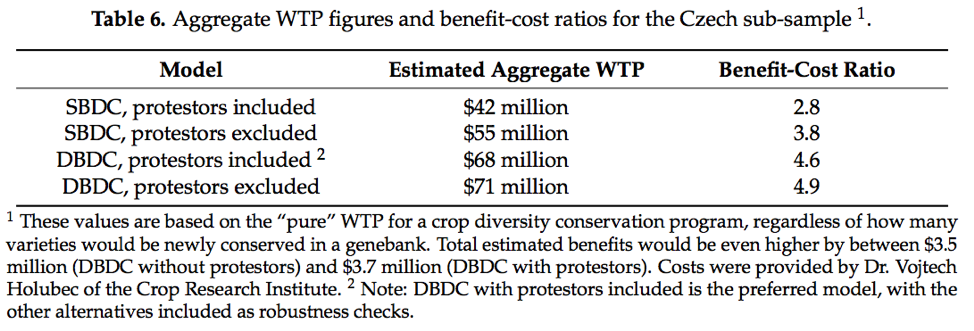
The basic idea of the paper is that public decision-making about how much to spend on crop diversity conservation should include a consideration of how much the public cares about conservation, and in addition should acknowledge that a national collection of crop diversity does not just ensure the availability of material for plant breeders, but also provides a whole set of other values such as those provided by a national park system or public museums. For example, just as an individual may be willing to pay something to ensure that their children and grandchildren will have an opportunity to visit Yosemite, they may also be willing to pay something so that their descendants will have the chance to eat a favorite fruit variety.
The estimates we provide represent an approximation of this social value of crop diversity conservation for the case of the Czech Republic. The study illustrates an empirical approach of potential value for policymakers responsible for determining funding levels for genetic resource conservation, and similar empirical work may be used to potentially provide justification for increased spending on the conservation of crop diversity worldwide.
The article “Seed longevity phenotyping: recommendations on research methodology,” by Fiona Hay and others, is now freely available online. Read the whole thing, and note the use of DOIs, if you’re thinking of phenotyping seedlots for longevity or storability. But here’s the bottom line, just to whet you appetite:
- Use ageing conditions that are appropriate to the potential downstream use of the findings. Ideally such conditions should be standardized to enable comparisons across studies and perhaps, species.
- Take enough samples for germination testing such that a survival curve can be fitted to the data and appropriate parameters determined.
- Specify if seeds were de- or adsorbing moisture; determine the MC of the seeds if they are placed in a controlled-RH environment (e.g. over a saturated salt solution).
In an earlier Brainfood I said it was behind a paywall, which I swear it was when I checked, but that’s not the case anymore, thank goodness.