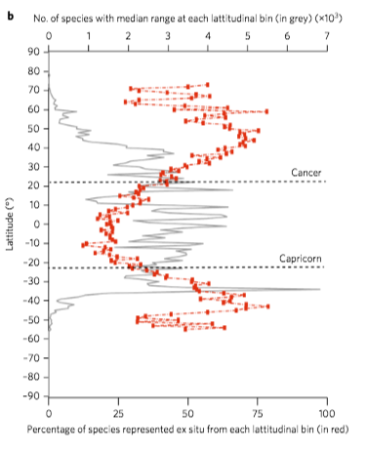
 A monumental study of the plant species conserved in botanical gardens has just been published, and is getting quite a lot of traction in the media. The headline numbers are impressive: “botanic gardens manage at least 105,634 species, equating to 30% of all plant species diversity, and conserve over 41% of known threatened species.” It is worrying, however, that three quarters of the species that are absent from botanical gardens collections are tropical in origin. Lots of hot, sweaty work still do be done.
Nibbles: Agrobiodiversity Index, PPB, Heirloom rice, CATIE genebank, Faberge potato, Val @CePaCT, Nigerian food, Ethnobotanical book, Hope Jahren quote
- Bioversity DG lobbies for the Agrobiodiversity Index.
- One of her staff lobbies for participatory plant breeding. And he’s not the only one.
- Maybe they could tackle Indian rice next?
- Protecting cacao at CATIE.
- Faberge had a potato, of all things, and it’s a beaut.
- Celebrating Valerie Tuia, until recently genebank manager at SPC. Faberge taro, anyone?
- The Nigeria food database includes taro, but only leaves.
- The Digital atlas of traditional agricultural practices and food processing weighs 10kg, but seems a stone-cold Faberge-level masterpiece. Not sure if it has much on taro, though.
- “Every replete tree was first a seed that waited.”
Brainfood: Pennisetum genome, Dioscorea genome, CBS timeline, Global taro, Science storytelling, Fragmented populations, Beet diversity, Potato diversity, Norwegian chickens, Med holidays, ABS, Jatropha diversity, Better olive oil
- Pearl millet genome sequence provides a resource to improve agronomic traits in arid environments. Of course it does. Lots of genes for natural wax proteins may be part of the answer.
- Genome sequencing of the staple food crop white Guinea yam enables the development of a molecular marker for sex determination. Which should make breeding more efficient.
- Cassava brown streak disease: historical timeline, current knowledge and future prospects. Re-emergence drives intense scientific scrutiny, and maybe some solutions, including 25 best-bet clones from the region which show foliar symptoms but no tuber necrosis.
- Adapting clonally propagated crops to climatic changes: a global approach for taro (Colocasia esculenta (L.) Schott). People need taro diversity.
- Opinion: Finding the plot in science storytelling in hopes of enhancing science communication. See all of the above.
- Call for a Paradigm Shift in the Genetic Management of Fragmented Populations. Mix it up!
- How scattered trees matter for biodiversity conservation in active pastures. By being diverse, and helping in forest recovery. Someone should mash up with the previous.
- Insights into the genetic relationships among plants of Beta section Beta using SNP markers. Fancy markers say same thing as less fancy markers.
- Levels of Intra-Specific AFLP diversity in Tuber-Bearing Potato Species with Different Breeding Systems and Ploidy Levels. One plant is enough for self-compatible species.
- Genetic diversity in five chicken lines from the Norwegian live poultry gene bank. Not much, globally speaking. But that’s not the whole point.
- Is It Still Necessary to Continue to Collect Crop Genetic Resources in the Mediterranean Area? A Case Study in Catalonia. Yes.
- Beyond access and benefit-sharing : lessons from the emergence and application of the principle of fair and equitable benefit-sharing in agrobiodiversity governance. It’s not yet working, maybe because it’s too complicated.
- Genetic Tracing of Jatropha curcas L. from Its Mesoamerican Origin to the World. Now we know where to go look for fixes to the low productivity problem of African and Asian material, which is all derived from a couple of accessions.
- Exploration of genetic resources to improve the functional quality of virgin olive oil. We need data on phenolic composition.
What will the 2020s be like for crop diversity conservation?
The low level of activity last week on the blog was due to the fact that I was at the Botanic Garden Meise in Belgium participating in the annual meeting organized by the Genebank Platform. You can get a flavour of what happened from Twitter. And yes, I’m sorry, I should have told you all about #genebanks2017 before the meeting, rather than after. My bad.
Anyway, we’re finalizing the Platform’s website and you’ll be able to read all about it there soon. In the meantime, you can see a nice pic of the genebank managers and others working in some of the world’s largest and most used genebanks on the Crop Trust’s Facebook page.
One of those managers is Jean Hanson, and she’ll be retiring from her job at ILRI at the end of the year. In her farewell presentation to the group she summarized the history of plant genetic resources conservation, from the point of view of the international collections, in this way:
- 1970s: The Decade of Getting Started
- 1980s: The Decade of Doing
- 1990s: The Decade of Uncertainty
- 2000s: The Decade Upgrading
- 2010s: The Decade of Accounting
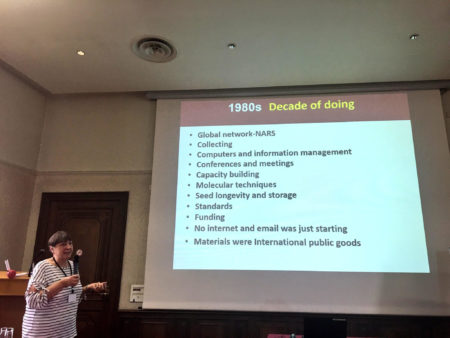
Jean didn’t say in her talk what she thought the 2020s were going to be the decade of, but she did share some thoughts during the Q&A. So let me open it up. What do you think? What do the 2020s have in store for the conservation of plant genetic resources for food and agriculture?
Nibbles: Millets galore, Human diversity & ag, Super farmers, Extinction is forever, Indian nutrition maps, Future Food competition, Banana viruses, Cassava in Brazil & Africa, Sugar book, Fairchild & Irma, Vegetable ROI, Embrapa beans, Certified coffee, Legal pot, Native American foods
- Today’s new genome is pearl millet. The most climate-smart of crops? Now, to process it more easily.
- Finger millet is not too bad either.
- Agriculture was good for human diversity, at least in Papua New Guinea. Elsewhere, maybe not so much.
- Julio Hancco Mamani grows 400 potato varieties up in the Andes (but how did it all start?). And Rahibai Soma Popere “15 varieties of rice, nine varieties of pigeon pea and sixty varieties of vegetables, besides many oil seeds” in Maharashtra.
- “West Bengal government encourages cultivation of extinct rice varieties.” Wait, what?
- Presumably not extinct like silphium.
- India’s first nutrition atlas will maybe tells us where more Rahibai Soma Poperes are most needed.
- Future Food includes seeds.
- Cleaning up bananas.
- Would love to have been on the “Brazilian Cassava Learning Journey.” Tanzania next?
- The bitter side of sugar.
- Fairchild Tropical Botanic Garden damaged by Irma.
- Research on vegetables really pays off, vegetable researchers say.
- Brazilian bean catalog launched.
- Certifying coffee seeds.
- Pot next?
- Closely followed by Navajo tea.