- High-level agricultural scientists thinks high agricultural science will feed the world. Oh, and smart policies.
- This new rice would qualify, I suspect.
- Participatory varietal selection manual revised to take women into account. Someone mention high science?
- No such manual needed in India, it seems.
- The banana-is-doomed story sure has legs. Or hands.
- What did the Inkas ever do for us?
- Is agriculture diverse enough? That is the question.
- Yerba mate gets sequenced. Because it can be.
- Following an Indian cucumber down the value chain.
- Thank your lucky stars for this weedy-looking tomato wild relative.
- “We’re interested in the color, shape and sizes of the vegetables from 400 years ago, compared to modern cultivars of the same vegetables: the deep sutures on cantaloupe in Italian art of the Renaissance or the lack of pigmentation in pictures of watermelon compared to today.”
- Quite a bit of agrobiodiversity featured in Day of Archaeology. Nice idea.
Nibbles: Nutrition successes, Fruit grafting, Bee hero, VERY early ag, Humans bad shock, Biodiversity video
- Do you have a nutrition success story? Asking for IFPRI.
- What, another “Tree of 40 Fruit”?
- Bee expert Prof. Dave Goulson is a BBC conservation hero.
- Pre-Neolithic hunter-gatherers did some sort of semi-cultivation of some plants, in one place, at one time, maybe.
- Anthropogenic environmental change affecting pollinators and crop zinc levels shock.
- Video on biodiversity loss mentions crop diversity shock.
From the Maldives to New Jersey
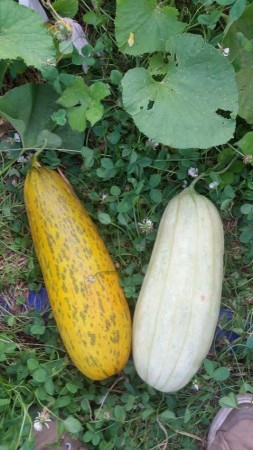 This photo accompanies a Facebook post on the page of the Experimental Farm Network, an initiative “dedicated to facilitating participatory plant breeding and other collaborative agricultural projects.” Now, I don’t understand Facebook enough to know who will actually be able to see the post, so I’ll reproduce it here:
Our first two “Hithadhoo Melons” from Hithadhoo, Laamu atoll, in the Maldives! These two very different looking melons came from the same packet of seeds we received through the USDA (PI 536482). We picked them yesterday because they were starting to split, likely due to the immense rain of last week, followed by the intense heat of this week here in NJ.
The USDA collected this in 1986, but it was listed as a cucumber until 1999 when they correctly re-id’d it as a melon. When the fruit are still small, they do look and taste very much like cucumbers. We’re letting these sit for a bit to continue ripening before we crack them open to see what they’re like inside. We plan to reach out to folks in the Maldives to learn what they call this melon, what they use it for, how they grow it, etc. Hithadhoo is one of the largest islands in the archipelago.
After putting off these two early on, plus a couple other large fruit still on the vines, the plants are suddenly putting off tons of female flowers, meaning many more fruit are on the way. It seems likely each plant could produce a dozen or more full-size melons before the season is through. Hand-pollination has been relatively easy with this one too, even in the afternoon (some cucurbits are only fertile in the morning). This one definitely seems like a winner.
Just one more reason why it’s a shame the Maldives are likely to slip beneath the waves before this century is through.
What intrigues me here is whether the North Central Regional PI Station at Ames, Iowa, which is where PI 536482 is conserved, know about this. Because I bet they’d be really interested to know all about how those Maldivian melons are doing in New Jersey.
There must be a way to monitor the internet for references to PI numbers. Right? Some clever way of setting up a Google Alert that returns only instances of the string “PI” followed by numbers (perhaps with a space in front), perhaps?
Nibbles: Oz vineyard apocalypse, California vineyards redux, Ethiopian genebank, Maya collapse revisionism, SunBlack tomato, Nutritious staples, Citrus endowment, Sheep pix
- In Australia, they’re ripping up vineyards.
- Whereas in California, they’re going to breed 10,000 new grape varieties and make a new wine. Go figure.
- Interview with the director of the Ethiopian national genebank, Dr Gemedo Dalle.
- Deforestation et al. not responsible for Maya collapse after all. Jared Diamond unavailable for comment.
- Black tomato a hit in Italy. Looks crap on pizza though.
- The case for biofortification.
- University of Florida sets up endowment to protect its research groves in face of citrus greening.
- Googlesheepview. Nuff said.
Sequence everything — but not only
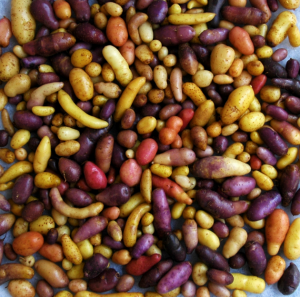 The contents of a potato genebank? Nope: “…a maximum of two alleles per locus contributed to this variation.” That’s because this tuberous cornucopia is what the authors of a recent essay in the American Journal of Botany 1 got when they selfed a diploid potato clone which was itself derived from a cross between a completely homozygous parent and one that was very nearly so.
 What does this mean for genebanks? Basically, that they can’t rely on morphological variation, in even a whole set of traits, as a proxy for overall genetic diversity. So long, old-fashioned core collections. What you really need to do is sequence everything. Music to DivSeek ears, I’m sure. But that’s not all. You also have to make sure that the resulting better diversity information gets to farmers in a way that helps them support the processes that “create and maintain useful variation for functional traits and to develop strategies to identify and select valuable phenotypes.” Or on-farm conservation, to you and me.