It’s been five years since Robert Koebner and Theo van Hintum published the following call to action on our blog:
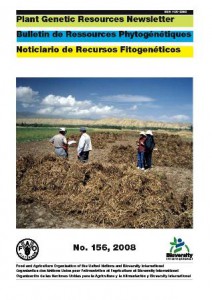
There has not been an issue of the Plant Genetic Resources Newsletter (PGRN) for a year. Its loss means that there is no longer a sensible outlet for “grey” literature on PRG -– such as reports of collecting expeditions, genebank updates, preliminary testing of new characterization protocols etc. A new intiative is currently being launched by Robert Koebner and Theo van Hintum (WUR) to bring PGRN back from the dead. The idea is to resume publication as a web-only English language journal housed at WUR, and to provide authors with linguistic support if needed. We are currently looking for the necessary financial sponsorship, and to achieve this we need to demonstrate that there is appreciable community support for the revival of PGRN.
So if you think that this is a worthwhile goal and that you would like to see PGRN back as a freely available, web-based journal, please email a message of support to Robert Koebner at mockbeggars(at)gmail.com, and leave a comment here.
We hope to hear from as many of you as possible!
There was an outpouring of support for the idea of bringing back a new PGR Newsletter — over 50 comments! — but the necessary financial sponsorship has not, alas, materialized. What has just materialized, however, is a new and hopefully fairly robust archiving arrangement for the old PGR Newsletter, courtesy of Bioversity. 1 Which is better than nothing, and we should all be grateful for.
…the Bioversity International Library felt it was important to make the full set of the Newsletter from its inception in 1957 to the last issue, no. 156 in 2008, available to all. We began the project in late 2014 and we are extremely proud to have been an integral part in making the Plant Genetic Resources Newsletter available to the plant genetic resource research community.
You can browse — though not, I believe, search — all the back issues from Bioversity’s e-Library pages.