- Biological collections under pressure.
- And mobile phones probably wont help. Much.
- Chilean pisco? Really?
- The end of cooking?
- Sericulture on the Silk Road.
- ILRI is 40, did we say? Not sure what they do on sericulture. No doubt somebody there will tell us. They’re social networking machines over there.
- Watch out, ILRI, Silicon Valley is coming for ya.
- One of the reasons why we need livestock research: deforestation.
- I like any article with the word nexus in the title.
- The landscape approach meta-analyzed to within an inch of its life. Bottom line: it’s the women, stupid!
- The power of the people’s potatoes.
- A secret herb garden revealed. I hope they install CCTV.
- Kana’tarokhónwe. Yep, clickbait, but worth it, trust me. And then scale the thing up.
- How to do climate-smart agriculture in Latin America and the Caribbean, country by country.
- Oh no, yet another article on that Himalayan Viagra caterpillar fungus thingy.
- Boffins resurrect 700-year-old fungus from reindeer crap.
- Indian rice breeders talk about their cool new basmati.
Dia de los Muertos at CIMMYT
Thanks to Dr Denise Costich, manager of the maize collection at CIMMYT, for this photo of the decorations currently gracing the lobby of the genebank building.

And let’s all “Like” the genebank’s new Facebook page, which features this and other nice photos!
Nibbles: Cannabis, Brachiaria, Grasslands, Oryza, Taxonomy resources, Artocarpus, Quercus, Zea, MAS, GBIF
- “Something researchers are looking at is which cultivars, or strains, of hemp are best for the various uses — fiber, oil, nutrition, etc.” Love that etc.
- Speaking about grass: Brachiaria goes home, to wild acclaim.
- Did someone say wild? Wild grass needs help!
- Rice is a grass. Oh my yes.
- How to keep up to date with taxonomic research online.
- Pacific Regional Breadfruit Initiative gets an award.
- You can also make flour from acorns.
- And maize: what’s a grit?
- Greenpeace touts MAS.
- Next thing you know they’ll be singing the praises of Big Data. Yeah, maybe not.
The identity of “millet” in East Africa
A blog post from the Chicago Council on Global Affairs a couple of days ago reminded me that we had blogged about GYGA — the Global Yield Gap and Water Productivity Atlas — a couple of years back. Just to remind us all
…the target of the Global Yield Gap Atlas (GYGA) is to provide best available estimates of the exploitable yield gap (Yg-E) — difference between current average farm yields and 80% of Yp and Yw. Water resources to support rainfed and irrigated agriculture also are limited, which means efficiency in converting water to food, water productivity (WP), is another key food security benchmark included in the Atlas.
I’ve had a quick look at the GYGA website, and it seems serviceable enough, though it has the drawbacks, often remarked on in these pages, that it is difficult to share the maps you make, and import your own data into them. Here I’d like to point out another potential issue, though. This is what you get when you look at the yield gap for “rainfed millet.” Because of the aforementioned drawbacks, a clunky screenshot is the best I can manage, I’m afraid.
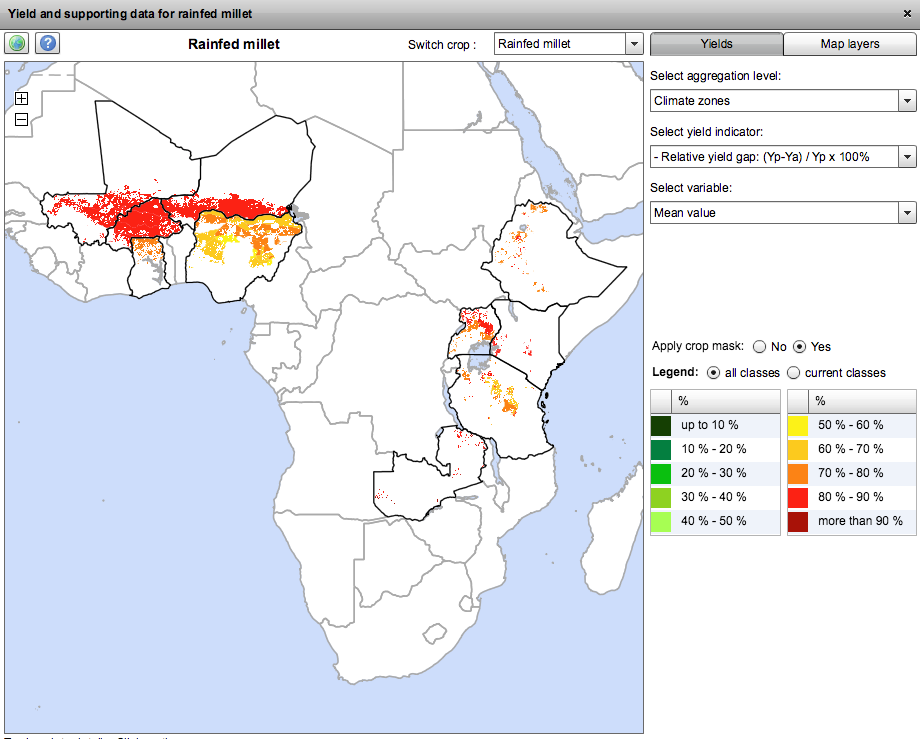
Now, the stuff in West Africa is clearly pearl millet, but what about in East Africa? Is there really that much pearl millet in Uganda, say? This is what Genesys knows about the two millets in East Africa. And yes, it’s a clunky screen grab too, but if I had wanted to, I could have downloaded separate KML files for the two crops and opened them both in Google Earth and then exported a nice JPG.
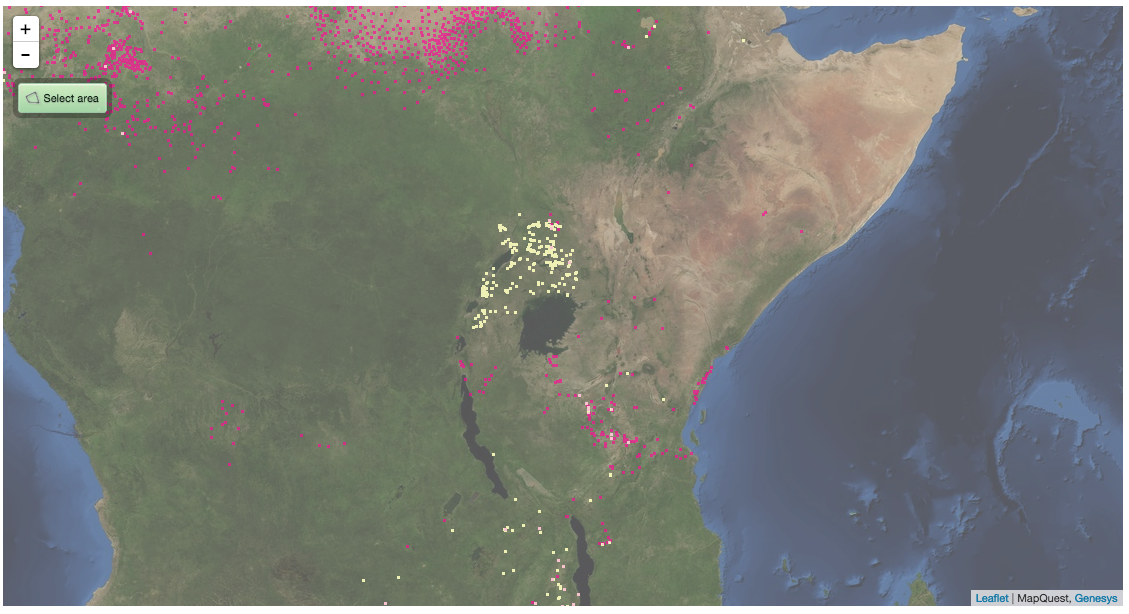
Pink is pearl, yellow is finger. There’s a little bit of pearl millet in Uganda, but not all that much. The millet there is mainly finger millet. So, which is the millet in GYGA? Is it confusing the two?
Nibbles: Wonder Bread, Cassava sex, Languages and biodiversity, Wild Musa, Bronze Age musings, New Indian rice varieties, Improved breeds in Kenya, GMOs in China, Organic vision, Foreign food, Publicity, Nutrition advice & indicators, Ethiopian seed banks, Zimbabwe millet, Agroforestry, MSB legume collection, Demon paywalls, CIMMYT seed, Tempting apple
- The industrial sliced loaf as racist fantasy.
- Bill Gates talks dirty. About cassava, settle down.
- Where the wild things are is where the languages are, but why? And where are they endangered?
- This new Indian wild banana is probably a bit endangered.
- The past may be a foreign country, but they got Street View there too.
- Blockbuster rice in India. (But how energy-efficient is it?)
- And potentially blockbuster livestock breeds in Kenya.
- China goes GMO. Which of these?
- Maybe they should read this vision for organic farming? You know, just for completeness?
- Have a food adventure! Just perhaps not in China.
- FAO and National Geographic have a food security adventure together. For more stuff like this, no doubt…
- Eat more plants, and ditch the junk food. Sounds easy, doesn’t it? Ok, for the more complicated, nerdy approach, there’s always fancy indicators.
- Ethiopia’s community seed banks.
- I bet there are some in Zimbabwe…
- African Development Bank makes a bet on agroforestry. Maybe health is why? There’s more that one reason…
- Gotta be strategic with your legume collecting.
- Want conservation science to translate into impact? Don’t publish behind a paywall.
- CIMMYT earns its keep.
- Build a better apple, and you won’t be able to keep the journalists away.