Pizzutello: An ampelographer writes

Our discussion of Ruoppolo’s grapes found its way to Erika Maul, curator of the German grape collection and manager of the European Vitis database. 1 Many thanks to Helmut Knuepffer for facilitating that process and for providing this translation of Erika’s comments.

About 20 years ago I tried the to solve the confusion concerning Pizzutello, Cornichon Blanc, Dedo de Dama, Kadin Barmak, Lady’s Finger Grape, etc. from behind my writing desk. Since this turned out to be impossible, I then introduced grape varieties from different germplasm collections, to get the thing on track. For various reasons, I did not succeed and since then I did not take up the matter again.

However, what appears certain to me is that these grape forms had quite some importance as a curiosity, due to the particular shape of their fruits. (That shape evolves when the seeds do not develop. The well-shaped outer part includes a seed, while in the inner shorter compartment the seed is only rudimentary.) Presumably these forms come from the Near East, and they do not ripen in our northern growing areas — even in warmer summers.

That will make a nice project for someone some day…

Conservation status of European crop wild relatives assessed

The latest IUCN assessment of the conservation status of European biodiversity is out, and is making the news. The bit on plants is co-authored by Melanie Bilz, Shelagh P. Kell, Nigel Maxted and Richard V. Lansdown and, unsurprisingly perhaps given their track record, includes, I believe for the first time, extensive discussion of crop wild relatives as a distinct class. 2 The authors, which coordinated input from dozens of experts, conclude that out of a total of 591 CWR species:

Within the EU 27, at least 10.5% of the CWR species assessed are threatened, of which at least 3.5% are Critically Endangered, 3.3% Endangered and 3.8% Vulnerable – in addition, 4.0% of the species are considered as Near Threatened. One species, Allium jubatum, is Regionally Extinct within Europe and the EU; it is native to Asiatic Turkey and Bulgaria, but has not been found in Bulgaria since its original collection in 1844.

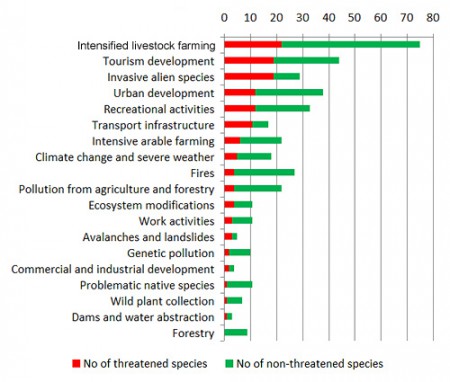
It does not even seem to be available from botanic gardens, according to Botanic Gardens Conservation International’s database. I don’t know what has caused its disappearance in Bulgaria, but currently the main threats to CWRs seem to be intensified livestock farming, tourist development and invasives:

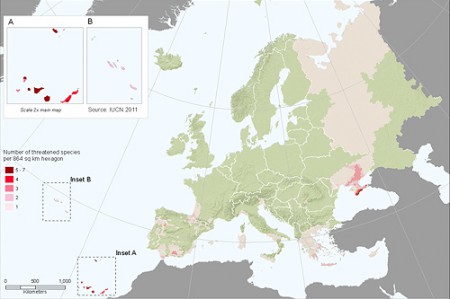
And there are maps 3 of both the distribution of overall CWR species richness and of the most threatened species:

An extremely useful review is provided of previous work assessing the extent to which CWRs are conserved in genebanks, botanical gardens and protected areas in Europe. But here perhaps I would like to quibble with the authors. Although their listing of existing conservation efforts seems to me thorough and comprehensive, there is no attempt made to synthesize the results of all the different initiatives and come up with a list, however preliminary, of high priority plants for immediate conservation intervention. Surely it would not have been particularly difficult to cross-reference their list of threatened species with listings of accessions in Eurisco and the BGCI database, for example. Maybe this was beyond the scope of this particular exercise and is the focus of parallel work. Perhaps Nigel or Shelagh will respond here.

This is a very important contribution to raising the profile of CWRs within the biodiversity conservation community. Let us hope that it will translate into increased support for their conservation, both ex situ and in situ, along the lines so usefully set out by the authors in their recommendations.

“Super broccoli” from field to fork

The story begins in the Mediterranean in the early 1980s when Professor Richard Mithen, currently at IFR, was on a field trip to collect rare plants as part of his PhD at the University of East Anglia. “We collected wild brassicas in southern Italy and Sicily, and that material was sent into various seed banks in Italy, Sweden and Spain,” says Mithen. “I was able to go on this expedition due to Professor Harold Woolhouse, the then Director of the John Innes Institute, who provided me with a small grant to cover some of my travel costs.”

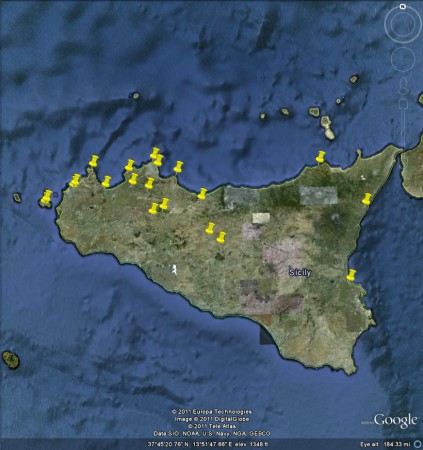
If you want to read about this collecting trip, you can, thanks to the Collecting Missions Repository: look for CN375. Here’s the material the boys collected which ended up in Spain, according to an “advanced” Eurisco search, as mapped by Genesys:

Where does the story end, you ask? Well, with Beneforté ‘super broccoli’. And a fascinating story it is too. Read for yourself.

LATER: Prof. Mithen informs me the wild species involved was Brassica villosa.

Rounding up wild Guatemalan cacao accessions

…are there really no wild Guatemalan cacao accessions conserved in genebanks around the world?

I asked the question, so I better have a go at answering it, I suppose.

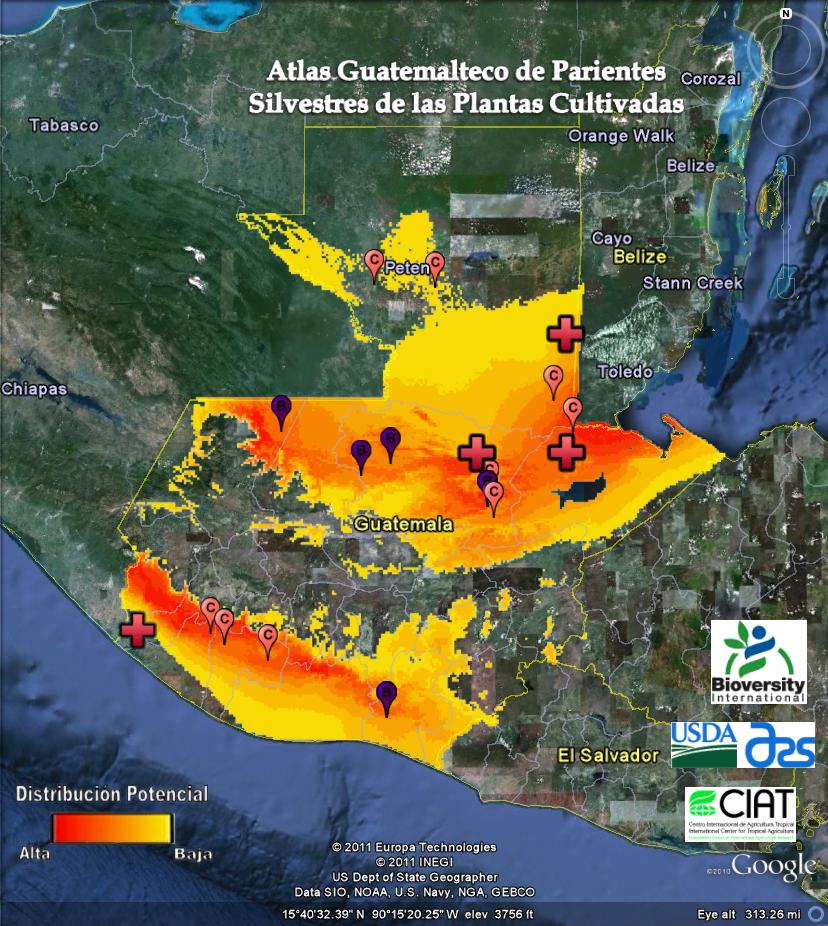
WIEWS shows no wild cacao from Guatemala, and actually not all that much cacao in Guatemala of any kind. GRIN returns 10 Theobroma accessions from Guatemala, but none of them are described as wild. The International Cocoa Germplasm Database (ICGD) returns 6 accessions from 4 localities. Here they are shown as crosses.

I got them into Google Earth via DIVA-GIS. The other icons show the distribution of herbarium specimens of wild T. cacao (C) and T. bicolor (B) and the predicted range of the former, according to the Guatemalan CWR atlas I blogged about yesterday. But you can’t tell from the data in ICGD whether the accessions represented by crosses are wild or not. Don’t worry though, there’s a reference given for all the accessions, so all is not lost: Rivera De Leon, S. (1986). Informe general sobre el proyecto de recoleccion de cacao Criollo en Guatemala. Unpublished report AGPG:IBPGR (FAO Rome)/86/156. Estacion de Fomento Los Brillantes, Guatemala.

It is an IBPGR report, so it should be available in the Bioversity’s Collecting Missions Files Repository. Which it is, although finding it was non-trivial. I’m not sure if that last link is going to last long, so look for collecting mission CN234. The problem is, I can see no way of attaching the description of the material given in the report to one or another of the accessions in ICGD. So although it does look from the report as though some of the material collected in 1986 may have been wild, I can’t tell you which if any of those crosses in the map above could legitimately be added to the Atlas of Guatemalan Crop Wild Relatives.

So the answer to the question I started out with is: I don’t know. I suppose it’ll take an expert in the crop to sort it out. You come up against this again and again in Genebank Database Hell. You can get so far, but to get any further you need human intervention.

Some faba beans, without the nice Chianti

ResearchBlogging.orgIf you’re a faba bean breeder interested in cold tolerance you will have come across a paper recently in GRACE the title of which will have set your pulse racing: Screening and selection of faba beans (Vicia faba L.) for cold tolerance and comparison to wild relatives. 4 And if you had skimmed ahead to the conclusion you would have found it difficult to contain your excitement.

In conclusion, some faba bean accessions were selected for cold tolerance and desirable agronomic characteristics. ACV-42, ACV-84 and ACV-88 were selected as highly cold tolerant. These sources of cold tolerance could be used to improve cold tolerance level in faba bean breeding programs.

You would then have gone back and read the paper thoroughly to find more information on these previous accessions, and in particular on where to get hold of them. But you would have been disappointed, and you might very well have moved dejectedly onto the next paper in your Google alert.

Fortunately I am made of sterner stuff. So, thanks to an email to the authors, I can now tell you that

ACV-42 = TR 31590 at the Aegean Agricultural Research Institute, Izmir, Turkey
ACV-84 = IG 14048 at ICARDA
ACV-88 = IG 72247 also at ICARDA

And, thanks to Genesys, I can add that IG 14048 is a Polish landrace called Debek and IG 72247 is from Canada and has at some point had the number “73 Rm 70”, though I can find no reference to this in GRIN-Canada. Neither Eurisco nor Genesys has the Turkish genebank’s faba bean data, and their website was down when I tried it today, so I can’t tell you anything about TR 31590, I’m afraid.

You’re welcome.

And here’s a bit of a bonus for you. The paper also drops the fact that

The best known freezing tolerant genotype is a French genotype ‘Cote d’Or’ which can survive –22ºC if previously hardened…

Well, being a faba bean breeder interested in cold tolerance you probably already know that, and have it, but in case you’ve run out or something, Genesys/Eurisco says you can get it in a couple of different genebanks, including CGN in the Netherlands. 5

Now, to feed back that evaluation information on ACV 42, 84 and 88 — and indeed all the other hundred-odd accessions evaluated in the paper — to the genebanks from whence they came, to make life that little bit easier for the next faba bean breeder interested in cold tolerance breeder…