- Desert seeds go to Svalbard.
- “Two young engineers, Fuad Gasi and Idin Fazlic, are in charge of the bank, which is staffed by volunteers.”
- Seedbombs: recipes and legal niceties.
- Achieving food security sustainably. Report of a PAR/FAO workshop.
- On the other hand, here’s what Australia’s leaders heard about A Food Secure World.
- How much do you really need to know about mandrake?
- Do rich countries produce more per hectare? h/t GOOD
- Pocket guides to chili farming. Might have a wider audience than originally intended.
- Collecting cockles is women’s work, at least in Ecuador.
- Why would anyone want to eat it when they could use cassava for biofuel instead?
To Serve and Conserve presentations
The presentations given at the Eucarpia To Serve and Conserve meeting are now up on the conference website. Have fun!
Different genebanks, different roles
I feel a little more needs to be said about the video I nibbled earlier about the Philippine Rice Research Institute (PhilRice) genebank, in particular in light of the questions that were asked at the recent To Serve and Conserve conference about the relative roles of national and international genebanks. Here’s the video again:
I don’t speak Tagalog, but some things are pretty obvious. If you go to 1:57, for example, you get the following shot:

Fortunately, Genesys knows about this IRGC 44503. 1 It’s an IRRI accession, as the IRGC prefix implies:
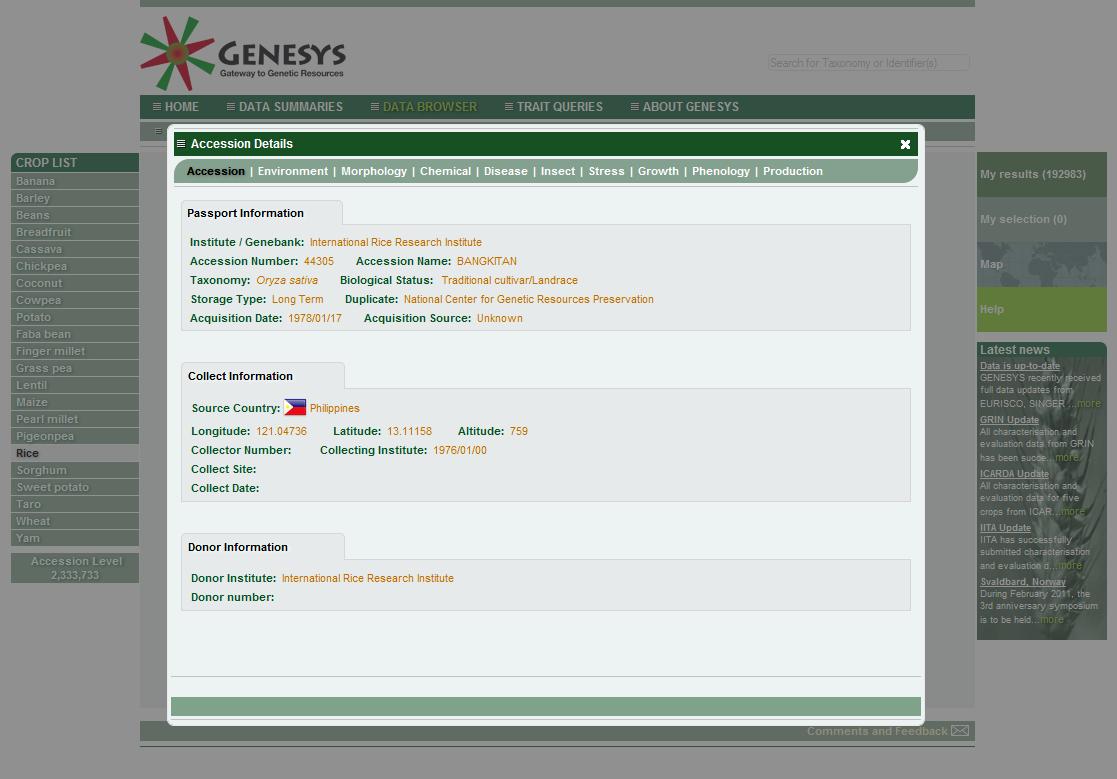
Now, I understand the need for safety duplication. But for proper safety you’d want it to happen in another country, another continent preferably, and the IRRI and PhilRice are both in the Philippines, although on different islands. 2 I can also understand that PhilRice might want a sample of IRGC 44503 to hand for research or whatever. But that looks like a seed sample going into long-term storage, and IRRI is not that far. And I understand there’s a measure of historical contingency involved. But things are different now. There’s Svalbard. And there’s the International Treaty on Plant Genetic Resources for Food and Agriculture. So is it really necessary for PhilRice to do long-term storage of an IRRI accession? Couldn’t they leave that to, well, IRRI? It’s not as if they don’t collaborate all the time.
Does it matter? Does it really matter if some rice accessions are kept in long-term stores in several place? Well, for a start it’s not some rice accessions, but many. And not just rice, but many crops. Maybe only about 20% of the world’s 7.2 million accessions are unique, some of those are not duplicated at all, others many times. If you’re trying to work out how much it would cost to conserve, safety duplicate and make available forever that 20%, rather than the full 7.2 million, it most certainly does matter.
Nibbles: Yemen, Squabs, Chilies, Questions, Impact Assessment, Huckleberry, Cacao, Filipino rice genebank
- Yemen saves local varieties, adapts local agriculture.
- Not all small livestock enterprises guarantee success. Beware.
- Hot new book: Chasing Chilies.
- Another list of really important questions. Answers? Can’t get the original, yet.
- New World Bank blog on impact assessment. Assess this.
- In the market for huckleberry market information?
- CocoaLink off the ground. Maybe not in Cote d’Ivoire yet, though, alas.
- PhilRice genebank in the Philnews.
To Serve and Conserve abstracts
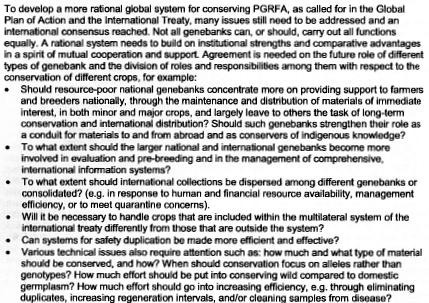
 We’ve managed to get our sweaty little hands on the volume of abstracts 3 of the Eucarpia To Serve and Conserve conference, which has just ended in Wageningen. No time to digest the contents fully yet, but to stimulate your appetite, here’s part of the abstract of Geoff Hawtin’s paper, which asked: “Whither Genebanks?” Some provocative questions in there.