All go at FAO again with the Commission on Genetic Resources for Food and Agriculture holding its 12th meeting. One of the things on the agenda is consideration of the 2nd report on the State of the World’s Plant Genetic Resources for Food and Agriculture (the final version is available online as a large pdf). There’s also a side event on crop wild relatives, among others. IISD has the low-down every day.
Indigenous food book online
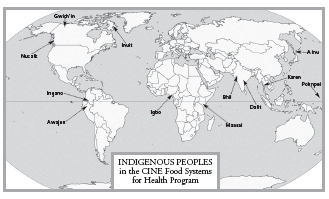
I don’t think I made it sufficiently clear when I last blogged about the FAO publication Indigenous Peoples’ Food Systems, published with the Centre for Indigenous Peoples’ Nutrition and Environment (CINE) that it is available in its entirety online as a pdf (9MB). Thank you, FAO!
A request from Gapminder
We are happy to pass on this request from Gapminder for feedback on their agricultural data, which came in as a comment on a recent post. And to apologize for the error it highlights in our characterization of the relationship between Gapminder and Google.
Dear Agricultural Biodiversity Weblog,
Thank you for your enthusiasm! You are so right it takes a while to find the interesting stories from the massive data. It is over 700 indicators which in different combinations can show interesting stuff. But just imagine trying to do that without the visualization. We are as excited as you.
Please, when you or your visitors find some interesting combination or revelation from the graphs, please let us know. We are soon going to implement a new function where we hint of some of the interesting facts that can be found in the graphs with the possibility to add some explaining text to each graph.
We therefore need good stories to tell from the graphs. Just drop us a line if you have an example you want to share with the world!
Just one correction though, Gapminder is not owned by Google. Gapminder is a foundation of its own, totally independent from Google. They only bought the software (Trendalyzer) to improve the technology further. Gapminder continues to use it in order to explain the world in an understandable way.
Thanks again and see you on Gapminder.org!
Staffan, Gapminder
Gapminder adds agricultural data at last
We’ve blogged before about how cool it would be if agricultural production statistics were available in Gapminder, the visualization tool developed by the great Hans Rosling and his family. Well, the wait is over! Gapminder, which is now owned by Google, announced a couple of days ago that you can now use it to explore the FAOSTAT database. This will take weeks, if not months, to get to grips with, but I just leave you with a tasty morsel: what’s happened to area of fonio cultivation in Guinea and Nigeria in the past 45 years. Note the rapid increase in the past decade or so. And compare to the trend in overall production. Why has Guinea done so much better in increasing yields, at least since 1995? Real, or artifact? Oh, there will be so much fun to be had from this. Thanks, Gapminder! And thanks Jon for the headsup.
Global Hunger Index goes interactive
The Global Hunger Index for 2009 has just been released with a very cool interactive map (see above). 1 There’s a general release from our friends at IFPRI and one focused on sub-Saharan Africa.
Coincidentally, or not, this just in: 2
Bill Gates, co-chair of the Bill and Melinda Gates Foundation, on Thursday will urge governments, donors, researchers, farmer groups, environmentalists, and others to set aside old divisions and join forces to help millions of the world’s poorest farming families boost their yields and incomes so they can lift themselves out of hunger and poverty.
Gates will say the effort must be guided by the farmers themselves, adapted to local circumstances, and sustainable for the economy and the environment.
The occasion for both news items is the award, tomorrow, of the World Food Prize to Dr Gebisa Ejeta.