- Eating frog legs is bad. France surrenders.
- Oxford boffins to map world’s sacred forests.
- Lafort onion: from the Wellesbourne genebank to Irish Seed Savers to urban kitchen garden.
- Lobster 101.
- A wild relative in trouble any way you slice it.
- And one that gets around. Didn’t we blog about this before? Yep.
Brainfood: Chinese landscapes, Agroforestry seed, Italian lentils, Carrot heterosis, Taro in islands, Indian wheat, AnGR ex situ, Woodland shrines, Vitamin A, Caraway, Adansonia, Neotropical blueberries, Yeast genetics, Rotations
- Agricultural landscapes and biodiversity in China. Traditional farming practices good for biodiversity, modern bad. Therefore need intensification, to take pressure off natural habitats. But no, wait, that usually means monocultures and chemicals, which are bad. Oh crap. No mention of genebanks.
- Innovation in input supply systems in smallholder agroforestry: seed sources, supply chains and support systems. Decentralized commercial system probably best for getting quality agroforestry seed to smallholders. Unfortunately, nobody listening.
- Characterization of Italian lentil (Lens culinaris Medik.) germplasm by agronomic traits, biochemical and molecular markers. I object in principle to any paper that says a particular landrace is “the best.”
- The relationship between heterosis and genetic distances based on RAPD and AFLP markers in carrot. It is positive. Was this really not known before in carrots? What am I missing?
- Genetic diversity of taro (Colocasia esculenta (L.) Schott) in Vanuatu (Oceania): an appraisal of the distribution of allelic diversity (DAD) with SSR markers. 10 villages, 344 landraces, 324 distinct multilocus genotypes, genetic pattern reflects social networks. Situation in Andaman Islands not quite so interesting.
- A study of genetic diversity among Indian bread wheat (Triticum aestivum L.) cultivars released during last 100 years. More diversity after Green Revolution than before, but steadily decreasing.
- Ex situ conservation genetics: a review of molecular studies on the genetic consequences of captive breeding programmes for endangered animal species. Restricted access, and you know what? I couldn’t care less.
- Consequences of wooded shrine rituals on vegetation conservation in West Africa: a case study from the Bwaba cultural area (West Burkina Faso). I expect there are some, but with restricted access, what’s the point of even linking?
- Evaluating sweet potato as an intervention food to prevent Vitamin A deficiency. To have an effect, you’d have to replace all the other types with orange-fleshed ones. Well, almost. Wonder whether it will be presented at the “International Scientific Symposium on Food & Nutrition Security Information: From valid measurement to effective decision-making” early next year.
- Evaluation of variability of morphological traits of selected caraway (Carum carvi L.) genotypes. They’re actually breeding this stuff in Poland. But they had to get their germplasm from botanical gardens around Europe.
- Variation in baobab seedling morphology and its implications for selecting superior planting material. There is some.
- Edible Neotropical blueberries: antioxidant and compositional fingerprint analysis. The 5 species involved have different ones.
- Population genomics and speciation in yeasts. There’s a question as to whether yeast species in fact exist in any meaningful sense.
- Cereal–forage rotations effect on biochemical characteristics of topsoil and productivity of the crops in Mediterranean environment. Continuous cereal stressed the soil.
Nibbles: Fish, Veggies, Fruit
- Sturgeon being farmed in Vietnam. What could possibly go wrong?
- Ghanaians eating all their greens to fight malnutrition.
- ICRAF goes to town on fruit trees. Well, I call that a pretty balanced and nutritious meal so far.
Nibbles: Food Deserts, Garlics, Communication, Bee breeding, Millets, Sweet potatoes, Visualizing herbaria, Medieval beer
- The Economist discovers food deserts. Money quote: “some Americans simply do not care to eat a balanced diet, while others, increasingly, cannot afford to”.
- William Woys Weaver on garlics, and America, and garlic in America.
- Agricultural Communication for Development conference. Sure. But 12 days long?
- Breeding a better bee. And why not?
- Kenya Agricultural research Institute to release three new high-yielding finger millets.
- Too many sweet potato seedlings. What’s a poor breeder to do?
- A visual history of California botanizing.
- Ah, to have lived at a time when a man got most of his calories from beer! No, wait…
Educate girls, plant a school garden, promote biodiversity
What’s not to like?
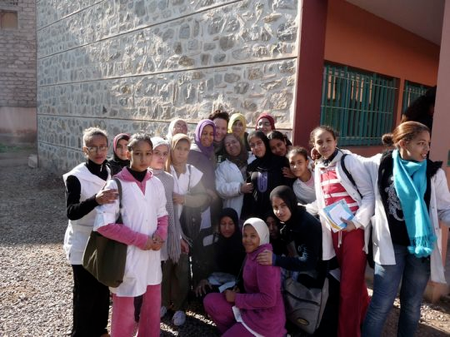
This post is simply an abuse of authorial rights to promote a project. I just received the second project report from Educate 1300 Girls By Restoring A Marrakech Garden, which I am supporting via Global Giving. Why that project? Because it is relevant to me in all sorts of ways. Maybe to you too; they still need to raise about $15,000.
During the past academic year, thirty students conducted their own field research by interviewing Marrakechi herbalists about important cultural recipes. [The Global Diversity Foundation] is now organizing a database of the girls’ findings, titled, “An Ethnobotanical Study of Five Traditional Women’s Recipes.” In the autumn of this year, the girls will be able to re-examine, analyze, and discuss their own data. We hope that this will be the first of many such educational initiatives at Lalla Aouda Saadia.
I look forward to the next report, which I hope will tell me more about those traditional recipes, and to the garden’s continued growth.