- An interview with the legendary Melaku Worede.
- Rwanda has to go from 100 to 30,000 ha of bananas, apparently.
- Coconut water good for athletes. And the rest of us too, actually.
- Gates Foundation launches a “community page.”
- Bolivians going back to their food roots.
- “…better integration of health and agricultural interventions and policy” needed. Seconded.
- “[A] graphical accounting of the limits to what one planet can provide.” Groovy climate change stuff.
- And if that left you gasping for more, here’s “Socioeconomic consequences of climate change in Sub-equatorial Africa related to the agricultural sector”.
- “Mediterranean” diet set for World Heritage Listing. Maybe. Spaniards, Greeks to object?
- Kenya’s macadamia crop threatened, but help is at hand. In other news, Kenya has a macadamia crop.
- Equilibrium goes Nuts.
The romance of the Pachino
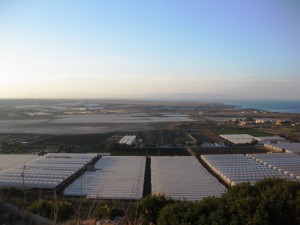
 I guess I always assumed that Sicily’s famous Pachino tomato, valued component of the Mediterranean diet, with its coveted EU-sanctioned protection, was grown exclusively by wizened, cantankerous old men bent rheumatically over the stony soil of parched ancestral smallholdings. Alas, thanks to my friend Amanda, who spent Ferragosto touring the area, apparently the southernmost point in Europe, and provided these photos, I now know better.
Trouble for livestock
Local leafy greens go viral in Kenya
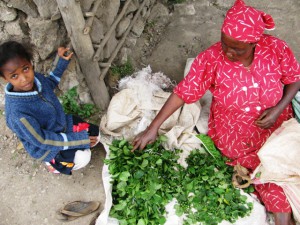
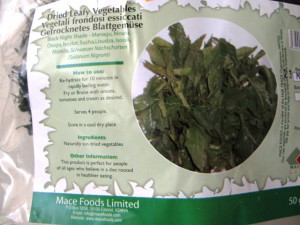 I continue to be amazed by the progress being made by — or, better, the resurgence of — indigenous leafy greens in Kenya. You can now buy managu (Solanum scabrum?) nicely packaged in supermarkets. Although it is also sold loose on the street.
And this is what the plant looks like.
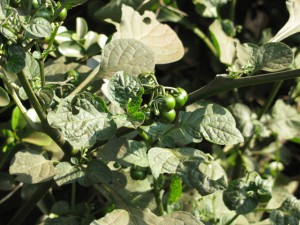
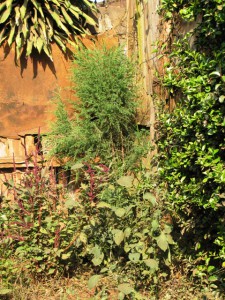 I found it in my sister-in-law’s homegarden in Limuru, along with Amaranthus. She didn’t grow either of them until a couple of years back. Progress. More holiday snaps here.
Fruit diversity in SE Europe
Fuad Gasi tells us about an interesting effort to document the diversity of fruits in the former Yugoslavia.
A new regional collaboration between the Faculty of Agriculture and Food Sciences, University of Sarajevo and the Faculty of Agriculture, University of Zagreb has been established in the field of fruit (including Vitis) genetic resources. This collaboration is being strengthened through the SEEDNet project (South East European Network on Plant Genetic Resources) financed by SIDA (Swedish International Development Agency). So far, we have had a publication on apple genetic resources in Bosnia and Herzegovina as a result of this collaboration. We are currently preparing a similar publication on plum genetic resources that will present results of a study made on autochthonous plums from B&H, Croatia and Serbia, focusing mainly on different synonyms of Pozegaca, but not exclusively (molecular and morphological data, as well as some food processing qualities). Similar work has been done on the chestnut and is currently being done on the pear.