- China’s largest genebank just got a little bit larger. And some context.
- Small Pennsylvania genebank may get a lot smaller.
- Denmark shows the way on seed saving in Europe.
- Chocolate really got around.
- Coffee didn’t do too badly either. But home is where the heart is.
- More pix of wheat wild relatives than you can shake a stick at.
Measuring the elements of sorghum
There’s a great photo on the cover of Plant Physiology this month.
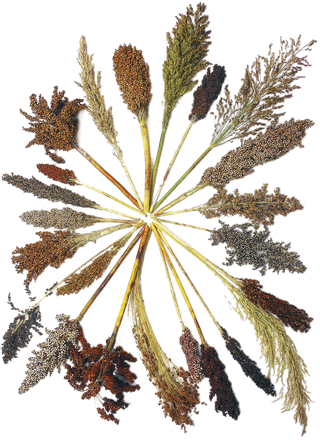
The paper in question looks at the “ionome” of sorghum seeds. That’s a new one on me too. It’s the genes responsible for the accumulation of different elements in whatever tissue. The authors measured the levels of a whole suite of elements in the seeds of a carefully chosen set of very diverse, and equally carefully genotyped, sorghum accessions representing all races. By comparing phenotype with genoptype, they identified gene variants associated with high levels of zinc, manganese, nickel, calcium, and cadmium. Now breeders interested in biofortification know what to include in their crossing programs.
Nibbles: BananaGuard, Wheat has a blast, Grow your own antibiotic, Bhutanese cypress, Natural history collections, Genebanks big & small, Better grasslands, Local foodways
- Who needs resistant banana varieties when you have synthetic biology? And more.
- More trouble for wheat, and climate change is to blame. Maybe Vavilov can help there too?
- DIY penicillin.
- Saving the sacred cypress. Try saying that quickly.
- What have herbaria ever done for us? Apart from giving us endless joy, you mean?
- The Indian and other genebanks securing the future of food. But see also our earlier post on Dr Tyagi’s paper.
- Aboriginal community gets a genebank.
- We need better grass. No, not that kind of grass. Well, not only that kind of grass.
- A pean for African food cultures. And Pacific ones too.
Fancy maths meets haystack
One of the authors, Michael Mackay, tells us about a new book that is sure to set pulses racing.
A question anyone involved in crop improvement — breeders, pre-breeders, genebank managers, genetic resources experts of all hues — has invariably asked is: where can I find some new genetic variation to overcome this nasty new problem that’s hammering productivity in my region? We all know there is an enormous reservoir of plant genetic resources held in ex situ or in situ around the globe. To use a cliché that’s been much used but never bettered in this context: it’s all too often like looking for a needle in a haystack. Sure, molecular biology is increasingly predicting, and occasionally even delivering, a more rapid pathway to identifying and using those elusive new genes or alleles. But are we making the best possible use of the information that’s out there already?
Enter Applied Mathematics and Omics to Assess Crop Genetic Resources for Climate Change Adaptive Traits. This book, just published by CRC Press, applies the latest statistical techniques to explore plant genetic resources data of all different kinds. The aim is to help researchers create manageable, trait-specific, sub-sets of germplasm. These should end up being best-bet candidates for evaluation and further research. Think of core collections, but skewed towards — enriched for — particular traits, rather than efficiently covering diversity overall. Think of a smaller haystack with a much better chance of containing that needle.
While the book proposes a general conceptual mathematical framework for exploring how different data can be used to estimate the likelihood of specific variation existing within a given accession, there is a particular focus on climate change. It includes discussion of how genetic resources can be used to mitigate and adapt to climate change, and how different plant traits are likely to become more important as the climate changes.
So, as genebanks accumulate information on their germplasm — making the haystack ever bigger — and plant breeders come up with ever better ways to use that elusive needle, this book identifies an opportunity to bring these two communities together in the cause of adaptation to climate change. The maths needed to facilitate a more effective ‘mining’ of novel genes and alleles from the world’s genebanks is certainly fancy. But this books puts it within the reach of anyone with a computer. Or a pitchfork.
Lethal yellowing spreads in West Africa
Readers may remember our recent post on the threat to the international coconut collection in Papua New Guinea that is being posed by a new disease. Now it looks like an old disease, lethal yellowing, is likewise making strides towards another important international coconut genebank, that in Cote d’Ivoire…
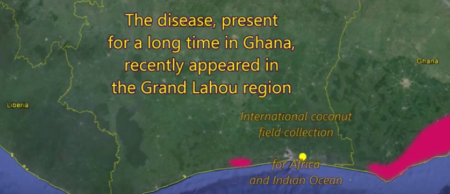
…quite apart from affecting the livelihoods of an increasing number of farmers who can hardly afford the hit. See the video by Rouland Bourdeix for more details.