- Prospects for forest-based ecosystem services in forest-coffee mosaics as forest loss continues in southwestern Ethiopia. Coffee agroforests provide about half to two thirds of the ecosystem services of plain old forests.
- Social Process of Adaptation to Environmental Changes: How Eastern African Societies Intervene between Crops and Climate. Your seeds may not be able to cut it in the future.
- Bioavailability of iron, zinc, and provitamin A carotenoids in biofortified staple crops. Focus on breeding varieties with elevated micronutrient concentrations is justified. Phew.
- The future of warm-season, tropical and subtropical forage legumes in sustainable pastures and rangelands. Those who cannot remember the past are condemned to repeat it. And the past, in this case, was full of mistakes.
- Wild leafy vegetable use and knowledge across multiple sites in Morocco: a case study for transmission of local knowledge? The Rif Mts are a hotspot of weed diversity. Not that kind of weed, settle down. No, wait…
- Agricultural Trade, Biodiversity Effects and Food Price Volatility. Pests are damaging to neat economic models. Pesticides fix that but damage the environment. No word on the economics of natural enemies, integrated pest management, varietal diversity etc.
- Annual burning drives plant communities in remnant grassland ecological networks in an afforested landscape. In the southern Afromontane region, annual burning does not reduce the species diversity of grassland patches, but does make these patches look more and more alike. Add heavy cattle grazing though and that does reduce diversity.
- Responses to fire differ between South African and North American grassland communities. Decreasing fire frequency increased species diversity in Kansas, decreased it in Kwa-Zulu Natal. It’s because of the rhizomatous species in America. What does this and above mean for crop wild relatives?
- Prolonging the longevity of ex situ conserved seeds by storage under anoxia. Remove oxygen to make seeds last longer in genebanks.
- Identification of Sources of Bacterial Wilt Resistance in Common Beans (Phaseolus vulgaris L.). Only 1 resistant accession out of 500 in the USDA collection. And it’s a wild one.
- Evaluation of Evolution and Diversity of Maize Open-Pollinated Varieties Cultivated under Contrasted Environmental and Farmers’ Selection Pressures: A Phenotypical Approach. OPVs are diverse and change over time. Still no cure for cancer.
- A novel allele of the P-starvation tolerance gene OsPSTOL1 from African rice (Oryza glaberrima Steud) and its distribution in the genus Oryza. Kasalath comes to the rescue of NERICA. Must be the only sativa gene NOT in NERICA.
- Agronomic potential of genebank landrace elite accessions for common bean genetic breeding. Yeah, but are they in the Brazilian genebank? Doesn’t look like it.
Nibbles: Uncommon grains, Wheat model, Yield gains, Cheese bugs, Grapes, Bee biodiversity, Pakistan seed industry, Bangladesh nutrition, Baobab juice
- Could teff or millets topple wheat, maize and rice? Anyone for unintended consequences?
- Not if superior models lead to bigger wheat harvests. ’Cos that’s all it takes.
- That and a good book: Yield Gains in Major U.S. Field Crops.
- Did somebody mention models? Vorarlberger Bergkäse is a model cheese, and “The rind is the boundary layer between a cheese and its environment”. Welcome to the cheese microbiome.
- What’s the difference between a wine grape and a table grape? Simple: Pectic-{beta}(1,4)-galactan, extensin and arabinogalactan-protein epitopes.
- Bee biodiversity results in mo’ bigger blueberries. Now to make use of that.
- Seed policy wonks – you know who you are – will thrill to IFPRI’s new report: The seed industry in Pakistan.
- So how does that square with the Financial Express of Bangladesh’s discovery that “Agro biodiversity can improve nutrition and health”?
- How to make baobab juice. Time to edit those factsheets.
Iraqi agricultural atlas ready for prime time
Nice to see the first National Atlas of Food and Development launched in Iraq, courtesy of the Ministry of Agriculture and ICARDA. You can find it here. You can map various agricultural and development indicators (although some of them don’t seem to work), including harvested area and yield of a number of crops. Here’s barley yield:
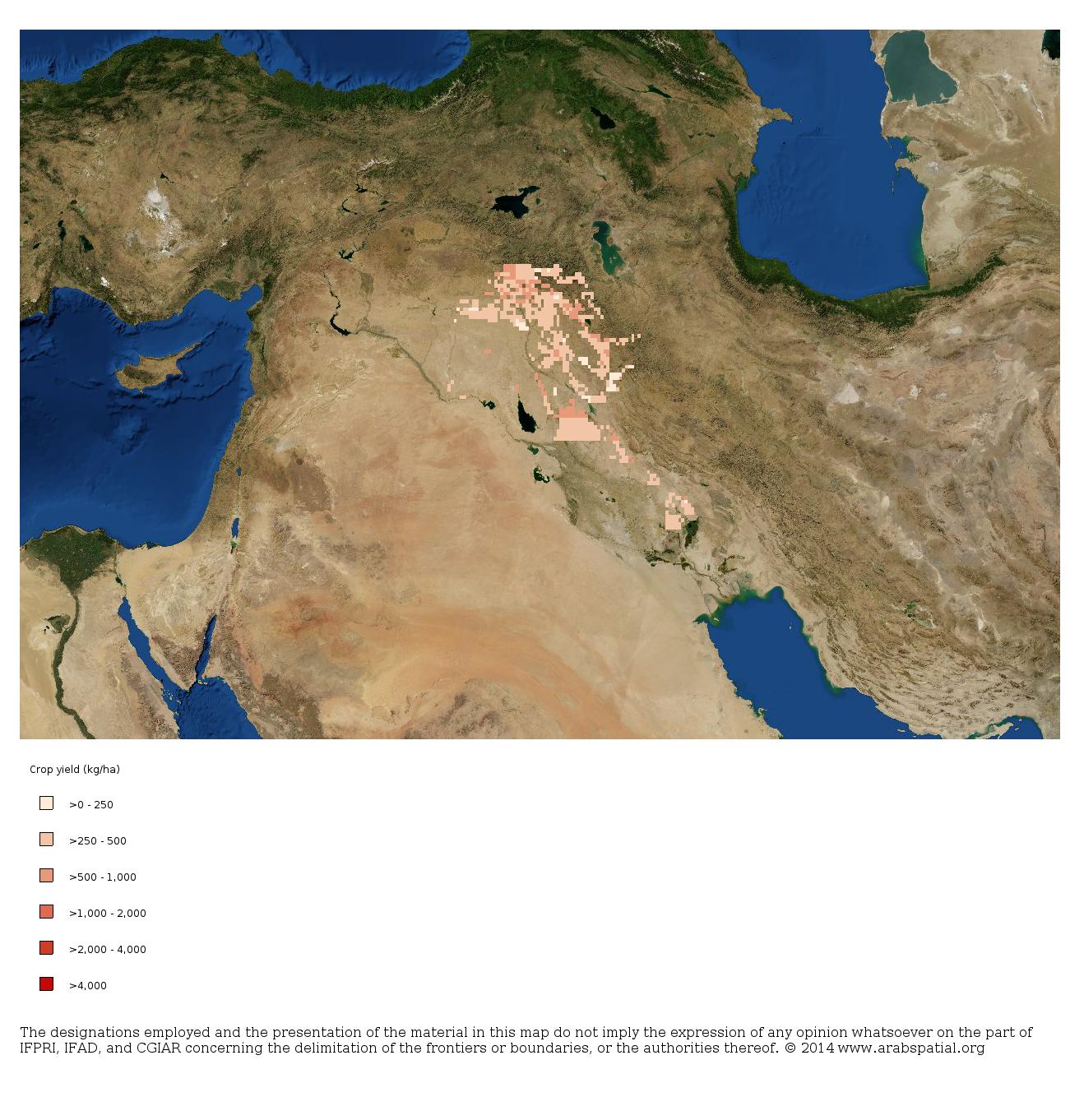
You can export the map as an image (as above) or as a URL, which is good but insufficient. Because one would like to mash it up with other datasets, like for example germplasm holdings, right? You know what’s coming next, and here it is, the locations of Iraqi barley material in Genesys:
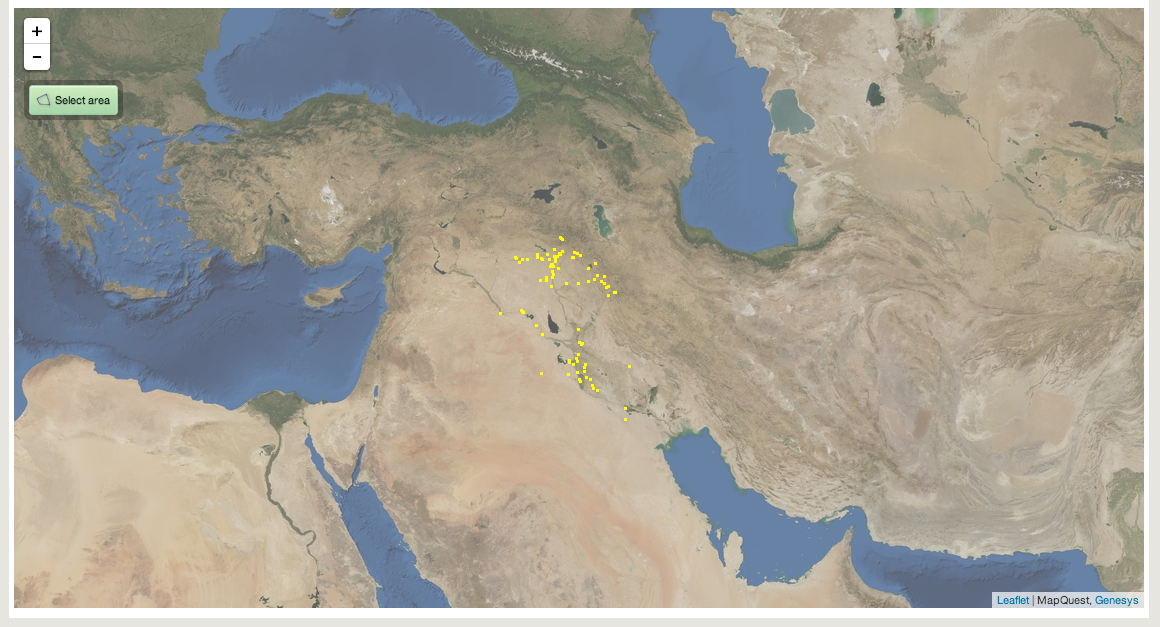
And yeah, I know, it takes two to tango, and it’s not exactly easy to share that Genesys data either, less easy than sharing the Iraqi atlas map if we are honest. We’re working on that…
But in the meantime, my colleague Matija and I spent the best part of a day hacking both tools and were eventually able to import image files from the Iraqi atlas and from Genesys into Google Earth. It’s not perfect, not even close, but here’s our first attempt at mashing up barley yield in Iraq (the pinkish squares) with the location of germplasm samples from that country in the world’s genebanks (in yellow).
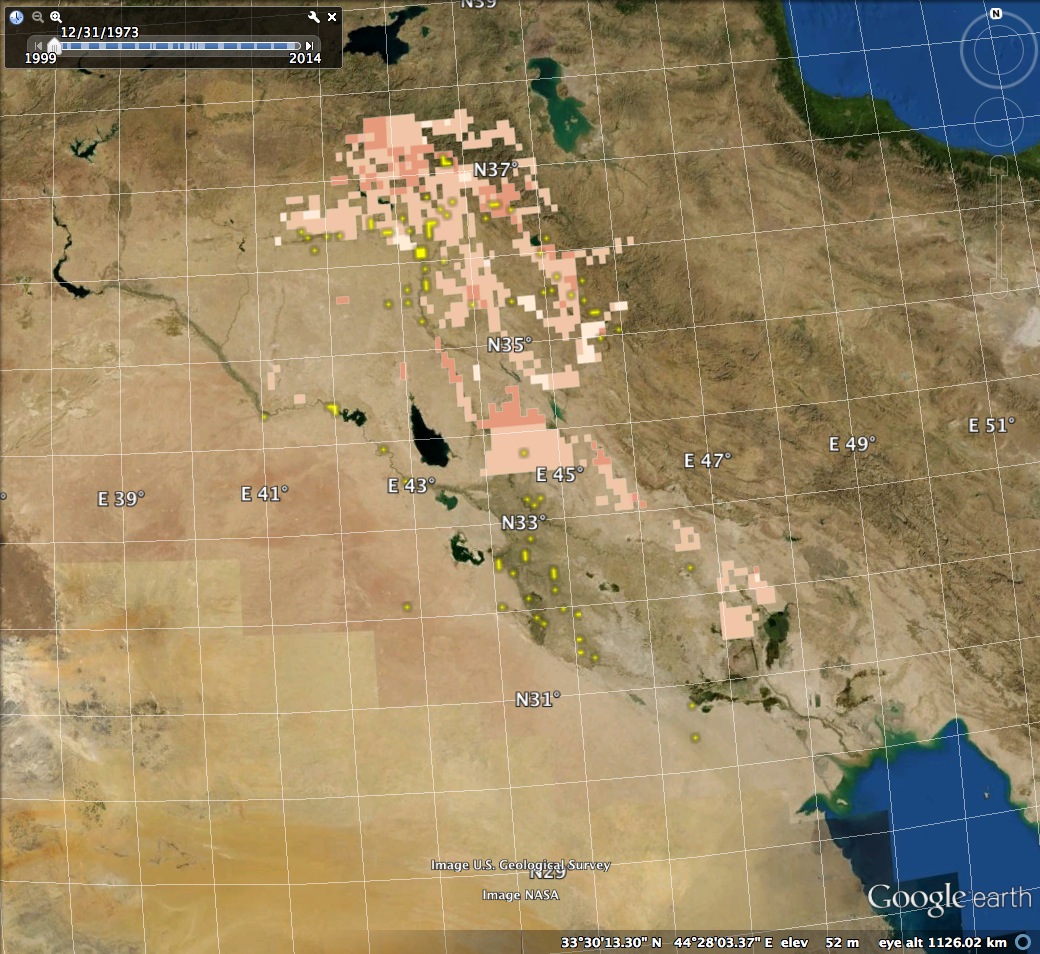
So, possibly some areas where further collecting might be warranted, conditions permitting. But is there an issue with the barley data in the atlas? You see that horizontal line right in the middle of the image, where barley apparently abruptly disappears south of latitude 33.5°N? That looks a bit suspicious, especially as the Genesys data seems to suggest that barley cultivation extends southwards along the Euphrates.
Nibbles: Nepal goat project, Kenyan camels, Sustainable diet metrics, Agri-informatics centre, Cassava dishes, CC & nutrients, Yield is all, African CC hotspots, AGRA seed enterprises, PlantVillage blog, Medieval weeds, French reserve, Black garlic, Australian tree tool
- Sometimes all it takes is a goat.
- Or a camel.
- I wonder how either would figure into a metric for a sustainable diet. Wonder if these people will be interested in those metrics.
- Cassava figures in lots of different ways.
- No word on whether carbon dioxide will affect its nutrient content the way it does with other crops.
- Who cares, it’s yield we’re after. Well, that’s in trouble too in some parts of Africa.
- That’s the only way those African seed start-ups are going to survive.
- Yeah, but disease resistance is important, Shirley. PlantVillage gets a blog.
- And weeds? Don’t forget the weeds. Although of course some of them you can eat. Put that in your metrics.
- Meanwhile, France starts to re-wild. Would love to see some wild relatives in the Bois du Boulogne. Livestock wild relatives, not your crazy cousin on his gap year.
- And now we can figure out what climate change might do to them. I guess this thing might work for European animals. Says here it works for Australian trees.
- Speaking of France, garlic is quintessentially French, isn’t it? Well, maybe, but it’s also very Korean, in its black, cured form.
Getting down with Gadam sorghum
Kirinyaga County government will this week start distributing free Gadam sorghum seeds to residents of South Ngariama settlement scheme as way of fighting poverty in the area. The exercise which will see the residents receive 2,000 kg of the free seeds is expected to be flagged off by Governor Joseph Ndathi.
Interesting enough, but a month-old Kenya News Agency press release about the distribution of some sorghum seed, even free sorghum seed, wouldn’t normally exercise me unduly. Except, that is, when the above is followed by this:
The Gadam sorghum is best suited for industrial production of beer and farmers are expected to rake thousands of shillings from sale of the produce which will be marketed to the Kenya Breweries Limited (KBL).
Ah, well, now you’re talking. I did know that sorghum is increasingly being used in beer brewing in Kenya, but I didn’t realise that there was a specific variety involved, I thought any old sorghum, including landraces, would do. You can get extension leaflets on Gaudam, such as this:
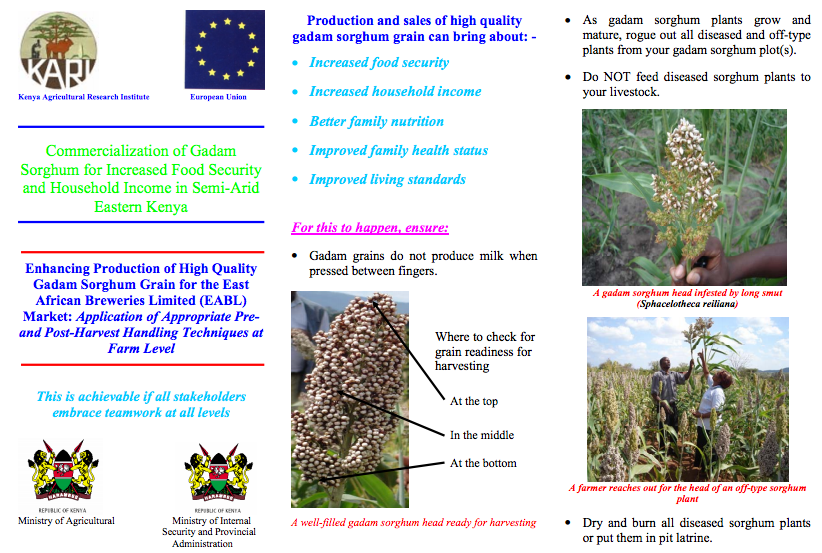
Which is just as well, because there are clearly some problems with it, as well as undoubted advantages, in particular earliness. The value chain for sorghum beer in Kenya has been well documented, and from that study comes this admittedly sketchy description of the Gadam variety and its history:
Sorghum beer is made from Gadam, a semi-dwarf sorghum variety with specific market traits, including white colour, low tannin and a high starch content. Originating in Sudan, Gadam was officially introduced in Kenya as a food crop in 1972 but then re-launched as an industrial crop in eastern Kenya in 2004. The KARI Seed Unit, located at Katumani, was established to grow and market seed of open-pollinated varieties (OPVs) that were unprofitable for private seed companies. It is the biggest producer of sorghum seed in Kenya. The Seed Unit sub-contracts seed production to 3000 growers who are advanced seed and repay in kind after harvest. The minimum acreage for a contract farmer is five acres. The Seed Unit buys whatever quantity farmers want to sell, provided it passes seed inspection by KEPHIS. Sales are made to large buyers but not to stockists because of risk of adulteration
Gadam is widespread and common enough to have been included as a sort of control in a recent survey of sorghum diversity in Kenya, which includes this passage:
In contrast to the case of some landraces, improved varieties were uniformly distributed and their frequencies did not differ between ethnic groups. The recently introduced Gadam variety was genetically distinct from the landraces and showed limited introgression from the other genetic clusters. It was genetically uniform and complied with certified control. However, farmers also gave the names of local and already known variety to individuals that have the same genetic profile as Gadam, an improved variety. This can be explained by a morphological similarity. Yet it raises the question of the consequences this will have for the on-farm evolution of the improved variety. Kaguru, for instance, which was introduced in the area 10–15 years ago, seems to have evolved differently across ethnic groups.
So Gadam‘s genetic future is uncertain. It may well change significantly, and in different ways in different places, and that will be interesting to follow, though those brewers may perhaps object. But what about its past? Can we trace Gadam back in time to its source? Unfortunately, I was not able to find anything online about its pedigree or breeding history, beyond hints at the involvement of ICRISAT, and vague references to an ultimate origin in Sudan. I’ll have to ask some sorghum experts, I suppose. Or look harder. However, my searches did produce one lead. There are 5 entries in GRIN that feature the word Gadam, including two from Sudan, a 1945 introduction called Gadam El Haman, PI152664, and a much later introduction called Gadam El Hamam, PI571389.
Note the slight difference in the last word of the name — hamaN versus hamaM. I think the first version may perhaps be a typo. I can’t find an Arabic word that can plausibly be transliterated as hamaN; hamaM, on the other hand, may mean “bath,” or perhaps “dove.” Gadam is even trickier, because that initial G could equally be a ق (leading to the noun “foot”, or possibly to a verb which may mean “to present”), or a خ (leading to the verb “to serve”). Bringing my mighty Arabic resources to bear on the problem, I conclude that the full name could well be translated as “footbath.” Or perhaps “serving the dove.” The perils of a little knowledge. Whichever it is (and I can’t for the life of me think why a sorghum variety should be called either), I’m no closer to knowing whether either, or neither, of those PI numbers is the ultimate source of Kenya’s Gadam, tout court. But I’m going there next week. Maybe I’ll ask around. If I find anything, I’ll let you know. And have a sorghum beer in celebration.